
Quick Summary
Microsoft Dynamics 365 Sales leverages integrated AI to automate lead scoring, prospect qualification, and pipeline management. This approach allows organisations to increase deal-closure rates efficiently, without additional staffing or operational complexity.Key Takeaways
- D365 Sales AI learns from your data, not generic benchmarks. The predictive scoring model trains on your own won and lost deals, making it unique to your business.
- AI not only scores lead but also manages them. D365 automates qualification, outreach, and deal progression from the Sales Qualification Agent through to the Sales Close Agent.
- Implementation quality drives ROI. Clean data, team alignment, and effective change management are more important than the technology alone.
Your sales team is busy. But are they busy with the right leads?
Every day, sales reps spend hours chasing prospects who will never buy, while genuinely interested buyers go cold because no one followed up fast enough. It’s not a people problem; in fact, it is a process problem. And it’s costing you revenue you don’t even know you are losing.
Here’s what the data says: sales teams that implement AI-powered lead scoring see productivity jump by up to 41%, experience 43% higher win rates, and 37% faster sales cycles. Not because they hired more people, but because they stopped guessing.
Microsoft Dynamics 365 Sales has AI built directly into the platform. It is not bolted on, not an expensive add-on, not even something that your IT team needs six months to configure. It automatically scores every lead, tells your reps exactly who to call next, and flags pipeline risks before they turn into lost deals.
This article explores exactly how D365 in sales automates pipeline and lead scoring management, and the real-world ROI business leaders are seeing after implementation.
What is AI Lead Scoring in Dynamics 365 Sales?
AI lead scoring in Dynamics 365 Sales is a built-in predictive capability that automatically ranks every lead from 0 to 100 based on how likely they are to convert, using your own historical sales data. The lead score updates in real time as prospects engage, so your team always knows exactly where to focus.
According to HubSpot, sales representatives spend just two hours each day on active selling, while the remainder of their time is consumed by administrative tasks, data management, and unqualified follow-ups.
D365 Sales AI lead scoring addresses this challenge directly. Rather than relying solely on individual judgment, D365 Sales uses a scoring model trained on your historical data to evaluate every lead automatically, consistently, and in real time.
Prioritise the Right Deals, Every Time
Leverage AI-driven lead scoring and pipeline intelligence with a rapid deployment approach that delivers measurable impact in weeks.
What AI Lead Scoring in D365 Sales Actually Does?
D365 Sales determines lead value using your data, historical win patterns, and real-time buyer behaviour. It does not rely on guesswork.
Traditional Scoring vs. D365 AI Lead Scoring
| Parameters | Traditional Lead Scoring | D365 AI Lead Scoring |
|---|---|---|
| Scoring model | Manually built by ops/marketing | Auto-built from your own CRM data |
| Update frequency | Static or periodic | Real time, as behaviour changes |
| Personalisation | Generic criteria | Unique to your business patterns |
| Effort required |
High & ongoing manual tuning |
Low, model self-updates with feedback |
| Opportunity risk flagging | None | Proactive, AI-driven alerts |
Key Dynamics 365 Sales Enterprise Features Powering AI-Driven Pipeline Management
Predictive Lead Scoring
Most scoring tools AI-based generic approach. D365 Sales takes a different path. Dynamics 365 predictive lead scoring (PLS) creates a machine learning model trained exclusively on your historical CRM data, including your won and lost deals and your unique customer profiles.
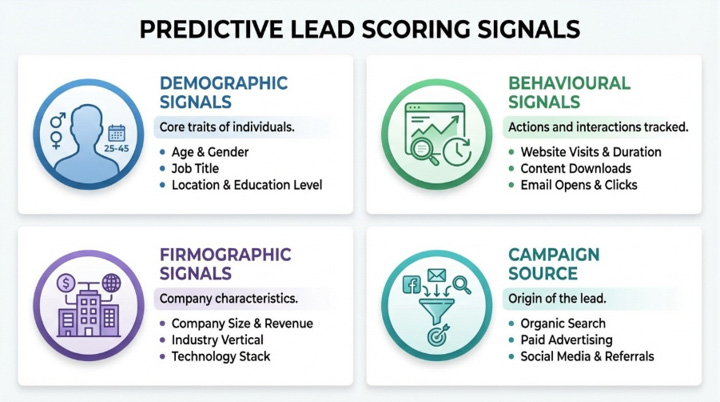
For example, the system may identify that finance leads from LinkedIn campaigns who request a demo within 7 days convert at three times your average rate. This pattern is automatically incorporated into scoring, without manual formula creation.
Predictive Opportunity Scoring
Opportunity Scoring ensures the most promising opportunities continue to progress. This separate AI layer, available in D365 Sales Enterprise and above, evaluates each open opportunity and scores its likelihood of closing. It also flags at-risk deals before your representatives notice issues.
Copilot’s Next Best Action
After scoring a lead, Microsoft Dynamics 365 Copilot sales not only identify whom to contact but also recommends the next steps and provides the reasoning behind each suggestion.
Based on the lead’s profile, score, and engagement history, D365 Copilot suggests specific actions such as sending a pricing deck, inviting the lead to a webinar, pausing outreach for seven days, or escalating to a senior representative.
How D365 Sales AI Pipeline Management CRM Automates Your Entire Sales Process?
Scoring a lead is just the starting point. The real competitive advantage comes from what D365 Sales does with that score automatically, across every stage of your pipeline.
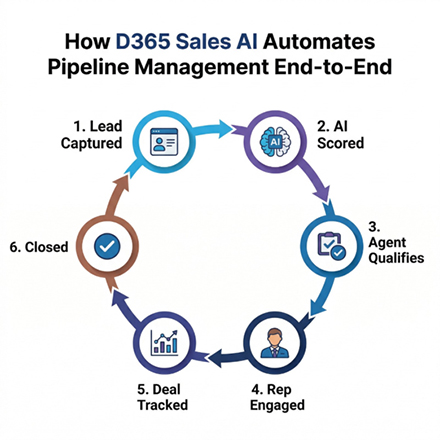
Here’s how the full journey looks when AI is running the process:
Sales Qualification Agent
Most businesses can’t afford to have a senior rep personally qualify every inbound lead. The Dynamics 365 Sales Qualification Agent changes that equation entirely.
Launched in 2025, this autonomous AI agent research leads across multiple sources, crafts personalised outreach emails, engages in multi-turn conversations with prospects, and transfers leads to human sellers only when genuine purchase intent is confirmed.
The results are independently validated. In Microsoft’s own benchmark evaluation, the Sales Qualification Agent outperformed GPT-4.1 by 16% on engagement quality, measured by accuracy, personalisation, and the ability to move a prospect toward a buying conversation.
Sales Accelerator
Even with good leads in the pipeline, reps lose significant time deciding what to do next. Who to call, which email to send & which deal to prioritise today.
Sales Accelerator eliminates this decision-making process. It provides each representative with a prioritised work list, recommending the right lead and action at the optimal time based on AI scoring, engagement signals, and pipeline stage. Leads are automatically routed by territory, product interest, or intent level, ensuring each prospect is matched with the appropriate representative.
Sales Close Agent
Knowing a deal exists in your pipeline is not the same as knowing it’s actually progressing.
The Sales Close Agent, available in public preview as of October 2025, monitors every open opportunity in real time. It identifies deals with the highest close probability, flags risks before they result in losses, and can autonomously progress or close straightforward transactions.
AI-Powered Forecasting
Sales forecasts based solely on representative-entered data are often unreliable.
D365 Sales forecasting AI applies predictions to pipeline data, generating revenue forecasts with confidence indicators at the deal, individual, and team levels. Managers can view both predicted closures and the model’s confidence, as well as identify gaps. This enables timely course corrections rather than waiting until the end of the quarter.
Copilot for Pipeline Visibility
One of the biggest reasons CRM data goes stale is that reps find it painful to update. D365 Copilot removes that friction entirely.
With a chat-style interface integrated into the CRM, representatives and managers can access real-time pipeline summaries, prepare for customer meetings, draft follow-up emails, and stay updated on account news without switching tools or manually creating reports. For example, asking Copilot “what’s changed in my top 10 deals this week?” provides an immediate response.
Taken together, these capabilities create a connected pipeline system where leads are captured, scored, qualified, worked, tracked, and closed with AI handling the repetitive layer and your team focused entirely on the human work that actually wins deals.
Want to see how these Dynamics 365 Sales Enterprise features work inside your existing sales process?
Real-World Impact: What Business Leaders Are Actually Seeing
The numbers speak louder than any product demo. Sandvik Coromant piloted D365 Sales Qualification Agent and recovered 120+ hours and $19,000 in costs within three weeks, before full rollout even began. They’re forecasting a 5% revenue increase at scale. Even Microsoft’s internal Sales Development Agent autonomously contacted 61,734 prospects and achieved a 15.1% lead-to-opportunity rate, without human SDR involvement in the initial outreach.
Upto 353% Projected ROI (132% Low-end ROI) |
Upto $ 1.2 M Projected Benefits ($629K Low- end PV) |
$127 K Total Implementation Costs |
In fact, Forrester’s Total Economic Impact study estimates Microsoft Copilot Return on Investment (ROI) ranging from 132% to 353%. Nearly 70% of Fortune 500 companies have already adopted the solution.
What Does D365 Sales AI Cost?
The cost of implementing AI-driven lead scoring and pipeline management in Dynamics 365 Sales depends on your chosen licence tier, user volume, and level of customisation.
- Dynamics 365 Sales Enterprise licence is required for predictive lead and opportunity scoring
- Premium licence unlocks Copilot and autonomous AI agents
- Implementation costs vary based on data readiness, integrations, and rollout scope
For most organisations, the real consideration is time-to-value. A structured quick-start approach can significantly reduce both deployment timelines and overall investment.
If you’re evaluating cost vs impact, the most effective next step is a tailored assessment based on your current CRM maturity.
Is Your Business Ready? Prerequisites & What to Set Up First
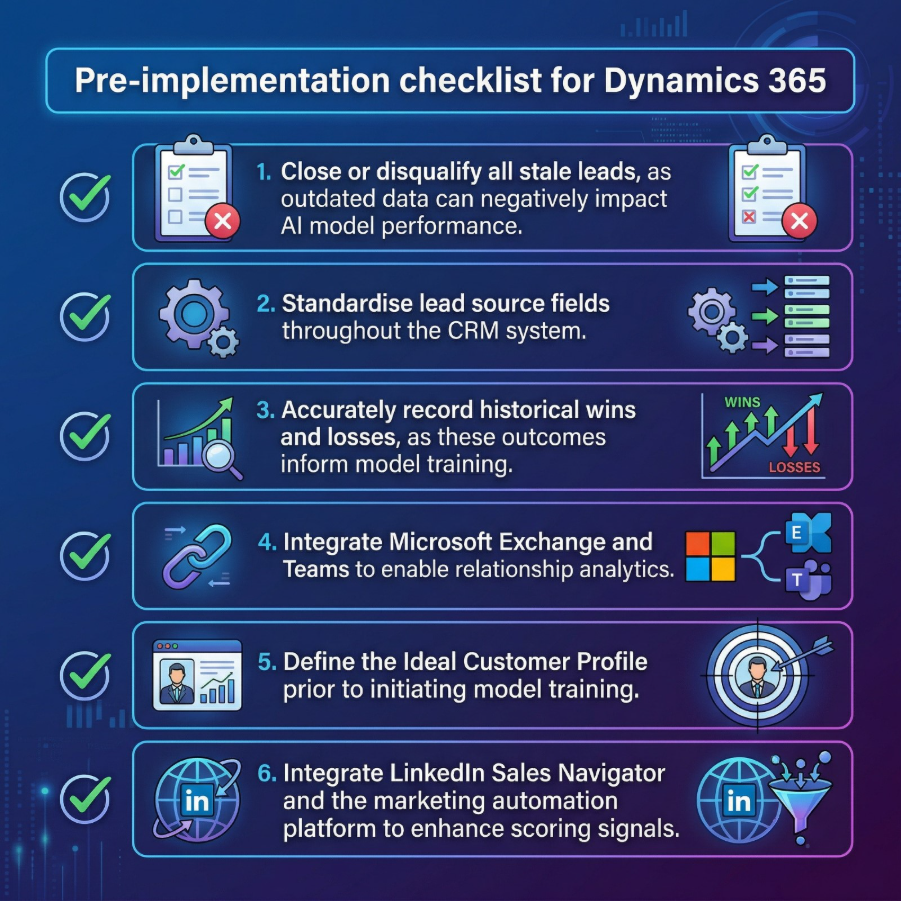
Before D365 Sales AI can score and prioritise your pipeline, the right foundation needs to be in place. Here’s what to check before you begin with the D365 Sales implementation.
Minimum Data Requirements:
- At least 40 qualified and 40 disqualified leads must be present in the CRM, created within the past two years.
- A D365 Sales Enterprise licence is required for comprehensive AI lead scoring. The Premium licence is necessary for Copilot and autonomous agent functionalities.
- GDPR, Data Residency & EU Boundary- For UK and EU organisations, data governance is critical. Microsoft Dynamics 365 operates within Microsoft’s secure cloud infrastructure, aligned with GDPR and enterprise-grade compliance standards.
Pre-Implementation Checklist for Dynamics 365
Not sure where your CRM data stands today?
That’s exactly where a conversation with Mercurius begins.
Common Mistakes Companies Make When Implementing D365 AI Scoring
The technology rarely fails but the implementation does. The following outlines common pitfalls.
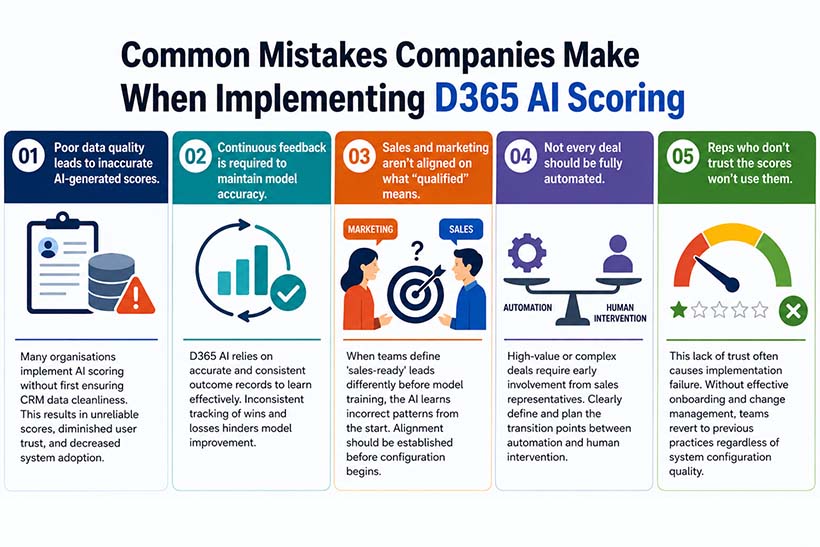
Addressing these factors from the outset distinguishes a successful D365 implementation that enhances pipeline performance from one that fails to achieve its potential.
How Mercurius IT Helps You Implement D365 Sales AI?
Implementing D365 Sales AI isn’t just a technical project. It’s a sales transformation, and how it’s configured determines everything.
At Mercurius, we’ve helped businesses in manufacturing, distribution, and professional services get this right, from CRM data readiness and model training to rep enablement and adoption. We don’t just hand over a configured system and walk away. As a trusted Microsoft D365 Sales implementation partner, we ensure your team uses it, trusts it, and sees results.
Every engagement starts with an honest assessment of your current data and processes because that determines how quickly you see ROI. Explore how we approach D365 Sales Implementation.
Frequently Asked Questions
What licence do I need for AI lead scoring in Dynamics 365 Sales?
The Dynamics 365 Sales Enterprise licence is required to access Predictive Lead Scoring and Opportunity Scoring. The Premium licence provides access to the full Copilot and autonomous agent capabilities. The Professional licence does not include AI scoring features.
How long does it take to set up predictive lead scoring in D365?
After activation, the AI model trains within 24 to 48 hours using existing CRM data. A minimum of 40 qualified and 40 disqualified leads created within the past two years is required for the model to generate reliable scores.
What is the difference between D365 Sales Copilot and Sales Insights?
D365 Sales Insights offers AI-driven analytics, including predictive scoring, relationship intelligence, and pipeline signals. Copilot serves as the conversational AI layer that leverages these insights to draft emails, summarise deals, recommend next actions, and execute autonomous qualification tasks within the CRM.
Can D365 AI lead scoring work with our existing marketing automation tool?
Yes. Dynamics 365 Sales integrates with major marketing automation platforms, including HubSpot, Marketo, and Mailchimp. Integration enriches the AI scoring model with behavioural data such as email engagement, campaign source, and content downloads, thereby increasing the accuracy of lead scores.
How is D365 Sales AI different from Salesforce Einstein lead scoring?
Both platforms use machine learning to score leads. However, Dynamics 365 Sales AI is natively integrated across the Microsoft ecosystem, including Outlook, Teams, LinkedIn, and ERP systems, which provides access to richer data signals. Additionally, Dynamics 365 includes autonomous Copilot agents that independently qualify and engage leads, extending functionality beyond lead scoring.