
Overview
- What Microsoft Work IQ is and why it matters to UK ERP leaders
- How AI and agents shift Dynamics 365 from record keeping to action
- The day-to-day impact across Finance, Supply Chain, Sales, Service, Field Service, Projects, HR, Commerce, and Business Central
- UK compliance guardrails for GDPR, residency, and responsible AI operations
- A practical playbook and KPIs to pilot safely and scale with confidence
Bottom line:
AI is turning ERP into an action platform that improves speed, accuracy, and resilience across UK operations.
Across UK enterprises, leaders are asking: How do we make decisions faster, reduce manual handoffs, and protect data without slowing teams down? Microsoft’s latest advances answer these questions by bringing context-aware intelligence into daily work. Work IQ, Microsoft 365 Copilot, and agentic ERP introduce agents that understand the flow of activity and take dependable actions under clear governance. These capabilities mark a shift from systems of record to systems of action, where insight and execution happen in the same place and at the same time.
What is Microsoft Work IQ?
Work IQ is the intelligence layer within Microsoft 365 that powers Copilot and agents. It learns from work data across emails, meetings, files, and chats, while respecting enterprise controls. Work IQ captures preferences and relationships, allowing it to infer intent and predict the next best step, adding organisational context to every interaction—vital when decisions span finance, operations, and customers.
Importantly, Work IQ is not a native Dynamics 365 feature. Instead, it lives in Microsoft 365 and powers Copilot and agents across the Microsoft ecosystem. ERP scenarios benefit via connected agents and the Model Context Protocol (MCP), which enables agents to apply organisation-wide context to Dynamics 365, rather than embedding Work IQ directly within Dynamics 365.
From Records to Actions with Agentic ERP
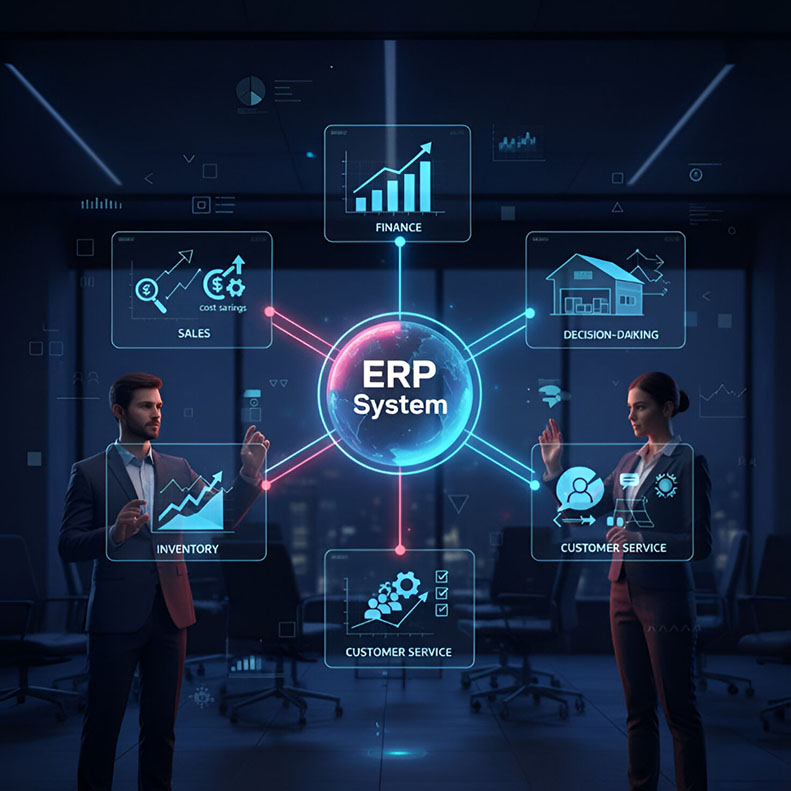
Dynamics 365 is evolving into an agentic platform where AI assists, recommends, and increasingly acts. Microsoft describes this as moving from systems of record to systems of action, aligning technology design to measurable outcomes.
Model Context Protocol (MCP) servers act as secure, configurable bridges between ERP, CRM, and other systems, exposing data and actions so agents can orchestrate multi-step processes across systems under your policies, rather than removing application silos outright.
Agent 365 is the central control plane for Microsoft 365 and connected agents—including those acting on Dynamics 365 via MCP. It governs agent provisioning, policy, and auditing across the Microsoft ecosystem, not just ERP.
The model is human-led and agent-operated, with explicit boundaries for what agents can do, when to escalate, and how to record actions. This approach is essential for regulated UK businesses that must demonstrate accountability with clear evidence trails.
Transform Your ERP into a System of Action with AI
Unlock faster decisions, smarter automation, and measurable impact across Finance, Supply Chain, Sales, and Service with Work IQ and Dynamics 365.
What Will Change in Your Day-to-Day ERP Work ?
Finance
Finance leaders can expect faster close cycles, cleaner reconciliations, and fewer email-driven handoffs. Microsoft Copilot for Finance is generally available, bringing ERP-connected insights into Excel, Outlook, and Teams. Collections teams can summarise inbound emails, retrieve balances from Dynamics 365 Finance, draft responses, and write back action items without switching context.
In Dynamics 365 Finance, the Account Reconciliation Agent (currently in preview) monitors subledger to general ledger alignment and suggests corrective actions. Release plans add automation for tags, bank reconciliation, and cross-company data exploration. These capabilities reduce manual matching, improve audit readiness, and shorten the time to trustworthy numbers.
Supply Chain Management
Supply chain teams gain rapid insight through Copilot analysis of demand plans in natural language. Planners can ask about shifts between periods, seasonality, and drivers, then receive explanations grounded in live data. Release wave plans add seasonality detection and explainability, increasing trust in forecast adjustments.
Procurement and warehouse leaders see summarised purchase order impacts and operational KPIs in dedicated workspaces, helping teams address high-impact changes first. New capabilities around supplier communications and traceability support risk-aware planning and faster resolution of issues.
Sales and Revenue Operations

Sellers spend less time on administration and more time with customers. Copilot for Sales connects Outlook, Teams, and CRM so notes, summaries, and updates flow into Dynamics 365 or Salesforce. Teams meeting recaps can now be saved directly to CRM from the recap experience, with edit controls to ensure accuracy.
Release plans introduce planned sales agents in the 2025 wave 1 release that autonomously enrich leads and nurture pipeline under clear governance. Dynamics 365 Sales continues to add predictive insights that warn about deal risks and help sellers prioritise actions.
Customer Service and Contact Centre
Service teams gain speed through generated responses, case summaries, and knowledge retrieval with Copilot. UK tenants can enable features with guidance on data movement, capacity, and regional considerations. New agents automate parts of the case lifecycle and support quality evaluation, improving consistency across teams.
Copilot can also recommend email templates based on context, reducing response time and improving tone alignment. Adoption resources from Microsoft help teams trial capabilities, onboard safely, and measure impact.
Field Service and Projects
Field Service is receiving enhancements across AI scheduling, mobile experiences, and Microsoft 365 integration. These capabilities help dispatchers sequence work orders efficiently and give engineers clearer context onsite.
Project Operations benefits from the broader agentic pattern that coordinates planning, costs, and delivery activities. Microsoft’s release plans emphasise cross-application coherence, critical when service, projects, and procurement all influence customer outcomes.
HR, Commerce, and Business Central
Roadmaps highlight innovations for HR and Commerce, particularly where AI can assist with routine operations. Business Central brings agentic capabilities that automate common tasks and improve cost adjustments for high-volume items. Microsoft and partner updates show integrations with manufacturing and Shopify scenarios, reducing manual processing for smaller teams.
UK Compliance, Data Protection and Responsible AI

UK organisations must align AI adoption with UK GDPR and sector expectations for privacy and security. Dynamics 365 provides documentation and tools for data subject requests, including discovery, access, rectification, and deletion. Privacy guidance covers EU Data Boundary considerations and explains how to operate within regional controls.
Copilot features in Customer Service include specific instructions for UK geographies, with options for cross-region data movement when capacity requires it. Geography and data-movement options vary by product and feature, and are subject to each service’s documented limits. Compliance teams should use Microsoft Purview Compliance Manager to assess posture, apply sensitivity labels, and monitor improvement actions.
Microsoft’s Responsible AI Standard and annual Transparency Reports describe development safeguards, testing approaches, and operational governance. These materials map to recognised frameworks and help you evidence responsible practice during internal and external reviews.
Implementation Playbook for UK Leaders
Start with three focused use cases that combine high value with predictable risk. Good candidates are account reconciliation (preview agents), demand plan analysis, and case summarisation. Define executive-level metrics before you begin, including hours saved in close, forecast error reduction, and case handle time improvements.
Establish responsible AI governance with clear roles and oversight before enabling agents. Document agent scope, allowed actions, escalation paths, and required approvals. Include bias testing for communications and routing, and define mitigation steps for exceptions. Capture observability requirements that link agent actions to business outcomes and user experience.
Prepare your data estate and enforce residency controls across Microsoft 365 and Dynamics 365. Use Purview to classify sensitive data, apply labels, and prevent unauthorised exfiltration with DLP. Validate that Copilot features are enabled in the correct geography and that data movement settings align with policy. Ensure your support teams understand licensing and capacity considerations to avoid throttling.
Stand up the agent control plane and observability so you can manage risk as you scale. Plan policies in Agent 365, configure action scopes, and enable logging that supports audit and forensic analysis. Adopt Model Context Protocol servers to bridge ERP, CRM, and line-of-business systems without brittle integrations. Pilot with a limited population, gather feedback, and extend coverage only when safeguards have been validated.
Track value and safety with a balanced dashboard that executives will trust. Include productivity metrics, accuracy rates, human override counts, and compliance indicators. For Finance, report reconciliation exceptions resolved automatically and cycle time reductions. For Supply Chain, track forecast error and planner time spent in analysis rather than data preparation. For Service, measure handle time, first contact resolution, and sentiment improvements. Review model prompts, knowledge sources, and controls quarterly, then refine based on observed outcomes.
Conclusion
Work IQ, Copilot, and enterprise agents are transforming Dynamics 365 into a system of action for UK organisations. You can capture early value by pairing governance with focused use cases, preparing the data estate, and piloting with clear metrics. Establish the agent control plane, monitor observability, and iterate based on measured outcomes. This approach builds trust, proves impact, and sets a durable foundation for safe and scalable AI in ERP.
Frequently Asked Questions
What exactly is Work IQ, and do we need it to benefit in ERP?
Work IQ provides the contextual understanding that makes Copilot and agents more helpful. It helps the assistant align answers and actions to your role, content, and relationships. ERP users benefit because Copilot becomes aware of how your organisation actually works.
Can we keep UK data in the right geography while using Copilot?
Yes. Dynamics 365 and Power Platform provide regional settings and boundary options. Copilot features document UK geography support and explain cross-region data movement choices. Your compliance team should review these settings alongside Purview policies and risk assessments.
Which ERP tasks are best to automate first?
Begin with reconciliation (preview agents), collections, demand analysis, and case summarisation. These scenarios have proven value, manageable risks, and strong audit trails. They also provide metrics that boards and auditors recognise and accept.
Do agents work with non-Microsoft systems such as Salesforce or SAP?
Yes. Copilot for Sales supports Dynamics 365 and Salesforce in everyday tools. Model Context Protocol servers help agents work across systems and processes under your policies.
How does Microsoft ensure responsible AI in enterprise scenarios?
Microsoft publishes a Responsible AI Standard and Transparency Reports that explain design, testing, deployment, and monitoring practices. These artefacts align with recognised frameworks and help customers implement their own governance confidently.
Start Your AI-Ready ERP Transformation