
Quick Summary
Agentic ERP allows UK organisations to automate business processes with AI agents, strengthen governance, improve operational efficiency, and prepare Microsoft Dynamics 365 for secure, enterprise-wide adoption.
Key Takeaways
- Agentic ERP advances Dynamics 365 from basic automation to intelligent business execution.
- AI agents enhance finance, supply chain, and service workflows with minimal human intervention.
- Strong governance and data quality are essential before deploying autonomous AI agents.
- UK organisations must ensure AI adoption aligns with GDPR, DPIA, and evolving AI regulations.
- A phased rollout with human oversight accelerates adoption and reduces implementation risk.
With the 2026 release wave 1, running from April to September, Microsoft is turning Copilot from a simple productivity tool into a core part of Dynamics 365. Copilot is now built into finance, supply chain, HR, commerce, and ERP functions across the platform.
For technology leaders using Dynamics 365, this means more than just new features. Wave 1 brings a fundamental shift in how the software handles work for users and for UK enterprises, it lands at the same moment as a tightening regulatory landscape around AI and data.
This blog walks through what Agentic ERP actually means, what’s shipping in Wave 1, what it means for compliance in the UK, and what your organisation should be doing this quarter.
What is Agentic ERP?
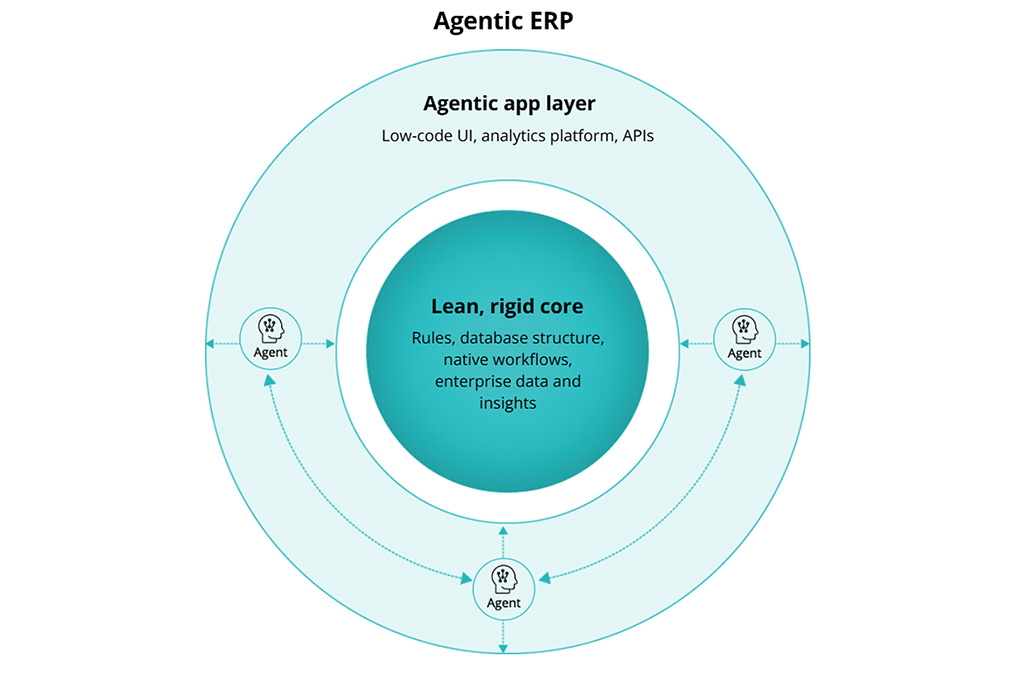
Agentic ERP is an AI-driven evolution of Enterprise Resource Planning software that shifts the system from a passive record-keeper into an active participant in business operations. Instead of simply generating reports for someone to interpret, it uses AI agents to detect signals, make decisions within set boundaries, and execute workflows with minimal human intervention.
The difference from “AI-assisted” ERP is subtle but important. Earlier generations of Copilot suggested actions and waited for a person to approve them. Agentic ERP closes more of that loop. With this Agentic ERP, agents can draft a purchase order, flag an anomaly and route it for review, or reconcile a transaction, with people stepping in only at defined checkpoints.
How AI Agents Work Within ERP Systems?
AI agents generally function through an orchestration layer that integrates ERP systems with data sources, APIs, and workflow engines. A standard architecture for agent-based AI within ERP systems includes the following components:
- ERP Core System– This component manages financial, supply chain, inventory, and operational data.
- Integration Layer- This layer connects the ERP system with Customer Relationship Management (CRM) platforms, e-commerce platforms, logistics systems, and other external services.
- AI Decision Layer- Machine learning models are employed to analyse data patterns and operational signals.
- Agent Orchestration Engine- AI agents coordinate workflows across multiple systems and execute designated tasks.
- Governance and Controls- Policies, approval mechanisms, and audit trails are implemented to ensure compliance and accountability.
Within this framework, AI agents in ERP systems interact with data, initiate workflows, and perform operational actions in accordance with established business rules.
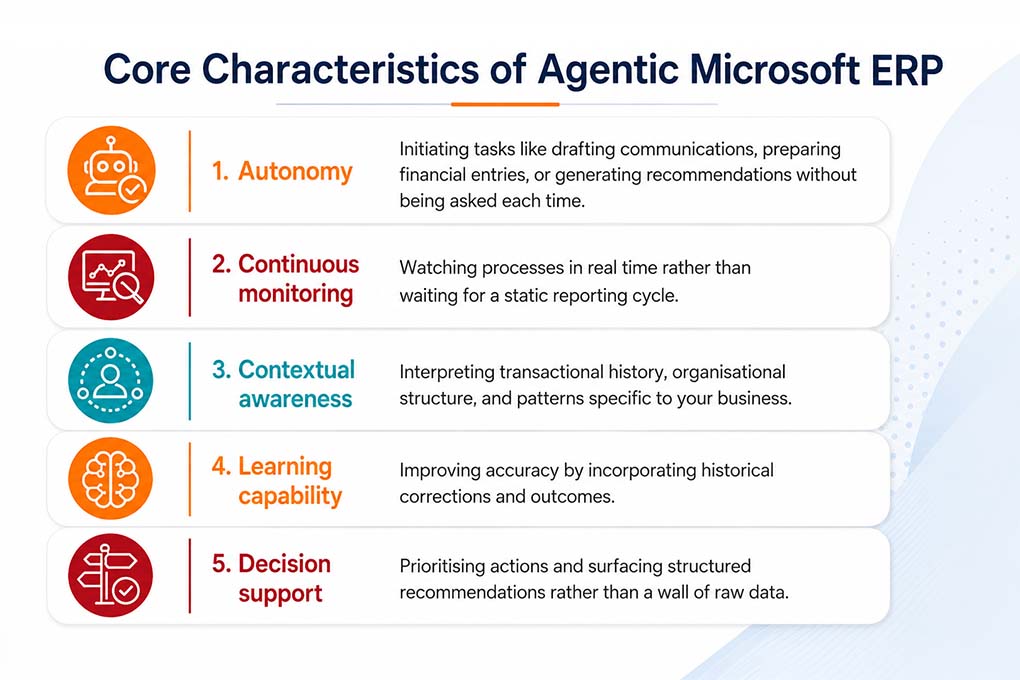
Core Characteristics of Agentic Microsoft ERP
An ERP solution earns the “agentic” label when it shows five characteristics:
What’s Actually Shipping in 2026 Release Wave 1
Well, it is worth separating the marketing language from what’s concretely rolling out between April and September 2026, because this is where UK buyers should focus their planning.
Dynamics 365 Business Central
D365 Business Central is advancing further on agentic ERP specifically. Microsoft has been refining its prebuilt Payables Agent and Sales Order Agent based on real customer feedback and has added support for Model Context Protocol (MCP). This makes it considerably easier to connect Business Central to Copilot Studio and build custom agents without major integration overhead.
In fact, users can build custom agent with natural language just by typing Instructions within Business Central. Organisations also gain transaction-level visibility into AI activity, with clear indicators showing records created or modified by AI. They can halt all agent activity instantly, which is especially valuable during testing or when unexpected behaviour occurs.
Dynamics 365 Finance and Supply Chain
Dynamics 365 FSCM cross-app capabilities now feature enhancements to MCP servers and introduce Immersive Home, an AI-powered adaptive landing page. This workspace allows users to manage agents and monitor workflows centrally, eliminating the need for multiple dashboards.
D365 Customer Service
Dynamics 365 Customer Service is expanding the capabilities of four agents launched in October 2025: Case Management, Customer Intent, Quality Evaluation, and Customer Knowledge Management. These updates include enhanced telemetry and improved Copilot integration, supporting both semi-autonomous and fully autonomous workflows.
Sales and Finance
Sales and finance operations teams now have access to Copilot experiences that integrate CRM data with Microsoft 365 signals, like email threads and meeting recaps. This ensures context is maintained across systems.
Turn Microsoft Copilot into measurable business value.
Identify the right AI use cases, reduce implementation risks, and accelerate enterprise adoption with expert guidance.
How Different Industries Can Benefit from Agentic ERP
Agentic ERP is designed to serve businesses to enhance their operational intelligence without requiring additional personnel.
Manufacturing- Agents monitor supply chain delays, refine planning recommendations, and identify potential risks at an early stage. It can also help on defining the planning parameters like re-ordering quantity based on the transaction level of an item. These capabilities help minimise shortages, operational downtime, and quality-related issues.
Finance- Agents check data accuracy, oversee transaction entries, detect anomalies, and support financial close, improving data quality and shortening month-end cycles. Agents can help finance team to do the cash flow forecasting, automating AR and AP processes.
Healthcare- With D365 in healthcare, agents automate administrative processes, coordinate scheduling, enhance documentation accuracy, and provide insights that contribute to improved patient care.
Retail and Distribution- Agents detect stock imbalances, optimise allocation decisions, and streamline inventory replenishment processes.
Professional Services- Agents facilitate tracking of billable hours, manage project workflows, notify teams of timeline deviations, and enhance resource utilisation.
Agent can help finance team to do the cash flow forecasting, automating AR and AP processes.
The Unavoidable UK Compliance Challenge
The deployment of autonomous agents for financial and operational data analysis constitutes not only a technological decision but also a matter of governance.
In 2026, UK organisations using AI must comply with several overlapping regulatory regimes rather than a single AI law. UK GDPR and the Data Protection Act 2018 set the baseline for any agent handling personal data. Article 22 restricts solely automated decisions that have a legal or similarly significant effect on individuals. This is especially relevant for agents involved in HR, credit, or pricing decisions. The Data (Use and Access) Act 2026 received Royal Assent on 19 June 2026, and its data protection provisions are now in force. This is a current legal requirement, not a future concern.
UK businesses with EU-facing operations should assume the EU AI Act applies to those activities. While the UK has adopted a principles-based approach focused on safety, transparency, fairness, accountability, and contestability, these principles are enforced by existing regulators such as the ICO, FCA, and CMA, rather than through a single new statute.
Enterprise licensing is also important. Using Microsoft Copilot within Dynamics 365 under proper enterprise licensing is generally more defensible than using ad hoc AI tools because it includes data protection terms. However, a stronger position still requires a Data Protection Impact Assessment, documented vendor due diligence, and a formal AI usage policy before agents access live financial or customer data. The main risk is not malicious misuse but agents quietly drafting purchase orders or summarising HR records before data flows and accountability are clearly mapped.
Deploy AI agents without creating compliance risks.
Build a secure roadmap for Agentic ERP with governance, permissions, and UK regulatory alignment from day one.
What Businesses Need to Prepare for Right Now
Transitioning to Agentic ERP represents more than a simple technology upgrade. Successful implementation requires comprehensive preparation in four key areas.
- Data Quality – Agents are only as good as the data they act on. Clean, structured, accessible data directly increases the value AI can deliver; messy data just gets automated faster.
- Process Clarity – AI cannot reliably support workflows that are inconsistent or undocumented. Clear process mapping has to come before agent deployment, not after.
- Security and Permission Models – Agents operate within your existing governance structure, not outside it. Access and permission models need updating specifically to account for what an autonomous agent can see, touch, and execute and where a human checkpoint is non-negotiable.
- Change Management – Employees need to understand how agents support, rather than replace, their roles. Transparent communication builds the trust that determines whether adoption actually sticks.
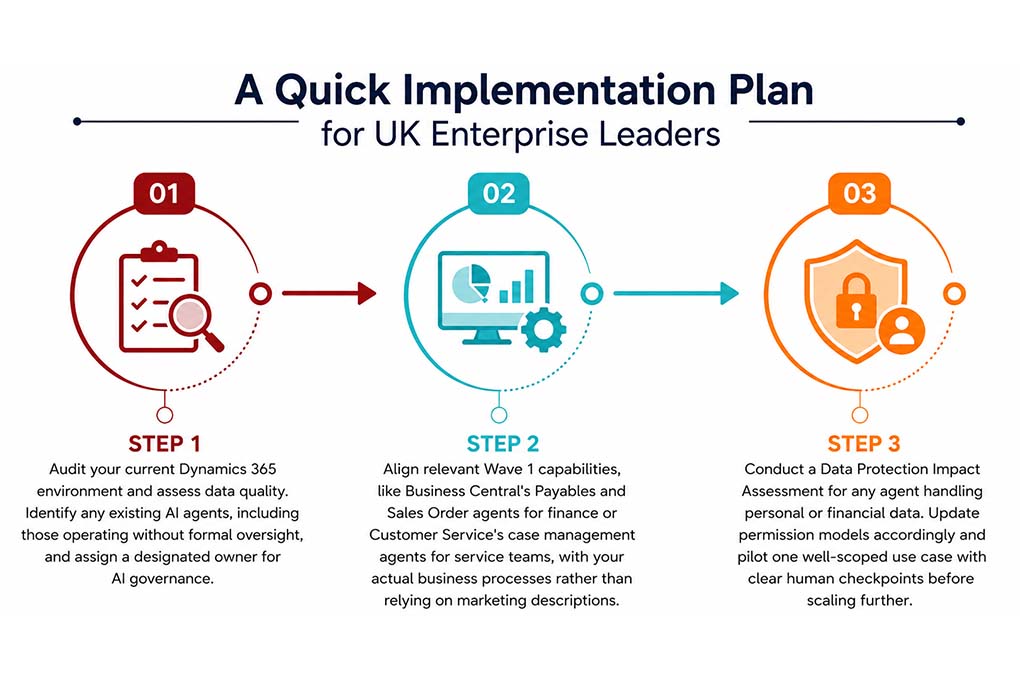
A Quick Implementation Plan for UK Enterprise Leaders
Instead of waiting for Wave 1 to be fully implemented by September, consider beginning with the following practical steps:
Is your organisation ready to adopt agentic ERP solutions?
Microsoft innovations like Copilot AI and AI agents are transforming ERP systems and delivering capabilities previously unattainable.
“Microsoft is leading the way to a new reality for ERP, a world in which ERP solutions operate with greater autonomy, continuously adapting to changing conditions and involving users only, when necessary,” stated Georg Glantschnig, Vice President of AI ERP at Microsoft.
As AI technology advances, the potential of agentic ERP will continue to grow. Organisations that adopt these solutions early will be better positioned to lead in a complex and competitive market. Contact us to learn more about how your organisation can leverage these advancements.
Is your Dynamics 365 environment ready for Agentic ERP?
Assess your data, governance, and AI readiness before autonomous agents become part of your business operations.
How Mercurius IT Can Help
Successfully implementing Agentic ERP requires thorough preparation in data quality, process mapping, permissions, and governance. This foundational work determines whether agents become valuable assets or compliance risks.
As a Microsoft Solutions Partner with deep, hands-on experience across Dynamics 365 Finance, Supply Chain, and Business Central, Mercurius IT helps UK enterprises navigate this groundwork. From readiness assessments and data clean-up, through DPIA-ready governance frameworks, to phased agent deployment with the right human checkpoints built in from day one. We have supported organisations through previous waves of Dynamics 365 change, and we understand both the platform and the UK regulatory context it now operates within.
If you are considering how Agentic ERP fits into your 2026 roadmap, contact us to discuss a readiness assessment tailored to your organisation.
Frequently Asked Questions
How do businesses determine if they are ready for Agentic ERP?
Businesses should assess data quality, process maturity, governance controls, security permissions, and AI readiness before deploying autonomous agents. A structured readiness assessment identifies operational gaps, minimises compliance risks, and ensures AI agents deliver measurable outcomes from the outset.
What business processes should organisations automate first with Agentic ERP?
Organisations often achieve the fastest return by automating repetitive, rules-based processes like invoice processing, purchase order management, financial reconciliation, case management, and inventory monitoring. Beginning with low-risk, high-volume workflows allows organisations to validate AI performance before expanding automation.
How can organisations measure the ROI of Agentic ERP implementations?
Businesses should monitor improvements in process cycle times, operational costs, employee productivity, decision accuracy, exception rates, and compliance performance. Comparing these KPIs before and after deployment demonstrates business value and informs future AI investment decisions.