
Quick Summary
Although Access Dimensions emphasises financial stability, Business Central offers comprehensive visibility across all business functions. This broader perspective enables organisational leaders to transition from merely reporting performance to proactively driving growth and operational efficiency.
Key Takeaways
- While Access Dimensions focuses mainly on finance, Business Central links finance with operations. This helps leaders make quicker and better decisions.
- Business Central is built for the cloud, so you get real-time access, automatic updates, and lower IT costs. These features are important for today’s distributed businesses.
- Business Central works smoothly with Microsoft tools, helping to break down data silos and boost teamwork across different departments.
- Access Dimensions helps keep operations steady, but Business Central is built to grow with your business, no matter the size, location, or changes in your business model.
- Access Dimensions might seem simpler at first, but Business Central offers better long-term value by automating tasks, scaling easily, and streamlining operations.
The operational efficiency of a firm is closely linked to the quality of its software systems. An integrated platform streamlines account management, inventory tracking, and internal communication. In contrast, reliance on outdated or incompatible systems often results in delayed reporting, increased error rates, and missed business opportunities.
In the United Kingdom, organisations seeking to upgrade their enterprise resource planning (ERP) or accounting software frequently consider Access Dimensions and Microsoft Dynamics 365 Business Central.
Both platforms manage financial and operational processes, but they are built on distinct foundations. Access Dimensions is suited to organizations that prioritize in-house control and has a longstanding presence in the market. In contrast, Microsoft Dynamics 365 Business Central utilises a modern cloud-based infrastructure designed for scalability and rapid accessibility.
So, which platform is a better choice for your business in 2026? Let us compare them and determine which is a better fit for your organisation.
Overview of Access Dimensions and Dynamics 365 Business Central
The following section provides an overview of Access Dimensions and Dynamics 365 Business Central.
What is Access Dimensions?
Access Dimensions is an ERP and accounting system from The Access Group that many UK businesses use. It supports small and mid-sized companies with tasks like invoicing, reporting, payroll, and managing stock.
Access Dimensions is known for being reliable and easy to use. You can run it on your own servers or in Access Workspace, the company’s cloud platform. Its older technology, though, can make connecting to real-time systems more difficult.
What is Microsoft Dynamics 365 Business Central?
Dynamics 365 Business Central is a straightforward Microsoft system that lets you manage your whole business from one place. It combines your accounts, sales, stock, and customer information in a single, easy-to-use dashboard.
Since it works with familiar Microsoft tools like Excel, Outlook, Teams, and Power BI, your team can get started quickly without a long learning curve. That’s what makes Business Central so appealing.
Access Dimensions vs Business Central: A Quick Comparison
| Feature | Access Dimensions | Dynamics 365 Business Central |
|---|---|---|
| System Type | On-premise or hosted | Cloud-first ERP |
| Ease of Use | Traditional design | Modern, user-friendly |
| Updates | Manual or version-based | Automatic cloud updates |
| Integration | Limited external links | Deep Microsoft and third-party integrations |
| Scalability | Suits stable setups | Expands easily with growth |
| Cost Model | Upfront licence & support fees | Monthly or annual plans |
| Security | Managed locally | Microsoft-grade protection |
| Ideal For | Firms with fixed operations | Businesses planning to scale |
Now that we had a quick glance over both, let us have a look at both of them in detail.
Seamless Integration
A primary distinction between the two systems lies in their approaches to integration.
Business Central offers seamless integration with the following platforms:
- Microsoft 365 applications, including Excel, Outlook, and Word
- Power BI for real-time analytics
- Microsoft Teams for collaboration
- Power Automate for workflow automation
- Third-party applications like PayPal and QuickBooks
In contrast, Access Dimensions primarily provides integration capabilities through custom configurations or additional connectors, which may increase both costs and complexity.
Cloud ERP
Cloud ERP has become integral to modern business operations. As organizations increasingly rely on remote teams and rapidly changing data, real-time access and automation are essential.
Business Central offers the following advantages:
- Secure access is available from any device or location.
- Data protection is managed directly by Microsoft.
- IT maintenance costs are significantly reduced.
- Live reporting capabilities enable faster decision-making.
Although Access Dimensions remains effective for many UK businesses, it requires more manual maintenance and lacks the flexibility provided by cloud-first solutions like Business Central.
Setup and Implementation
Both systems have distinct setup and implementation processes and requirements. The following sections provide a detailed comparison of these aspects.
The setup of Access Dimensions typically requires more time because it is primarily designed for on-premise deployment. Local servers, database management, and regular updates must be managed by an internal IT team or Access support.
Implementation of Business Central is generally faster. A Microsoft partner, like Mercurius IT, can manage data migration, system setup, and staff training within a few weeks. Organisations may also select a hybrid model to store part of their data locally.
Financial Management
Both platforms provide robust core accounting functionalities, including general ledger, accounts payable, and accounts receivable. Access Dimensions emphasizes finance-centric visibility through comprehensive built-in dashboards, facilitating immediate performance monitoring for finance teams.
In contrast, Microsoft Dynamics 365 Business Central extends financial management capabilities to operations, sales, and inventory, providing organisational leaders with a more integrated perspective on business performance.
Reporting & Analytics
Access Dimensions is optimised for real-time financial reporting, making it suitable for rapid performance tracking. Microsoft Dynamics 365 Business Central integrates with Microsoft Power BI, supporting advanced analytics and predictive insights across multiple departments.
Automation & Workflows
Microsoft Dynamics 365 Business Central includes built-in workflows that automate approvals, alerts, and cross-departmental processes, thereby reducing manual effort. In contrast, Access Dimensions primarily automates processes within the finance function, potentially constraining efficiency improvements across the broader organisation.
Scalability & Flexibility
Microsoft Dynamics 365 Business Central is built to scale across multiple entities, geographies, and operational functions, supporting industries like manufacturing and distribution. This portrays the business central benefits over access dimensions. On the contrary, the access dimension is better suited for organisations with simpler, finance-led growth models.
User Experience & Adoption
Access Dimensions offers an intuitive, finance-oriented user experience, which can accelerate adoption among accounting teams. Microsoft Dynamics 365 Business Central may involve an initial learning curve; however, it provides a unified experience across departments, particularly benefiting organisations that already utilise Microsoft tools.
Deployment, Pricing & Total Cost of Ownership
Access Dimensions enables a straightforward deployment process with lower initial complexity. Microsoft Dynamics 365 Business Central typically begins at approximately $100 per user per month and necessitates an implementation partner, resulting in greater initial effort but enhanced long-term scalability.
Choosing the right ERP is only half the journey.
Partner with Mercurius IT to implement, optimise, and scale Business Central with confidence.
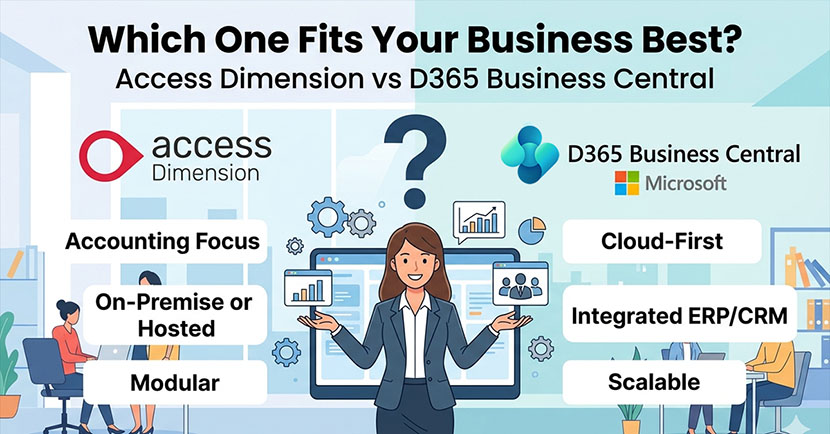
Access Dimension or D365 Business Central – Which One Fits Your Business Best?
The following analysis outlines key considerations for each platform.
Access Dimensions is recommended in the following scenarios:
- The organisation is already utilising Access Dimensions, and current requirements are being met.
- There is a preference for maintaining full local control over systems.
- No significant organisational growth or major system changes are anticipated soon.
Dynamics 365 Business Central is recommended in the following circumstances:
- The organisation requires a flexible enterprise resource planning (ERP) system that can accommodate future growth.
- There is reliance on Microsoft tools and a need for integrated connectivity among these applications.
- The organisation seeks to minimise manual updates and reduce IT overhead.
- You’re planning to scale or go global.
Make Your ERP Work for Growth, Not Just Reporting
Upgrade to a modern ERP that connects finance, operations, and data to support scalable, efficient business performance.
Bottom Line
Many UK organisations that prefer on-premise setups have traditionally relied on Access Dimensions. As technology advances, these legacy systems often require greater resources and offer less flexibility.
In contrast, Microsoft Dynamics 365 Business Central provides a modern and scalable solution. Its cloud-based architecture, user-friendly interface, and continuous updates enhance stability and ensure long-term viability. Organisations adopting Business Central report improved data sharing, streamlined performance tracking, and more efficient operations management. But to fully leverage the platform, a reliable Microsoft Solutions partner is crucial.
Mercurius IT is an award-winning solutions partner that helps leading organisations succeed in the digital world by improving efficiency and customer satisfaction.
Frequently Asked Questions
What is the difference between Access dimensions and Dynamics 365?
Access Dimensions is a financial accounting software solution targeted at mid-sized businesses. It can be used on-premise or as a hosted solution. The software includes tools for managing nominal ledgers, generating supplier turnover reports, and automating invoice processing through Access Capture. In contrast, Dynamics 365 is a cloud-based suite of customer relationship management (CRM) and enterprise resource planning (ERP) applications intended for medium- to large-sized organisations with more complex operational requirements.
Is Access Dimensions currently supported?
Yes, Access Dimensions remains supported by The Access Group; however, updates are less frequent than those for cloud-based ERP systems.
What is the typical timeframe for migrating to Business Central?
Implementation of Business Central typically requires three to six weeks, depending on the complexity of the migration.
Is it possible to migrate data from Access Dimensions to Business Central?
Yes. Certified partners, such as Mercurius IT, can securely migrate data and configure Business Central.
Does Business Central comply with UK financial regulations?
Yes. Business Central supports VAT, Making Tax Digital (MTD), and other UK accounting regulations.
Is it possible to evaluate Business Central prior to purchase?
Yes. Certified solution providers like Mercurius IT are providing a free trial of Business Central, allowing prospective users to explore its features before making a purchasing decision.