
Quick Summary
Multilingual voice agents in Dynamics 365 Contact Centre allow organisations to support multiple languages through a single AI-powered voice agent, simplifying operations while improving global customer experience.
Key Takeaways
- One unified voice agent can support multiple languages seamlessly.
- Reduce TCO by eliminating separate bots for each language.
- Enable mid-call language switching without disrupting calls.
- Improve CSAT with intelligent language-based routing.
- Scale global support faster using Copilot Studio in Dynamics 365.
Great customer experiences often lead to business success. In fact, according to the CSA, research suggests that 75% of customers are more likely to buy again if they receive after-sales care in their own native language.
Previously, businesses used Dynamics 365 Contact Centre to support customers in their native language. This existing voice channel required setting up a separate bot for all the languages to provide multilingual support.
This setup increased complexity, slowed deployments, and made maintenance harder. To address these issues, Microsoft now offers multilingual voice agents in Dynamics 365 Contact Centre. With this feature, you can manage customer interactions in multiple languages using a single bot.
In this blog, you’ll learn how multilingual voice agents work in Dynamics 365, how to configure them, and the business impact they deliver.
Simplified Multilingual Support with Dynamics 365 Contact Centre
While the adoption of multilingual voice agents in Dynamics 365 Contact Centre is still relatively new, early patterns show clear customer and operational value, especially for organisations serving diverse markets.
Voice agents are multilingual IVR bots powered by Copilot Studio. With multilingual voice agents, contact centres do not need a separate bot for every language. One Microsoft Copilot Studio voice agent can handle multiple languages, use the same business logic and integrations, and be launched in all languages with a single click.
Take the example of a large global retailer that supports customers across multiple countries. Traditionally, this retailer maintained separate voice bots and routing configurations for each language supported, which was indeed a costly and fragmented approach.
With AI voice bots in Dynamics 365, they were able to consolidate into a single voice bot that understands and switches languages mid-call, using one phone number for all customers.
Stop Losing Customers Because of Language Barriers
See how a unified multilingual voice strategy can protect revenue, boost retention, and help you scale confidently across regions.
Key Features of Dynamics 365 Contact Centre Multilingual Voice Agents
Multilingual voice agents are an operational simplification strategy that helps businesses deliver improved customer experiences. They help organisations scale globally without scaling complexity.
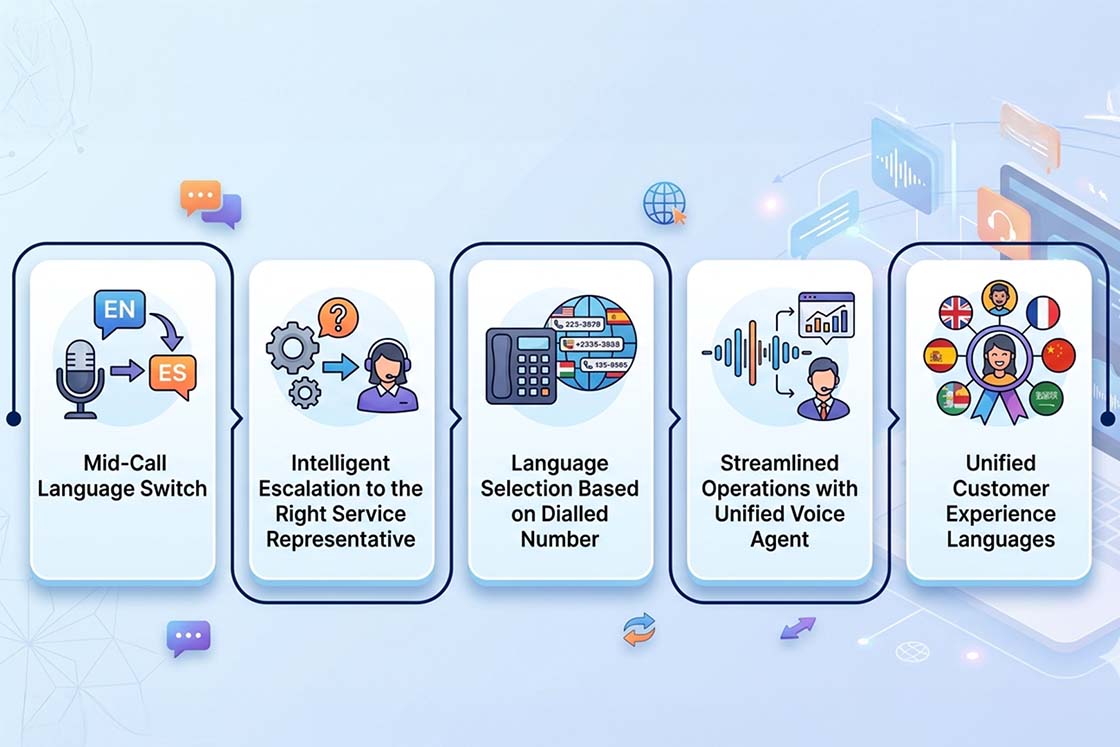
1. Mid-Call Language Switch
Customer conversations aren’t always predictable. A caller may start in English and then request Spanish midway through the interaction.
In areas where multiple languages are spoken, one phone number can serve all customers. The voice agent can change languages during the call if the user asks, for example, by choosing a language from a menu, as shown in the image.
With Microsoft Copilot Studio voice agents, the system can switch same languages as the customer’s input in real time, without even dropping the call or forcing a restart.
2. Intelligent Escalation to the Right Service Representative
Route customers to the right AI agents who speak their language seamlessly. When a situation requires human intervention, the transition matters. Enterprise contact centre automation using Dynamics 365 brings that transition in reality. Microsoft Copilot multilingual voice agents ensure that the customers are routed directly to service representatives fluent in their chosen supported language.
3. Language Selection Based on Dialled Number
Start the conversation in the right language from the first hello. Customers calling a regional or language-specific number can automatically be greeted in their preferred language. There’s no need for complex menu navigation or “Press 1 for” prompts unless required. It’s a subtle improvement that significantly elevates the customer perception of personalisation.
4. Streamlined Operations with One Unified Voice Agent
Traditionally, supporting multiple languages meant building and maintaining separate bots, flows, and languages configured. But that approach doesn’t scale well as it increases deployment time, testing effort, and long-term maintenance costs. With multilingual IVR in Dynamics 365 built through Copilot Studio capabilities, a single voice agent can handle customer’s questions in multiple languages within the same framework.
5. Unified Customer Experience Across Languages
When separate bots are built for different languages, experiences often drift. Scripts differ. Updates are not synchronised, and even the quality varies. A unified multilingual voice agent ensures:
- Consistent service logic
- Standardised compliance controls
- Uniform customer experience across geographies
For business leaders, this protects their brand consistency while enabling global scale.
Benefits of Dynamics 365 Contact Centre Multilingual Voice Agents for Business Leaders
For leadership teams, multilingual voice agents aren’t just a CX upgrade. They’re an operational and financial strategy. Here’s what that looks like from a business lens.
1. Lower Total Cost of Ownership
With a unified multilingual voice agent in Dynamics 365:
- One architecture supports multiple languages
- Updates roll out once
- Customer interactions taking place in natural conversations
- Governance and compliance controls stay centralised
That directly reduces duplication of effort and ongoing maintenance overhead. Over time, this significantly lowers the total cost of ownership while improving consistency.
2. Faster Global Expansion
Entering a new geography traditionally means building new language flows, hiring local support, and creating region-specific automation. Multilingual voice agents simplify that equation. You can launch support in new markets faster, activate additional languages without rebuilding logic, and maintain brand consistency across regions.
3. Higher Customer Retention and Loyalty
Customers feel valued when they are understood. When voice channel supports starts in their preferred language and transitions seamlessly when needed. This results in higher customer satisfaction scores, improved retention, and increased lifetime value.
4. Improved Operational Efficiency
Multilingual voice agents reduce unnecessary call transfers and misrouted conversations. Calls reach the right automation flow and the right agent from the start.
5. Smarter Workforce Utilisation
When language-based routing is automated intelligently, you can align calls with agents who are best equipped to resolve them. This ensures balanced workload distribution, better scheduling accuracy, and optimised use of multilingual talent.
6. Data-Driven Insights Across Languages
When conversations are managed within one unified system, reporting becomes clearer. So, instead of fragmented data across language silos, you see the full picture and clear insights into regional trends, which support smarter decision-making.
Your Customers Speak Multiple Languages. Does Your Contact Centre?
Modernise your voice strategy with Dynamics 365 multilingual agents designed for scalable growth and measurable impact.
How to Get Started with Multilingual Voice Agents in Dynamics 365 Contact Centre
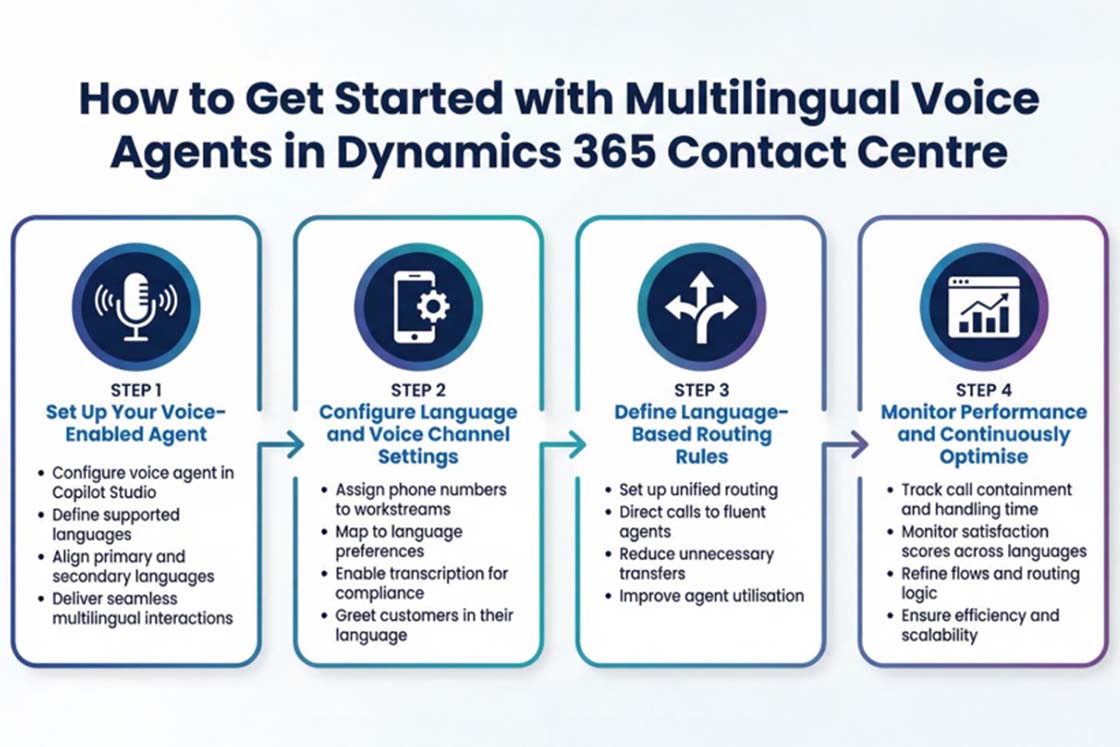
Getting started with multilingual voice agents is all about setting the right foundation, so the experience works smoothly from day one. Here’s a simple and structured way to approach it.
Step 1: Set Up Your Voice-Enabled Agent
Begin by configuring your voice agent in Copilot Studio and defining the languages it should support. Align the primary and secondary languages carefully so the experience remains consistent across voice channels.
Step 2: Configure Language and Voice Channel Settings
Assign phone numbers to the appropriate workstreams and map them to the correct language preferences. If transcription is enabled, the system will capture conversations in the detected language, improving visibility and compliance.
Step 3: Define Language-Based Routing Rules
Set up unified routing so calls are automatically directed to agents fluent in the customer’s chosen language.
Step 4: Monitor Performance and Continuously Optimise
Once live, track key metrics such as call containment, handling time, and satisfaction scores across languages. Use these insights to refine flows, adjust routing logic, and improve prompts.
Real-World Use Cases Where Multilingual Voice Agents Drive Business Value
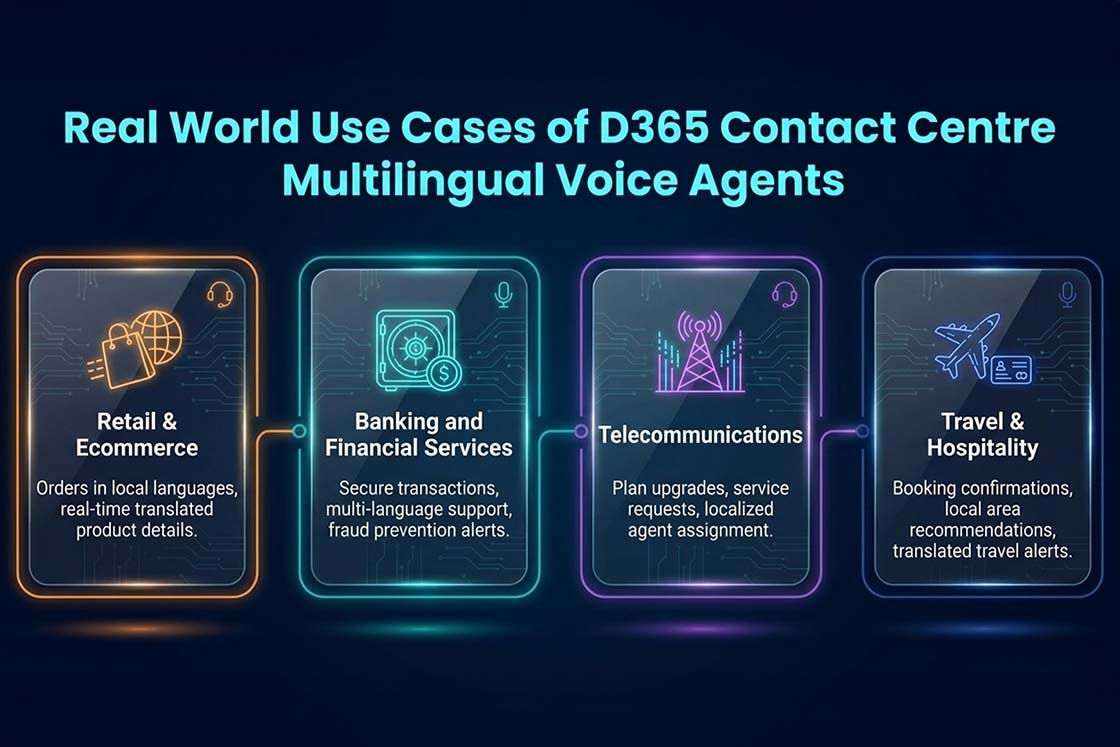
Multilingual voice agents are the real business enablers for almost every industry. Here’s how multilingual voice AI agents create measurable value across sectors:
Retail & E-Commerce
During high-volume events like festive sales or product launches, multilingual voice agents ensure customers are supported in their preferred language without increasing headcount. Faster resolution and fewer call transfers reduce cart abandonment and protect revenue during peak periods. This results in improved CSAT and smoother operations when it matters most.
Banking & Financial Services
Multilingual voice agents handle routine inquiries securely while routing complex issues to the right language-skilled specialist. This improves accessibility, strengthens customer confidence, and supports compliance without compromising efficiency.
Telecommunications
Multilingual voice agents automate common requests in the right language from the start, reducing repeated transfers and lowering average handling time. This directly improves service levels while keeping operational costs under control.
Travel & Hospitality
For global travellers, language plays a major role in the experience. Multilingual voice agents provide booking updates, itinerary changes, and local assistance in real time.
Ready to modernise your contact centre with multilingual voice agents in Dynamics 365?
Mercurius IT Dynamics 365 Solution experts can help you turn that vision into a scalable and future-ready reality.
How Mercurius IT Helps in Leveraging Multilingual Voice AI Agents?
Delivering multilingual voice experiences is not just a feature inside Dynamics 365 Contact Centre. It requires designing the right architecture, aligning it with your customer journey, and ensuring it scales as your business grows. That is where Mercurius IT helps.
As a Microsoft Solutions Partner, Mercurius IT brings deep expertise across Dynamics 365, Copilot Studio, and intelligent contact centre transformation. Our team works closely with organisations to understand customer expectations, operational bottlenecks, and expansion goals before designing a multilingual voice strategy that truly fits.
Whether you are looking to consolidate multiple language bots into a unified framework, expand into new geographies, or optimise your current contact centre operations, Mercurius IT helps you move from complexity to clarity.
Frequently Asked Questions
What happens if the languages don’t match?
If the selected language doesn’t match the channel configuration, the system defaults to the agent’s primary or secondary language to avoid call disruption. If transcription is enabled, it appears in the detected language. However, if the language isn’t supported by the channel, the transcript reverts to the channel’s primary language.
Any business that schedules field technicians, tracks service jobs, or manages SLAs can improve visibility, utilisation, and response times with this solution.
Can I use a single voice channel for multiple languages?
Yes. A single voice channel can support multiple languages when configured correctly in Copilot Studio. This allows you to serve diverse customer groups without maintaining separate bots or phone numbers.
What are the best multilingual voice agents for small businesses in the UK?
For small businesses in the UK, Dynamics 365 multilingual voice agents offer a scalable and cost-effective solution. They allow businesses to support multiple languages through a single framework, reducing complexity while enabling future growth.