
Quick Summary
Predictive analytics in Dynamics 365 helps UK businesses anticipate demand, optimise inventory, identify supply risks early, and turn ERP data into faster, smarter supply chain decisions.
Key Takeaways
- Predict problems early instead of reacting when disruption has already hit.
- AI-assisted forecasting helps planners spot trends, risks and demand changes sooner.
- Intelligent inventory planning helps balance service levels, availability and working capital.
- Start with one high-value use case and scale predictive capabilities around measurable results.
- The right implementation turns Dynamics 365 capabilities into measurable supply chain outcomes.
Supply chains don’t break. They get caught unprepared.
And businesses have plenty to prepare for.
Almost a third of UK businesses with at least 10 employees, or 29%, say they are concerned that international conflict could disrupt their supply chain.
The problem isn’t simply disruption. It is a visibility problem, and most businesses relying on spreadsheets and intuition lack the necessary insight.
So, it’s the time between seeing a problem and being able to act on it.
For UK manufacturers, distributors and retailers, predictive analytics in ERP can turn supply chain planning from a reactive exercise into a proactive one.
And with Dynamics 365 Finance and Supply Chain Management, predictive capabilities connect financial and operational data to the decisions that matter.
The Real Cost of Guessing
Most supply chains don’t fail because of disruption itself, but because organisations fail to anticipate it.
|
A demand spike arrives. Inventory isn’t available. A supplier misses a delivery. Production is affected. A product suddenly slows down. Excess stock builds up. A transport delay appears. Customers are already waiting before the planner sees the problem. This creates a familiar cycle: Forecast → react → expedite → overstock → write off → repeat. |
The cost isn’t always visible on one line of the P&L.
It appears through excess working capital, emergency freight, lost sales, production downtime, poor customer service and wasted planner time.
In fact, according to CIPS research referred to in IJCRT, about 60% of UK SMEs have suffered supply chain disruptions directly linked to the new trade rules.
That’s why the first question shouldn’t be:
“Which supply chain decisions are currently costing us because we see problems too late?”
That is where predictive analytics becomes useful.
What are Predictive Analytics in ERP?
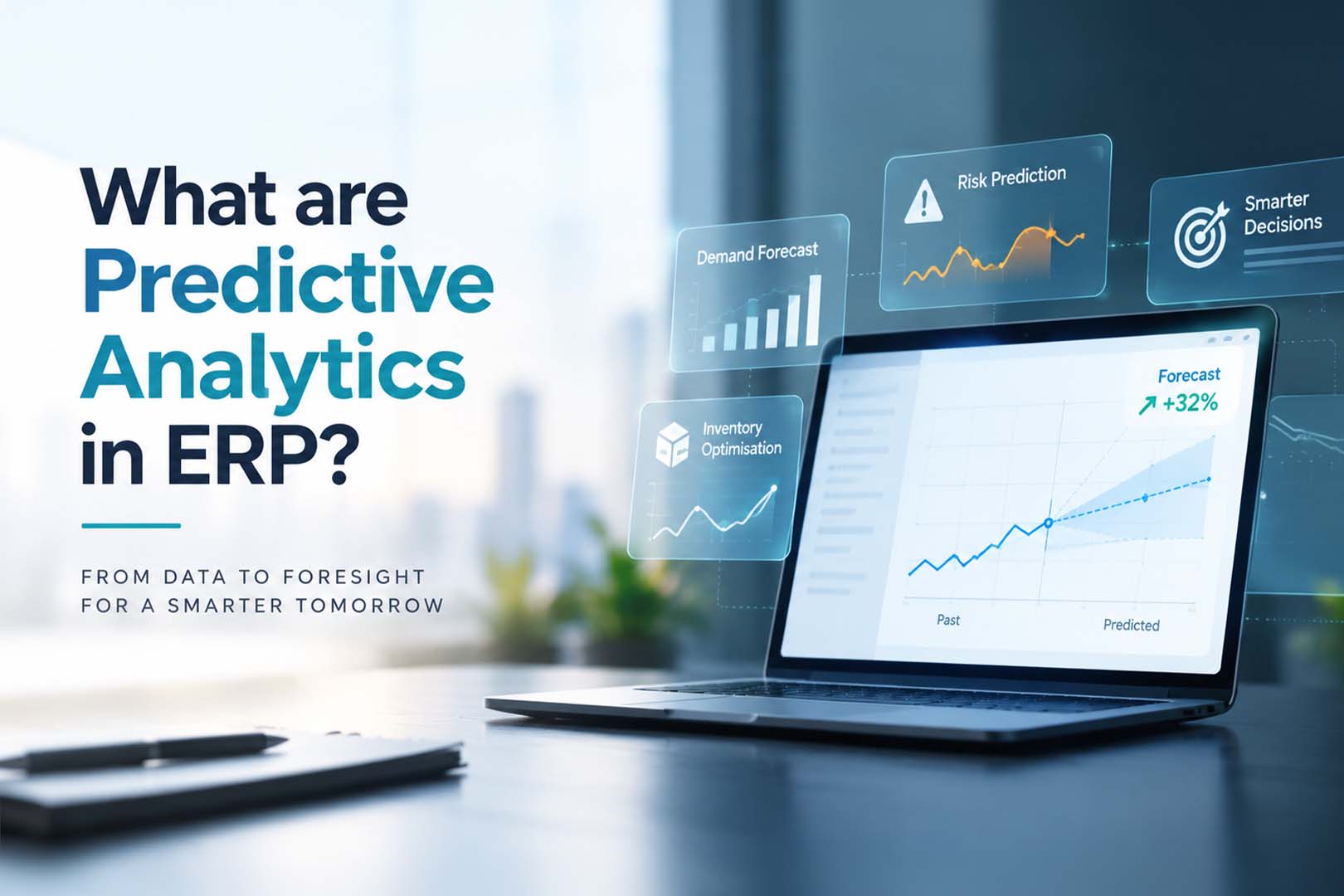
Predictive analytics in a Enterprise Resource Planning system uses historical business data, statistical models, and machine learning to forecast future events. Rather than only reporting past outcomes, it anticipates trends like future sales, cash flow requirements, or equipment failures. This allows companies to plan proactively and address potential issues early.
Demand Driven MRP (DDMRP) stock buffers are also natively integrated into Planning Optimisation in Dynamics 365 SCM, allowing businesses to automatically establish strategic decoupling points and dynamically adjust buffer levels based on actual order flow.
In an ERP environment, that prediction can be connected to operational data like:
- Sales orders
- Historical demand
- Inventory levels
- Supplier performance
- Purchase orders
- Lead times
- Production data
- Warehouse activity
- Customer behaviour
- External signals
Within Microsoft’s ecosystem, these capabilities are embedded across Dynamics 365 Finance & Supply Chain Management, connecting predictions with the processes where teams act on them. The implementation determines how effectively that foundation translates into business outcomes.
Still reacting to supply chain problems after they happen?
Mercurius IT can help you identify where Dynamics 365 predictive capabilities can create earlier visibility and better decisions.
Predictive vs Traditional Analytics
The difference is simple.
- Descriptive analytics asks: What happened?
- Diagnostic analytics asks: Why did it happen?
- Predictive analytics asks: What is likely to happen next?
- Prescriptive analytics asks: What should we do about it?
That last step matters.
A forecast that predicts a stockout is useful.
A connected ERP like Dynamics 365 FSCM can connect the affected product, supplier, inventory position and financial impact in one view.
At this stage, you might be thinking…
“Can’t I just use a separate analytics platform?”
You can!
But that can create another problem.
Dynamics 365 Finance and Supply Chain Management brings together finance and capabilities covering demand planning, procurement, inventory, warehouse management, fulfilment, manufacturing and asset management. Here SCM manages the operational tools while D365 Finance manages the GL/AP/AR.
How Predictive Analytics Works in a Dynamics 365 Supply Chain
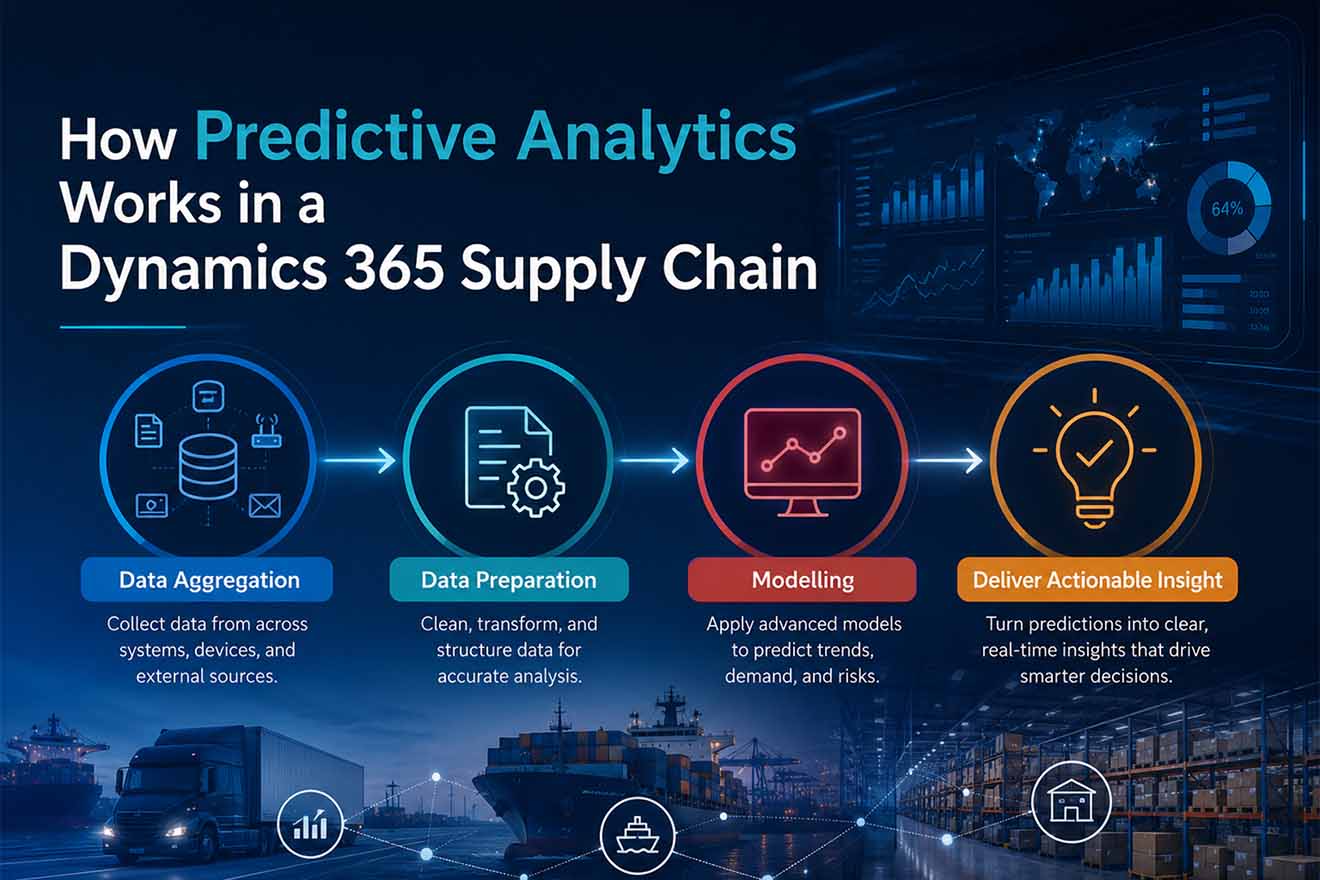
Most predictive analytics systems in supply chains use a similar four-step process:
Data Aggregation
Bring together relevant information from finance, ERP, warehouse, sales, procurement, supplier and other connected systems.
Data Preparation
Clean, standardise and structure the data.
This step is often underestimated.
It shouldn’t be.
A sophisticated model cannot compensate for unreliable master data, missing transactions or inconsistent product information.
Bad data in. Bad decisions out.
Modelling
Forecasting models identify patterns in historical and current information.
Depending on the use case, these patterns can help estimate:
- Future demand
- Inventory requirements
- Lead-time changes
- Supplier risks
- Potential shortages
- Capacity requirements
D365 Supply Chain Management includes demand forecasting capabilities and Microsoft’s newer Demand Planning experience, which uses forecasting algorithms, analytics and collaborative planning capabilities.
Deliver Actionable Insight
The final step is the one that matters most.
Insights need to reach the people responsible for making decisions.
That could mean:
- Planner alerts
- Forecast analysis
- Exception management
- Inventory recommendations
- Supplier risk indicators
- Dashboards
- Copilot-assisted analysis
The objective isn’t to produce more data. It’s to help people make better decisions faster.
Your supply chain already has the data. The question is whether you're using it before problems happen.
See where predictive analytics and Dynamics 365 can improve forecasting, inventory and supply chain decisions.
Where Does Predictive Analytics Deliver Measurable Impact?
Demand Forecasting
Bad forecasts don’t cost you a bad quarter. They cost you every quarter after it.
An inaccurate forecast can create two equally painful outcomes:
Too much inventory.
Or:
Not enough inventory.
Predictive forecasting helps planners identify trends, seasonality and demand changes earlier.
Even, Research by AWS and Kearney shows that algorithmic forecasting improves accuracy by 10-20%, reduces inventory by 5-10%, and increases revenue by up to 2%.
Microsoft’s Dynamics 365 Supply Chain Management capabilities include AI-supported demand planning, external signals, forecast explainability and outlier handling.
Inventory Optimisation
Every unit of unnecessary inventory ties up working capital, linking supply chain decisions directly to finance.
Every stockout creates a different problem.
Predictive analytics helps businesses find the balance.
Instead of applying the same inventory logic everywhere, businesses can use demand patterns, lead times and supply variability to make more informed inventory decisions.
Inventory Visibility and the Master Planning engine in Dynamics 365 Supply Chain Management apply these calculations directly to reorder points and safety stock within the ERP, rather than relying on external spreadsheets.
Planning Optimisation
The advanced Master Planning engine in Dynamics 365 Supply Chain Management calculates net requirements and dynamic safety stock directly within the enterprise resource planning (ERP) system. Meanwhile, the Inventory Visibility Service (IVS) enables real-time, global inventory tracking across high-volume channels while maintaining core transaction performance.
Supply Chain Risk & Disruption Warning
You can’t manage a supplier problem you discover after the delivery date.
Predictive analytics can analyse patterns in:
- Supplier lead times
- Order performance
- Delivery reliability
- Quality issues
- Purchase order changes
- Historical delays
This can help businesses identify suppliers or products that require closer attention.
For UK businesses dealing with changing trade conditions, transport disruption and international sourcing risk, earlier visibility can create valuable decision time.
47% now expect higher transport costs this year, largely unchanged since June but up 14 percentage points since December 2025.
Retail Supply Chain Predictive Analytics
Retailers use predictive models to anticipate demand at individual stores and hyperlocal levels, ensuring the right products are available at the right locations ahead of seasonal peaks, festivals, or promotions.
Predictive Analytics in Healthcare Supply Chain
In the healthcare sector, predictive analytics forecasts demand for medicines, personal protective equipment, and essential equipment, reduces wastage from expiry, and ensures hospitals and pharmaceutical distributors are not caught unawares during spikes in demand.
Common Challenges in Dynamics 365 Supply Chain Predictive Analytics
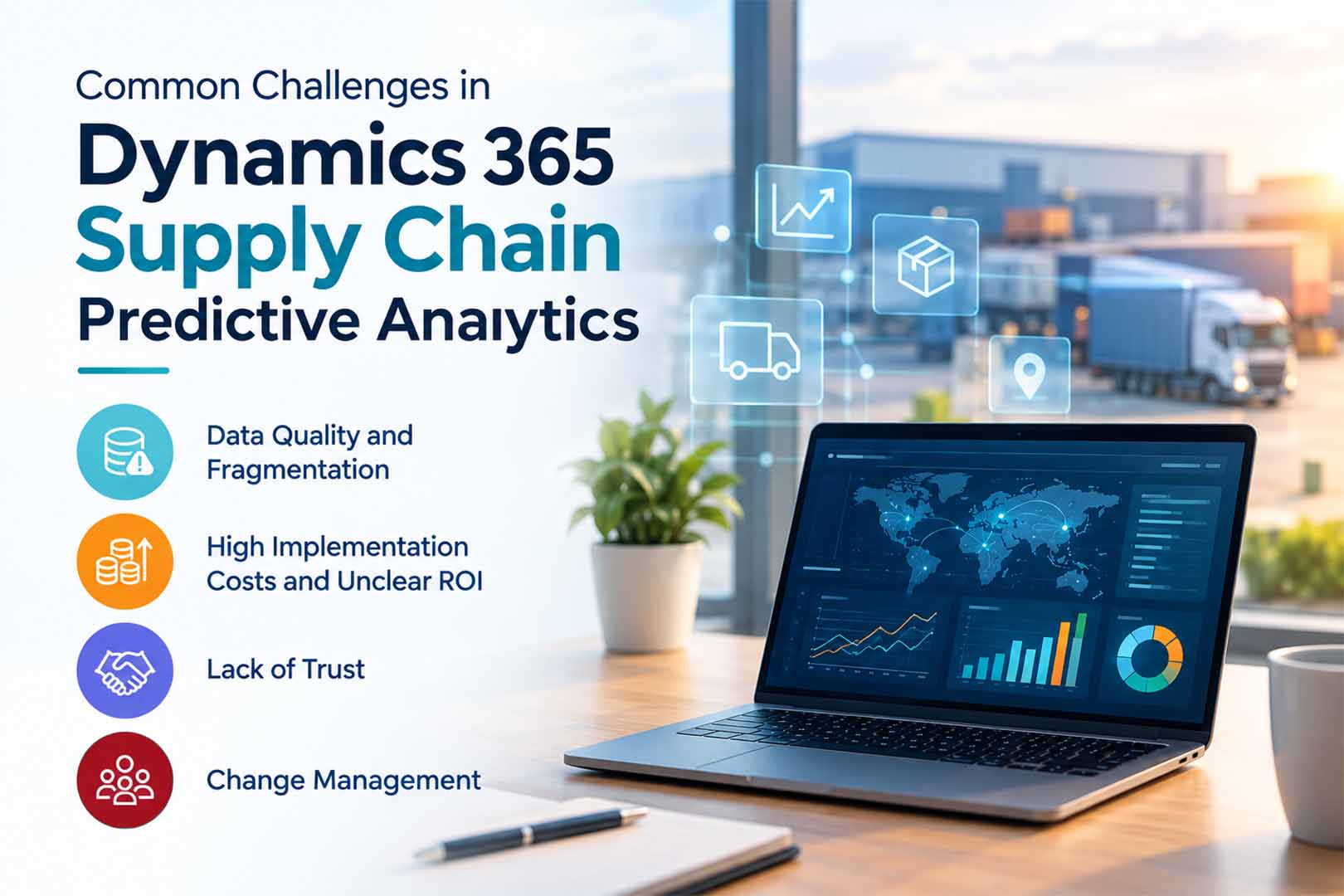
Predictive analytics across Dynamics 365 FSCM isn’t plug-and-play. Common hurdles that may interrupt the Dynamics 365 implementation include:
Data Quality and Fragmentation
When ERPs, WMS, and spreadsheets are not connected, data becomes inconsistent. Setting up a strong data governance framework, with regular audits and automated data cleaning, helps solve this problem.
High Implementation Costs and Unclear ROI
Don’t start with:
“Let’s implement AI everywhere.”
Start with:
“Which problem is costing us the most?”
Once you see results, you can expand across FSCM’s finance and supply chain capabilities.
Lack of Trust
Predictive systems use data from many platforms, so it is essential to use encryption, set up access controls, and follow data protection regulations.
Change Management
Accurate predictions only help if planners trust and use them. Adding predictions directly into the dashboards and workflows that planners already use, instead of creating separate reports, makes it much more likely they will adopt the new tools.
Future Trends in Dynamics 365 Predictive Supply Chain Analytics
- External factor integration – Integrating external factors involves combining historical sales data in the system with current external variables such as weather conditions, local trends, and supplier lead times.
- Copilot for forecasting – Microsoft Copilot enables planners to run machine learning models, manage data outliers, and produce explainable demand forecasts without writing complex code.
- AI exception agents: Autonomous AI agents keep an eye on logistics, manufacturing, and supplier networks to identify bottleneck risks before these risks affect fulfilment.
- IoT Spoilage Tracking – Using sensors, goods in transit can be monitored, and predictive algorithms can assess environmental risks to inventory quality.
Conclusion
UK supply chains are operating in a world where waiting for problems to appear is becoming increasingly expensive.
The businesses that perform better won’t necessarily be the ones with the most data.
They’ll be the ones that can turn data into decisions faster.
Predictive analytics in ERP helps make that possible.
It improves demand forecasting, optimises inventory and highlights supplier risk. Support production planning. And give supply chain teams earlier visibility into what may happen next.
But predictive analytics is not a plug-in. It needs the right data and the right processes.
The right Dynamics 365 configuration. And the right implementation strategy.
That’s where Mercurius IT can help.
As a Dynamics 365 implementation partner, Mercurius IT works closely with UK businesses to understand their requirements, map them to the right FSCM capabilities and build an implementation roadmap around measurable business outcomes.
Frequently Asked Questions
Is predictive analytics part of an ERP system?
Predictive analytics can be built into or integrated with modern ERP platforms. Dynamics 365 Supply Chain Management provides demand forecasting and demand planning capabilities alongside inventory, procurement, manufacturing and fulfilment processes.
Does Dynamics 365 Supply Chain Management support predictive analytics?
Yes. Dynamics 365 Supply Chain Management supports demand forecasting, demand planning, AI-assisted analysis, inventory optimisation and other intelligent supply chain capabilities.
Can SMEs use predictive analytics without a large data science team?
Yes. Modern ERP platforms increasingly provide embedded forecasting, analytics and AI capabilities. The more important question is whether the business has the right data, processes and implementation approach to use them effectively.
How long does it take to see ROI?
Most companies see measurable improvements in inventory and forecast accuracy within 6 to 12 months. However, results depend a lot on the quality of your starting data.