
Quick Summary
AI agents enable finance and supply chain teams to transition from slow, manual decision-making to real-time, automated processes. This transformation reduces costs, increases accuracy, and enhances operational resilience. Organisations that prioritise high-value applications, ensure data readiness, and establish clear governance can scale AI initiatives beyond pilot projects and achieve measurable business outcomes.
Key Takeaways
- AI agents go beyond automation to enable real-time decision-making and execution.
- High-impact use cases include risk detection, forecasting, procurement, and financial operations.
- The biggest challenge is not adoption, but scaling AI with the right deployment strategy.
- Data readiness and governance are critical for accuracy, control, and compliance.
- Enterprises that operationalise AI agents gain speed, resilience, and cost advantages.
AI is being adopted quickly, but scaling it is still a major challenge. A recent survey found that while 88% of workplaces use AI, only 28% of organizations have prepared their employees to create real business impact with it.
This is because most companies still see AI mainly as a tool for automation, rather than as a way to support smarter decision-making.
AI agents are changing this approach. They do more than automate tasks; they can make and carry out decisions in real time across finance and supply chain operations. In the supply chain, AI agents autonomously detect and respond to supply disruptions. In finance operations, AI agents continuously reconcile financial data and flag risks instantly.
Even Gartner reports that leading supply chain organisations use AI to optimise processes at more than twice the rate of lower-performing peers. Many of these systems now include generative AI features, like large language models (LLMs), which let users interact with data and systems using everyday language. In this blog, you’ll explore how AI agents are shaping finance and supply chain management and their impact.
AI Agents in Enterprises
Most companies today have invested a lot in automation, using tools like RPA bots, workflows, and dashboards. However, these systems still need people to make decisions, which can slow down finance cycles and supply chain responses. AI agents help solve this problem.
Unlike traditional automation, AI agents in Dynamics 365 Finance and Supply Chain Management do more than just carry out tasks. They can analyse, make decisions, and act on their own within set business rules. Because of this, many companies are moving from process automation to decision automation.
Top AI Capabilities for Finance and Supply Chain Management Enterprises
- Autonomous decisioning: Act on real-time data without waiting for manual inputs
- Context-aware execution: Understands business rules, dependencies, and exceptions
- Continuous learning: Improves results by learning from both past and current data
- Built-in adaptability: Agents demonstrate inherent adaptability by evaluating uncertainty and modifying their actions in response to changing market conditions, thereby facilitating continuous risk mitigation.
- Connected Functions: Agents enable integrated operations by sharing contextual information across planning, sourcing, manufacturing, and logistics, thereby reducing organisational silos.
Still stuck in AI pilots?
See how to scale AI agents across your enterprise, before your competitors do.
Use Cases for AI Agents in the Supply Chain
AI agents are now used in many important supply chain tasks. They help companies respond quickly, make smarter choices, and lower risks. The following examples highlight how agentic AI is already changing the way supply chains work.
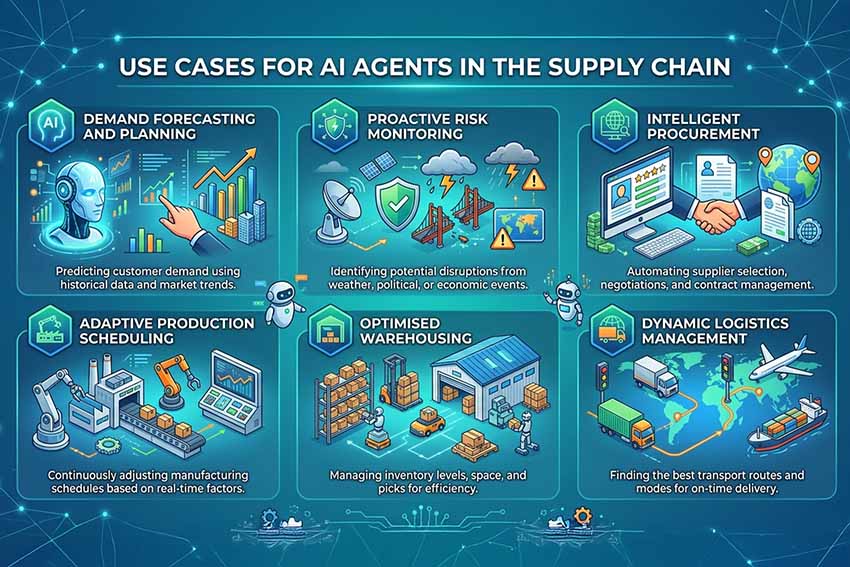
Demand forecasting and planning
AI agents constantly update forecasts using past data and real-time information like market trends and promotions. This helps companies quickly adjust inventory, production, and restocking plans. For example, big retailers use AI agents to predict demand at each store and adjust stock as customer needs change.
Proactive risk monitoring
For risk management, AI agents continuously monitor internal and external data for potential issues like supplier reliability, transport delays, or bad weather. They assess the impact and suggest ways to reduce risks, helping companies address issues before they worsen.
Intelligent procurement
AI agents monitor supplier performance, track price changes, and identify potential risks. They recommend alternative suppliers, flag delays, and adjust sourcing plans.
Adaptive production scheduling
During production, AI agents create optimal schedules by considering demand, available materials, and capacity constraints. If something unexpected happens, they quickly update plans and offer new options to reduce delays.
Optimised warehousing
AI agents handle inventory movement, storage spots, and order picking priorities. They monitor incoming and outgoing demand in real time to improve operations and reduce handling costs.
Dynamic logistics management
Agents monitor shipments, track carrier performance, and check route conditions to spot and fix problems. They suggest or make changes to delivery routes to keep everything on time. AI-powered agents always know where shipments are and change routes if there are delays or issues.
AI Agents in Finance Use Cases
AI agents are transforming finance operations by handling tasks that used to require significant manual effort. Here are some examples of where AI agents in Dynamics 365 Finance and Operations are making a difference:
Algorithmic trading
In trading, AI agents monitor the markets and make trades automatically. Unlike traditional automation, these autonomous agents can change their strategies as the market shifts.
Auditing
In auditing, AI agents break large, repetitive tasks into smaller, automated steps. They can review thousands of transactions, identify unusual patterns, and even draft sections of audit documents for review.
Credit assessment and underwriting
Traditional credit reviews are often slow and use limited data. AI agents improve this by considering additional information, such as payment history, financial statements, utility bills, and transaction patterns. They can quickly assess risk, suggest credit terms, and explain their decisions.
Regulatory compliance
A study on gen AI adoption found that 53% of executives worry about the limits set by regulations and compliance. AI agents help financial institutions keep up with these complex & ever-changing rules. Instead of only conducting periodic reviews, agents can continuously review transactions, communications, and documents to ensure they meet regulatory standards.
Customer service and engagement
Banks and fintech companies are increasingly using AI agents to improve customer service and support. These agents often work with chatbots and multilingual voice agents; they handle routine questions efficiently. AI agents can connect different systems, study customer behaviour, and offer personalised financial advice.
Financial reporting
AI agents are changing how finance teams do reporting. Instead of waiting until the end of the month to reconcile accounts and gather information, agents can gather data from systems like ERP platforms, billing tools, and external feeds connected via APIs, and analyse it in real time.
Fraud detection and risk management
Financial institutions are increasingly using AI agents to identify risks in real time. For example, an agent can scan thousands of credit applications and quickly identify those with higher default risk, using both financial data and external information such as news and market trends. In fraud detection, agents can notice unusual activity, such as large transfers from a dormant account, and flag them right away. This helps prevent problems early rather than react later.
Treasury and liquidity management
Managing liquidity across accounts, currencies, and subsidiaries can be tough. AI agents can watch cash flows in real time, predict short-term funding needs, and suggest the best way to allocate capital.
Benefits of AI Agents in the Finance and Supply Chain for Enterprises
Below, we have covered several advantages of using AI agents in finance and supply chain. Taken together, these benefits help explain why more companies are adopting agent-based approaches in their FSCM operations.
- Cost savings: AI agents reduce costs by eliminating manual work and errors. For example, less staff time is needed for routine reports, inventory optimisation, and early detection.
- Faster decision-making: AI agents constantly review data and act immediately. This shortens the gap between identifying insights and taking action, enabling companies to respond to changes more quickly.
- Improved accuracy: AI agents use machine learning and optimisation models together to reduce errors in forecasting, scheduling, and planning.
- Increased resilience: AI agents identify disruptions early and adjust as conditions change. This helps FSCM keep running smoothly during unexpected events.
- Risk mitigation: By continuously monitoring signals inside and outside the company, AI agents can identify risks earlier and help manage issues before they escalate.
- Scalability: Once effective decision patterns are established, AI agents can apply them quickly across multiple locations, products, or regions.
- Better customer experience: When working with customers, AI agents provide quicker responses, personalised financial advice, and effective customer support at any time, leading to improved customer experience.
- Enhanced risk management: Agents can continuously monitor risks, from credit exposure to fraud detection. Their ability to adapt to new patterns makes them effective at identifying threats.
- Financial inclusion: AI agents can help bring financial services to underserved markets by assessing creditworthiness autonomously, enabling microloans, and offering personalised digital banking at scale.
- Real-time insights: Finance teams no longer have to wait for end-of-period reports. With AI agents, they get real-time data analysis and can identify issues or opportunities as they arise, helping them make faster, better decisions.
- Scalability: As companies grow, AI agents can manage more data and more complex tasks without needing to hire many more people.
- Stronger compliance: AI agents stay up to date with complex regulations by automatically checking transactions, contracts, and reporting standards.
The gap between insight and action is costing you a lot more than you think.
Close it with custom AI agents that are built for execution.
Enterprise Deployment Guide: Transitioning from Pilot to Scaled Implementation
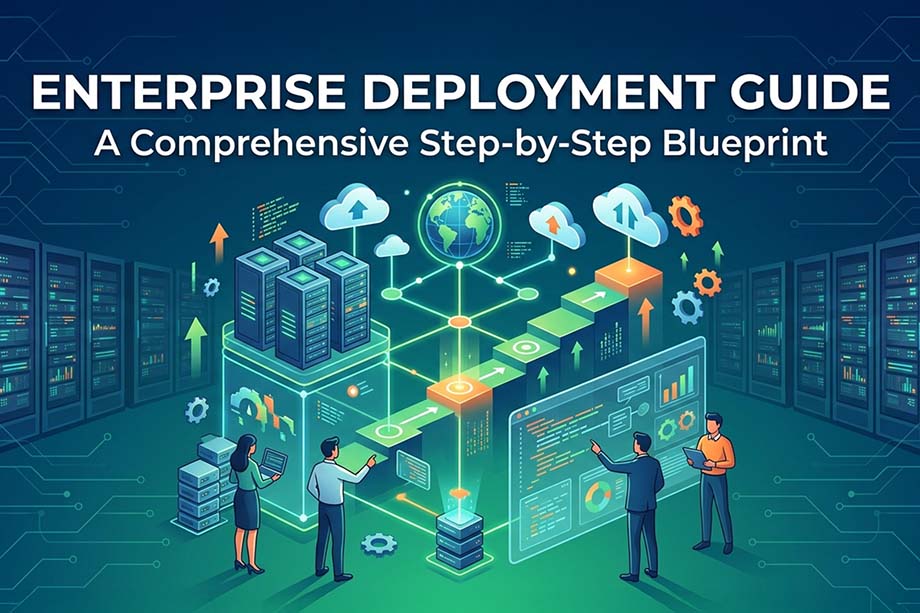
Most AI projects struggle to scale, not because of technology, but because of weak deployment strategies. Here is a quick guide to deploying AI agents for execution.
Identify High-Value Processes
Start with processes that are repetitive and decision-heavy, such as supply chain exceptions or financial reconciliations. These areas deliver faster, measurable ROI.
Build Data Readiness
Ensure data is unified, accurate, and real-time. Fragmented data is one of the biggest barriers to successful AI deployment.
Choose the Right AI Agent Architecture
Embedded agents enable faster adoption within existing systems, while standalone agents support cross-functional decision-making. Choose based on business complexity.
Pilot with Measurable KPIs
Define clear outcomes like cost reduction, speed, or accuracy. Strong KPIs help prove value quickly and justify scaling.
Scale with Governance
As AI scales, governance becomes critical. Human oversight, compliance, and auditability ensure controlled and trusted deployment.
Conclusion
AI agents have moved beyond being an innovation layer and are now central to the operation, decision-making, and scaling of finance and supply chain functions. Their value comes not from isolated use cases but from integration into core business processes, where they continuously enhance speed, accuracy, and resilience.
Business leaders must now transition from exploration to execution by identifying appropriate use cases, deploying AI agents with a defined strategy, and scaling initiatives with robust governance and control.
This is where the right partner makes the difference. As a Microsoft Solutions Partner, Mercurius IT offers expertise in Dynamics 365, data platforms, and AI-driven transformation. The company helps organisations adopt and operationalise AI agents within finance and supply chain ecosystems.
Frequently Asked Questions
What are AI agents in finance and supply chain?
AI agents are intelligent systems that analyse data, make decisions, and take actions in real time across finance and supply chain processes. Unlike traditional automation, they go beyond task execution to enable continuous, decision-driven operations.
How are AI agents different from RPA and automation tools?
RPA and automation tools follow predefined rules to execute tasks, while AI agents adapt, learn, and make context-aware decisions. This allows them to handle complex scenarios like demand fluctuations or financial anomalies without constant human input.
What are the top use cases of AI agents in the supply chain?
High-impact use cases include demand forecasting, disruption management, intelligent procurement, and logistics optimisation. These help businesses reduce delays, optimise inventory, and respond faster to market changes.
How do AI agents improve finance operations?
AI agents enable real-time financial reporting, continuous reconciliation, fraud detection, and dynamic forecasting. This reduces manual effort and helps finance teams make faster, more accurate decisions.
What are the key benefits of AI agents for enterprises?
AI agents help organisations achieve cost savings, faster decision-making, improved accuracy, and stronger risk management. They also enhance operational resilience by responding to issues in real time.