
Quick Summary
Choosing the right Dynamics 365 CRM partner is critical to controlling implementation costs, reducing delivery risk and achieving long-term value. This guide provides a seven-point framework for UK businesses to evaluate partner capability, pricing, support, compliance, integrations, references and team continuity before making a decision.
Key Takeaways
- Evaluate Dynamics 365 partners on capability and delivery experience, not just implementation price.
- UK-specific expertise and compliance knowledge can reduce implementation and regulatory risk.
- Transparent pricing and clear scope management help prevent unexpected project costs.
- Assess the partner’s post-go-live support model and service-level commitments.
- Check integration expertise across CRM, ERP, Power Platform and Power BI.
- Speak with relevant reference customers and assess team continuity before signing.
- Choose a partner based on your organisation’s size, sector, requirements and tolerance for implementation risk.
Between 30% and 63% of CRM implementations fail to meet their objectives. Yeah, that is not a typo. That’s the range across independent studies, year after year.
And here is the most uncomfortable part – it’s rarely the CRM’s fault. Dynamics 365 CRM is a mature and capable platform. What actually breaks these projects is the vendor sitting between you and it.
So before you shortlist another partner off a Google search, run them through this. It’s the framework we’d want if we were sat where you’re sat right now evaluating quotes, weighing promises, and trying to work out which vendor is telling the truth.
The Real Cost of Choosing the Wrong Partner
Let’s look at the numbers, because saying “it’ll cost you more” doesn’t have the same impact as seeing the real figures.
Dynamics 365 licensing in the UK starts at about £52.80 per user each month. If you roll out CRM to 30 users, that’s £1,584 a month just for licensing. Over a year, that’s £19,008, and that’s before you spend anything on implementation.
Now consider this: In the UK, projects managed by uncertified or poorly vetted partners often go over budget by 40 to 60%. For example, if a mid-sized implementation is quoted at £60,000, a 50% overrun, which is right in the middle of that range, means you’ll pay an extra £30,000 you didn’t expect. That’s £90,000 spent on a project that was supposed to cost £60,000.
That’s a real number. It should sting a bit.
But there’s good news: if you choose the right vendor, CRM projects usually deliver a strong return on investment. The benefits are real, but you need a partner who can keep your project on budget.
Choosing the wrong partner can cost far more than choosing the right one.
Get a clear view of implementation approach, pricing, support and delivery before you commit to a contract.
What is Vendor Evaluation in Dynamics 365?
Vendor evaluation in Dynamics 365 enables companies to assess performance based on adjustable factors such as delivery time, quality, and price. Procurement teams can tailor these criteria to their needs, supporting informed vendor selection and maintaining high procurement standards.
The vendor evaluation tool is flexible and configurable for different business needs. Users can create groups of criteria, each with specific standards, to rate vendors effectively. This approach helps identify qualified vendors and ensures only those meeting requirements are considered. The tool also supports continuous improvement by allowing updates to criteria, keeping evaluations relevant and effective.
The Dynamics 365 Vendor Evaluation Framework
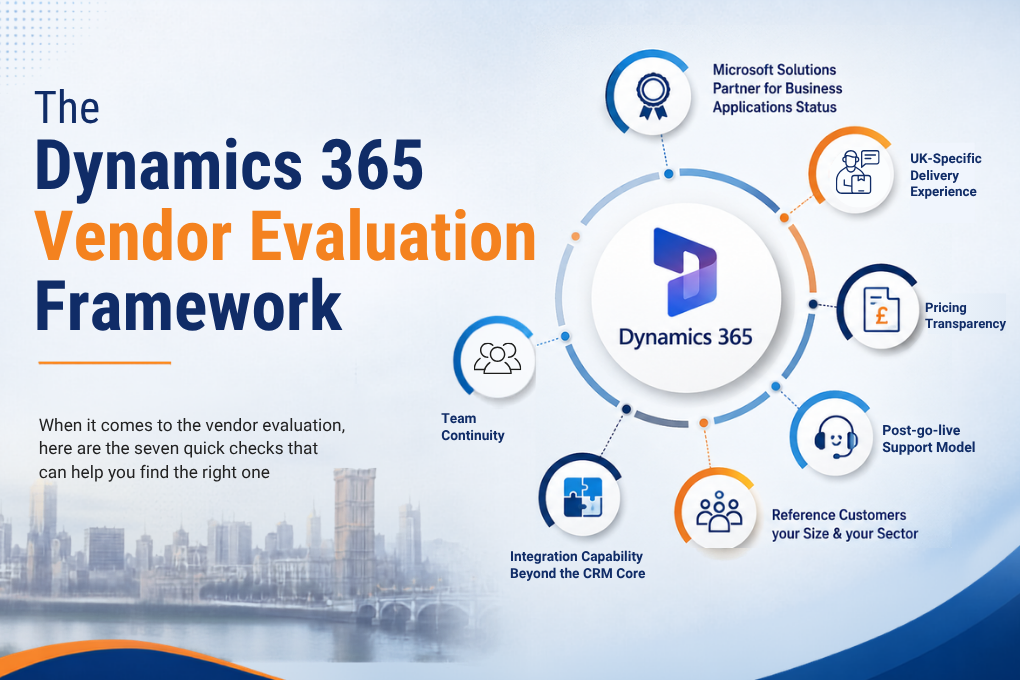
When it comes to the vendor evaluation, here are the seven quick checks that can help you find the right one.
Microsoft Solutions Partner for Business Applications Status
Not only the Microsoft experience. The actual designation of the vendor evaluation requires a minimum score of 70 out of 100, built from performance, skilling, and customer success metrics. Start by building your longlist from Microsoft’s own partner directory, filtered for relevant UK industry experience. Treat the designation as a baseline, though but not proof they are right for you.
In this context, that’s the same designation Mercurius IT holds – Microsoft Solutions Partner Business Applications status for Dynamics 365, audited the same way we’re telling you to check for.
UK-Specific Delivery Experience
GDPR and UK data residency are not optional extras. Neither is familiarity with Making Tax Digital if finance touches your CRM, or sector regulation if you are in financial services, legal, or healthcare.
Pricing Transparency
Complete Dynamics 365 Finance and Supply Chain programs for mid-sized companies usually start at £50,000 or more. CRM-only Sales or Customer Engagement projects often cost much less. If a vendor refuses to give you a clear quote before discovery, it is best to move on.
Post-go-live Support Model
“Ongoing support available” means nothing. Ask who specifically owns tickets after month one, and what the SLA actually says.
This is what a named support model looks like in practice. Ours is called MaxCare, with a defined SLA attached to it, not a vague promise bolted onto the end of a proposal.
Reference Customers your Size & your Sector
Ask for both. Call them without the vendor on the line. Ask for evidence beyond claims too like awards, named clients, audited scores. It’s a fair ask; we have been through it ourselves, winning Partner of the Year at Companial Connect two years running.
Integration Capability Beyond the CRM Core
Think about Power BI, Power Platform, and your current finance or ERP systems. If your partner only understands CRM by itself, you may face integration problems down the road.
Team Continuity
The person who scopes your project should be the person who delivers it. Ask directly & watch how they answer.
Not Sure Which Dynamics 365 Partner to Choose?
Let’s assess what matters for your business beyond the sales pitch.
What are the Benefits of Vendor Evaluation in Dynamics 365?
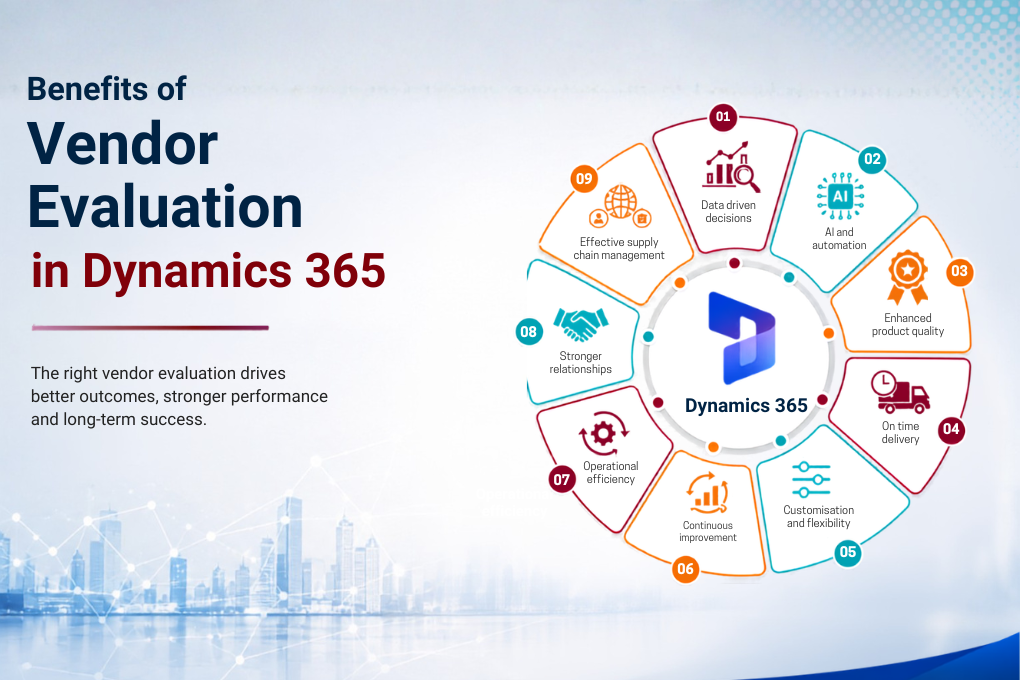
Vendor evaluation in Dynamics 365 offers several key benefits:
- Data-driven decisions – Make data-driven decisions by assessing vendors on quality, cost, and delivery performance. This helps you choose reliable suppliers.
- AI and Automation – Automating vendor evaluation reduces manual work, lowers errors, and speeds up procurement cycles.
- Enhanced Product Quality- Choosing top-performing vendors leads to better product quality and higher customer satisfaction.
- On-time delivery – Tracking vendor performance promotes timely deliveries and minimises supply chain delays.
- Customisation and Flexibility- You can adapt evaluation criteria to fit your business needs, solve challenges, and improve your supply chain.
- Continuous Improvement – Regularly updating and monitoring vendor data ensures your procurement decisions are made using the latest information.
- Operational Efficiency – Efficient procurement processes help lower costs and improve financial performance.
- Stronger Supplier Relationships – Centralised communication and performance tracking make it easier to collaborate with your suppliers.
- Effective Supply Chain Management – Better supplier management leads to a more resilient supply chain.
Together, these benefits improve your procurement strategies and help your organisation succeed.
Which Evaluation Path Fits Your Business?
Each business is unique, so you may not need to prioritise all seven points equally. Consider your specific needs and use this as a starting point.
- If you are purchasing a CRM for the first time without a legacy system, focus on points 2 and 4: UK delivery experience and a strong support model. Prioritise quick value over a comprehensive feature set.
- If you are transitioning from Salesforce to D365 or another legacy CRM, focus on points 3 and 6. Data migration can increase costs. Ensure you understand pricing and integration processes from the outset.
- If you operate in a regulated sector such as finance, legal, or healthcare, prioritise points 1 and 2. Compliance experience is essential, not optional.
- If your business is growing rapidly and the Power Platform is part of your roadmap, focus on points 6 and 7. This is not just a deployment. It is a long-term partnership that will remain important as your needs evolve.
Questions To Ask While Evaluating a Vendor
Ask these in the first call. Watch how quickly and how honestly they answer.
- “What’s your Partner Capability Score, and can I see it?”
- “Who specifically delivers post-launch, and what’s the SLA?”
- “Can I speak to a client in my sector, unsupervised?”
- “What happens to price if scope changes mid-project?”
- “Who owns data migration risk – you or us?”
No hand-waving. Just the answers you actually need to compare vendors properly.
Bottom Line
This framework was never about finding the best Dynamics 365 vendor in the UK. There isn’t one. There’s the vendor that fits your size, your sector, and how much risk you can absorb if something slips.
Run your shortlist through the seven points. Send the email. Ask the awkward questions before you are contractually stuck with the answers.
If you’d rather skip straight to a vendor who already meets every point on this list, that’s exactly where Mercurius IT sits – Microsoft Solutions Partner for Dynamics 365, UK-based, with MaxCare support and an audited track record behind it. Book a demo and put us through the same seven checks you’d run on anyone else.
Frequently Asked Questions
What is a Microsoft Solutions Partner for Business Applications?
This designation indicates that a partner has met Microsoft’s rigorous standards for performance, expertise, and customer success. Microsoft verifies and audits all partners before granting this status.
How much does a Dynamics 365 CRM implementation cost in the UK?
Licensing begins at approximately £52.80 per user per month. Implementation costs are additional and vary significantly by project. Request a detailed estimate tailored to your requirements rather than relying on general price ranges.
How long should a Dynamics 365 CRM vendor evaluation take?
A well-organised vendor evaluation typically takes two to four weeks. This process includes creating a longlist, screening candidates, issuing a structured RFP, and conducting discovery calls with a shortlist of two or three vendors.