
Quick Summary
D365 Supply Chain Management helps UK pharma manufacturers integrate GMP compliance into operations with traceability, automation, and audit-ready systems. This reduces risk and improves efficiency and regulatory readiness.Key Takeaways
- GMP compliance is increasingly managed through integrated systems. UK regulators now require real-time traceability, data integrity, and audit readiness, rather than relying solely on documented processes.
- Manual processes, isolated systems, and insufficient audit trails raise risks during MHRA inspections.
- D365 SCM integrates compliance into operational workflows. It supports continuous, system-enforced compliance from batch traceability to CAPA workflows.
- Compliance directly affects business performance. Faster batch releases, lower recall risk, and better audit readiness improve operational efficiency.
- Implementation expertise is critical to success. The value of D365 depends on effective configuration, validation, and alignment with GMP workflows.
GMP compliance in UK pharmaceutical manufacturing is now a continuous operational risk, not just a periodic audit concern. The Medicines and Healthcare products Regulatory Agency (MHRA) conducted 353 GMP inspections in 2024/25, demonstrating that regulatory scrutiny is ongoing. Pharmaceuticals remain a key UK export sector, contributing £41.2 billion in 2024. As a result, compliance failures threaten both revenue and market access.
Data integrity, and computerised system failures account for nearly one-third of GMP inspection findings. This shows a systemic gap, with compliance issues arising at the system level rather than only within individual processes.
This raises a key question for business leaders: Is your ERP system structured to support compliance, or does it increase audit risk due to fragmented data, manual controls, and limited traceability?
Microsoft Dynamics 365 Supply Chain Management addresses this challenge by shifting from reactive compliance to integrated controls. This blog shares how D365 Supply Chain Management supports GMP compliance for UK pharmaceutical manufacturers.
What UK GMP Compliance Actually Demands from Your Operations
In the UK, GMP compliance is demonstrated through operational evidence rather than written policies. The Medicines and Healthcare products Regulatory Agency requires manufacturers to show real-time control, traceability, and data integrity throughout all processes.
Here’s what that means in practice:
- End-to-End Batch Traceability- All raw material lots, production steps, and finished batches must be fully traceable. This includes timestamps, operator IDs, in-process checks, and deviation logs, which must be reconstructable at any point during an audit.
- Data Integrity (ALCOA+ Principles)- Systems must ensure data is attributable, legible, contemporaneous, original, and accurate. Data privacy and integrity failures continue to be a leading cause of GMP observations.
- Documentation & Quality System Control- Documentation gaps represent a primary compliance risk. Over 60% of GMP inspection observations relate to documentation, investigations, and procedural weaknesses.
- CAPA (Corrective and Preventive Action) Workflows- All deviations must be logged, investigated, and closed with complete audit trails and documented evidence of corrective action.
- Dual Regulatory Alignment (UK + EU)- UK manufacturers exporting to Europe must comply with both MHRA GMP and European Medicines Agency standards, which increases operational complexity.
Compliance gaps are costing more than you think.
Reduce the risk of recalls, delays, and regulatory findings with a system designed for controlled execution.
How Dynamics 365 Supply Chain Management Enables GMP Compliance?
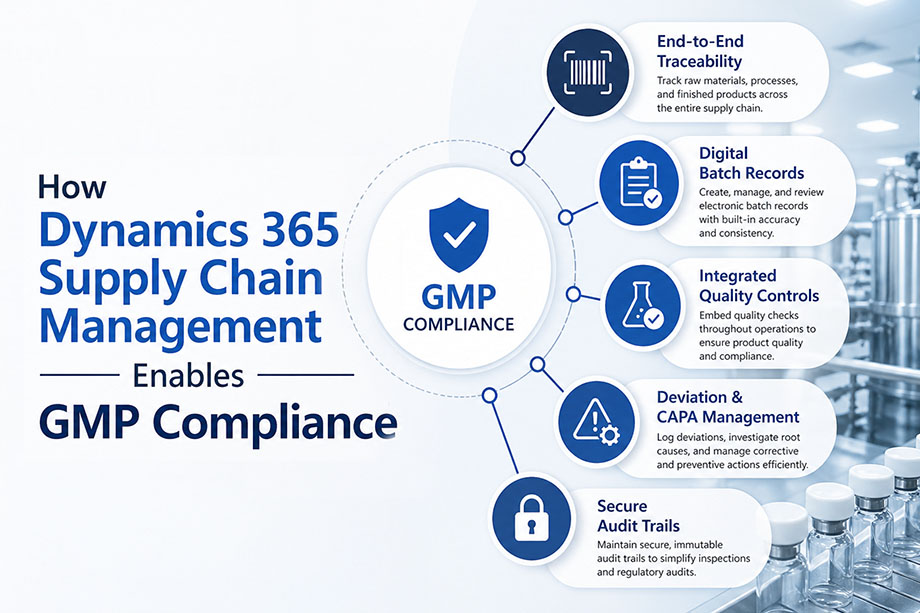
Microsoft Dynamics 365 Supply Chain Management enables UK pharmaceutical manufacturers to operationalise Good Manufacturing Practice (GMP) by embedding compliance controls within supply chain processes, thereby aligning with the expectations of the Medicines and Healthcare Products Regulatory Agency.
- End-to-End Traceability: All material movements and production steps are recorded, allowing immediate forward and backward tracking without manual effort.
- Digital Batch Records: Documentation is captured in real time, increasing accuracy and reducing dependence on paper or external records.
- Integrated Quality Controls: Automated checks at key stages ensure consistent compliance with quality standards, eliminating the need for manual intervention.
- Deviation & CAPA Management: Issues are logged, investigated, and resolved within a unified workflow, maintaining a continuous compliance record.
- Secure Audit Trails: Each action is time-stamped and attributable, supporting inspection readiness and meeting global regulatory requirements.
Where Traditional ERP Systems Fall Short
Many UK manufacturing businesses face compliance risks not because they lack systems, but because their systems were not built for GMP execution at scale. When the Medicines and Healthcare products Regulatory Agency reviews these setups, traditional ERP systems often reveal gaps during audits.
- No Native Batch Genealogy Tracking: Legacy ERPs have trouble linking raw materials, production steps, and finished goods in one traceable chain. This makes batch reconstruction slow and more error-prone.
- Weak Audit Trail Integrity: Audit logs are often incomplete or handled manually, raising the risk of data integrity issues. This is one of the most common problems found during inspections.
- Manual QA Approvals: Quality checks and approvals are often done outside the system. This causes delays and inconsistent records.
- Siloed Operations Across Functions: Quality, warehouse, and production systems often work separately. This limits visibility and control across operations.
- Limited Real-Time Audit Readiness: During inspections, teams often gather data from multiple sources rather than having it ready right away.
For executives, this means delayed product releases, greater compliance risks, and higher operational costs. Compliance becomes a reactive burden instead of a managed process.
Not sure where your compliance gaps exist?
Obtain a clear view of where your current systems fall short and how to fix them.
The Business Case: Compliance as an Operational Asset
For UK pharmaceutical manufacturers, GMP compliance is often seen as a cost centre, but data shows otherwise. Since 2000, enforcement actions and manufacturing shutdowns due to compliance failures have resulted in an estimated $12 billion in industry losses, highlighting the significant financial impact of non-compliance.
Microsoft Dynamics 365 Supply Chain Management transforms compliance from a reactive process to an integrated operational capability:
- Reduced Risk of Recalls & Violations- Integrated quality controls enable early detection, reducing downstream failures and regulatory risk.
- Faster Audit Readiness & Batch Release- Real-time data visibility reduces audit disruption and shortens Qualified Person (QP) release cycles.
- Operational Efficiency Through Automation- Automation removes manual documentation and approval bottlenecks, reducing overhead and increasing throughput.
- Unified Compliance Across UK & EU Markets- A unified, system-driven source of truth streamlines regulatory alignment with both the Medicines and Healthcare products Regulatory Agency and the European Medicines Agency.
Embedding GMP compliance within D365 SCM makes it a driver of efficiency, resilience, and scalable growth rather than just a regulatory requirement.
Bottom Line
The key issue is not whether Microsoft Dynamics 365 Supply Chain Management supports GMP compliance, as it already provides traceability, quality management, and auditability. The main challenge for UK pharmaceutical manufacturers is ensuring these capabilities are effectively implemented, configured, and managed in daily operations.
Despite substantial ERP investments, many organisations still use parallel spreadsheets, disconnected CAPA tools, and manual audit preparation. These are the same gaps regulators such as the Medicines and Healthcare products Regulatory Agency frequently identify. Over 60% of GMP inspection findings relate to documentation, investigations, and procedural weaknesses, indicating execution gaps rather than technology limitations.
This is where the right implementation partner becomes critical. Mercurius IT, a Microsoft Solutions Partner, works closely with manufacturing organisations to translate GMP requirements into system-driven processes within D365 SCM, from batch traceability and quality workflows to audit readiness and compliance reporting.
Evaluating Dynamics 365 for pharma compliance?
Work with experts who understand both the platform and the regulatory landscape to ensure successful implementation.
Frequently Asked Questions
How does Dynamics 365 ensure GMP compliance in pharma manufacturing?
Dynamics 365 supports regulatory compliance with batch traceability, digital records, automated quality checks, audit trails, and CAPA workflows. These system-driven controls replace manual processes, reduce audit risk, and enhance data integrity.
Is Dynamics 365 Supply Chain Management MHRA compliant?
The platform is not MHRA-certified, but it offers the necessary capabilities to meet regulatory standards. Compliance relies on proper configuration, validation (CSV), and effective operational use.
Can Dynamics 365 handle batch traceability for regulated industries?
Yes. It provides comprehensive lot and batch tracking across the supply chain, allowing rapid identification of affected products during audits or recalls. This is essential for regulated sectors such as pharmaceuticals.
What are GMP requirements for ERP systems in the UK pharma sector?
ERP systems must support traceability, data integrity (ALCOA+), audit trails, controlled documentation, and CAPA processes. They must also undergo validation to ensure consistent and compliant performance.
How long does it take to implement a GMP-compliant ERP system?
Implementation typically takes 6 to 12 months, depending on complexity, validation requirements, and integrations such as LIMS or MES. A structured approach with an experienced partner can help accelerate the timeline.