

Quick Summary
Microsoft Dynamics 365 Business Central helps UK pharmaceutical distributors improve compliance, inventory control, traceability, and financial visibility through a unified ERP platform.
Key Takeaways
- Disconnected systems raise compliance risks, cause delays, and create operational inefficiencies in pharma distribution.
- Business Central enables end-to-end batch traceability, audit readiness, and real-time visibility in a single platform.
- FEFO-based inventory and demand planning reduce expiry losses and improve working capital efficiency.
- With features like Warehouse Classification, Items with special storage needs like cold storage can be identified and actioned on Receipt.
- Integrated finance, supply chain, and compliance workflows accelerate decision-making and improve operational control.
- Choosing the right implementation partner ensures regulatory compliance, faster adoption, and long-term scalability.
Nearly 40% of pharmaceutical companies still operate on disconnected systems, leading to significant operational waste, delayed decisions, and compliance risks. This poses a significant business risk for UK pharmaceutical distributors.
With MHRA regulations and Good Distribution Practice (GDP) requirements, the margin for error is minimal. Each batch must be traceable, every record audit-ready, and all shipments must comply with strict quality and storage standards. However, many distributors still rely on fragmented systems, spreadsheets, or outdated tools not designed for regulated supply chains.
This is where the discussion around ERP changes significantly. Dynamics 365 Business Central serves as a strategic platform, embedding compliance, visibility, and control into daily operations. Leaders gain real-time insight into inventory, batches, financials, and compliance status in a single system, eliminating the need to track data across multiple platforms.
This blog explores everything you need to know about the role of D365 in the pharmaceutical industry and how it benefits them.
Industry-Specific Challenges UK Distributors Face

Pharmaceutical distribution in the UK is subject to strict regulatory oversight and narrow margins. Many distributors continue to manage critical processes across fragmented systems, which increases risks to compliance, cost, and business continuity.
- Traceability gaps increase recall risk- Incomplete or delayed batch and lot tracking hinders timely, compliant recalls, increasing both regulatory exposure and reputational risk.
- Expiry-driven inventory losses- Lack of real-time visibility and FEFO discipline leads to product expiry on shelves, eroding margins and tying up working capital.
- Serialisation and compliance complexity- Complying with product traceability, audit trail, and documentation requirements increases operational overhead, particularly when systems are not designed for regulated workflows.
- Disconnected systems slow decisions- Finance, warehouse, and quality teams often operate in silos, resulting in data mismatches, manual reconciliation, and delayed responses to critical issues.
- Unpredictable demand across NHS and private channels- Fluctuating demand patterns make it challenging to balance stock levels, leading to costly overstocking or service-impacting stockouts.
In a sector where precision is essential, these challenges are interconnected and intensify, making operational control more difficult as the business grows.
Still Managing Pharma Operations on Disconnected Systems?
Unify finance, warehouse, and compliance in one system and make faster, data-driven decisions.
What is Microsoft Dynamics 365 Business Central for Pharma Distributors?
Microsoft Dynamics 365 Business Central is a cloud-based ERP that unites finance, operations, and supply chain into one system, giving pharmaceutical distributors real-time control over inventory, compliance, and performance.
Built for scalability, it supports growing mid-sized distributors without adding complexity. Its native integration with Microsoft Excel, Microsoft Teams, and Microsoft Power BI ensures seamless data flow across teams. More importantly, it can be tailored to meet the strict regulatory and traceability requirements of pharmaceutical distribution.
Core Capabilities of D365 for Pharma Distribution Needs
Contemporary pharmaceutical distribution requires capabilities beyond basic Enterprise Resource Planning (ERP). Emphasising embedded compliance, operational visibility, and control helps organisations mitigate risk, safeguard profit margins, and respond promptly to evolving market and regulatory requirements.
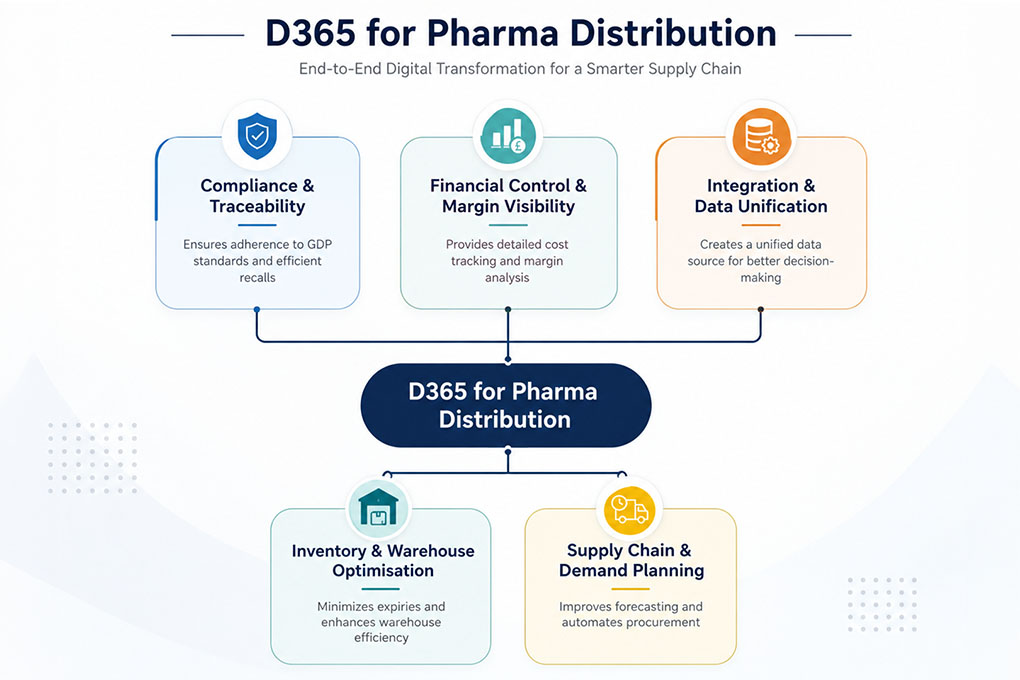
Compliance & Traceability
Enables comprehensive batch and lot tracking with expiry management, providing distributors with complete visibility for audits and facilitating expedited, compliant recalls in accordance with Good Distribution Practice (GDP) requirements.
Quality Management Enhancements
Microsoft has recently expanded its quality management capabilities within Dynamics 365, enabling organisations to define quality control processes, inspection requirements, and testing checkpoints across inventory and supply chain operations. For pharmaceutical distributors, this provides an additional layer of control to help maintain product quality, strengthen compliance procedures, and improve audit readiness.
Inventory & Warehouse Optimisation
Facilitates First-Expiry-First-Out (FEFO) inventory management with real-time, location-specific stock visibility to minimise expiries, prevent stockouts, and enhance warehouse efficiency.
Financial Control & Margin Visibility
Delivers consolidated financial reporting with detailed cost tracking at batch and product levels, supporting better management of pricing, rebates, and margin performance.
Supply Chain & Demand Planning
Improves demand forecasting accuracy and automates procurement workflows to optimise vendor performance and minimise supply chain delays.
Integration & Data Unification
Integrates Customer Relationship Management (CRM), eCommerce, and logistics systems to create a unified, reliable data source, eliminating silos and enabling faster, data-driven decisions.
Gain End-to-End Visibility Without Operational Disruption
Transition to a connected system with minimal risk and maximum business impact.
How Business Central Supports UK Regulatory Compliance
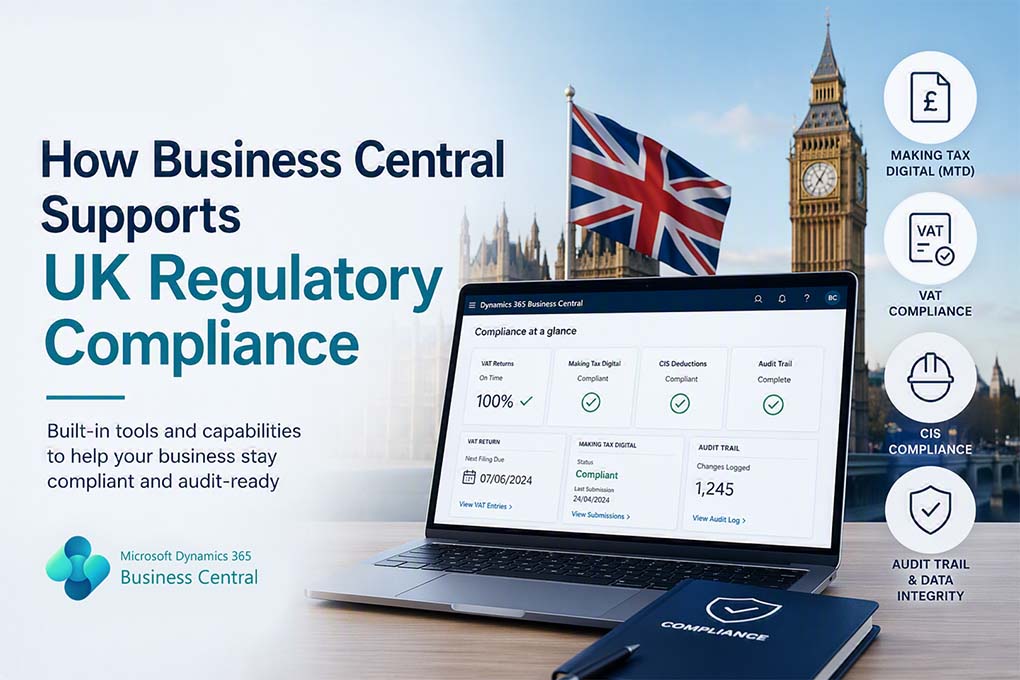
Microsoft Dynamics 365 Business Central enables pharmaceutical distributors to integrate compliance into daily operations instead of treating it as a separate task. It aligns with Medicines and Healthcare products Regulatory Agency expectations and Good Distribution Practice guidelines by providing structured data capture, controlled workflows, and full traceability.
Built-in audit trails, automated documentation, and role-based access control in Dynamics 365 help pharmaceutical businesses remain audit-ready and protect data integrity. This system not only meets regulatory requirements but also simplifies compliance at scale.
Real Business Outcomes of D365 Business Central in Pharmaceutical
Implementing Microsoft Dynamics 365 Business Central delivers measurable business results. Distributors reduce compliance risk and audit workload with accurate, accessible records. Enhanced inventory control minimises expiry-related losses, and greater process visibility speeds up order-to-cash cycles.
Leaders gain tighter control over working capital and can make faster, data-driven decisions, shifting operations from reactive to proactive.
When Business Central Is the Right Fit?
Microsoft Dynamics 365 Business Central is a strong fit for mid-sized pharmaceutical distributors that are scaling operations and need tighter control over inventory, compliance, and financials. It works particularly well for businesses that have outgrown standalone accounting or warehouse systems and are struggling with fragmented data and manual processes.
However, it may not be the best fit for organisations with highly complex, manufacturing-heavy operations that require deep production planning or specialised pharma manufacturing capabilities without additional extensions.
In a nutshell, it is ideal for distributors looking to standardise, scale, and stay compliant.
Implementation Considerations for UK Pharma Businesses
A successful implementation of Microsoft Dynamics 365 Business Central requires a structured approach that balances compliance, data accuracy, and business continuity.
- Partner selection with pharma/GDP expertise
Select an implementation partner who understands Good Distribution Practice and UK regulatory requirements to prevent compliance gaps. - Plan data migration for batch and compliance records
Ensure accurate migration of batch, expiry, and audit data to maintain traceability and audit readiness from the outset. - Validation and testing for regulatory alignment
Validate workflows and controls against compliance requirements before go-live to reduce audit risk. - Manage change for operations and quality assurance teams
Prepare teams for new processes to support adoption and minimise operational disruption. - Develop a timeline and phased rollout strategy
Implement in phases to reduce risk, maintain continuity, and stabilise processes before further scaling.
Common Pitfalls to Avoid
Even the right ERP can fail to deliver value if implemented with the wrong approach. Avoid these common missteps:
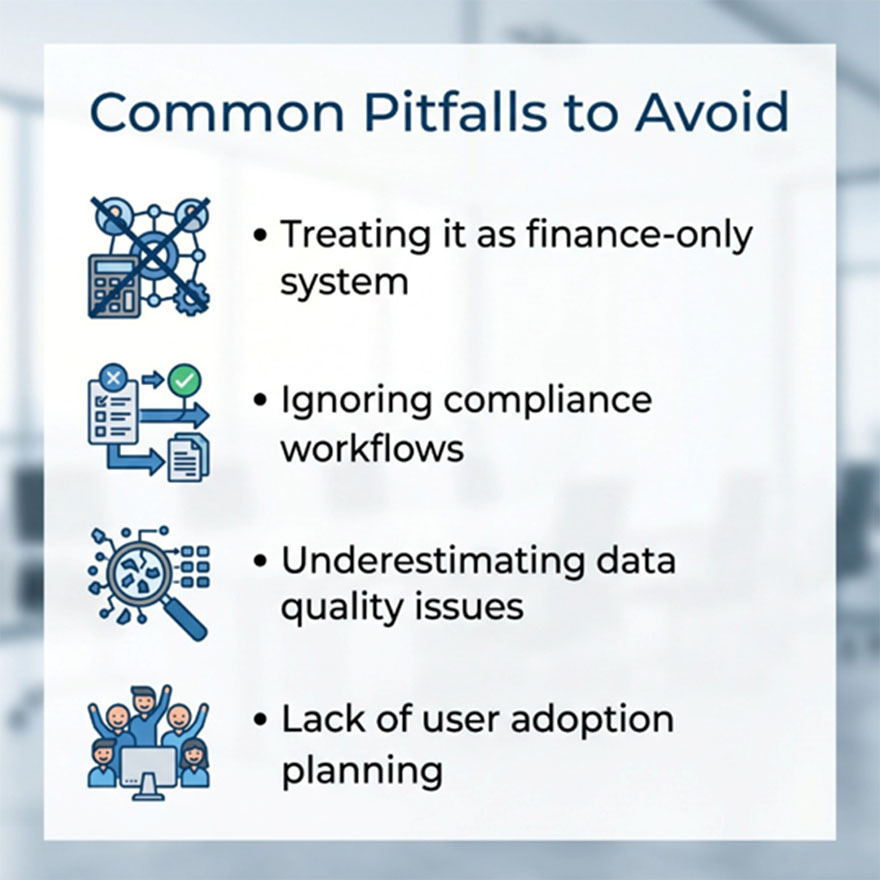
- Treating it as a finance-only system- This limits the system’s impact. Business Central should support operations, compliance, and supply chain management, not just accounting.
- Ignoring compliance workflows during implementation- This creates gaps in traceability and audit readiness, which are more difficult to address later.
- Underestimating data quality issues- Poor or inconsistent data compromises reporting, inventory accuracy, and decision-making from the start.
- Lack of user adoption planning- Without proper training and change management, teams may revert to old processes, which undermines the entire investment.
Get More from Business Central Right from Day One
Avoid common pitfalls with a partner that brings industry expertise and proven implementation approach.
Future-Proofing Pharma Distribution with Business Central
The adoption of AI and data-driven operations is now essential, as these approaches are already delivering measurable results across pharmaceutical supply chains. Organisations integrating these capabilities into ERP systems such as Microsoft Dynamics 365 Business Central are achieving faster, more resilient, and scalable operations.
Integration with Advanced Analytics
Advanced analytics using Power BI enables more accurate forecasting, improving forecast accuracy for up to 90% of products in certain pharmaceutical use cases. This drives better planning and faster decision-making.
Scalability for Growth and Acquisitions
Data-driven pharmaceutical organisations are achieving 15–30% EBITDA improvement through advanced analytics and operational efficiency gains.
Readiness for Evolving UK/EU Compliance Requirements
With 92% of pharmaceutical executives prioritising AI and 70% expecting ROI within two years, the move toward intelligent, compliant systems is accelerating. As a result, future-ready ERP has become a strategic necessity.
As demand volatility and regulatory expectations increase, future-proofing is less about adopting new technologies and more about building a connected, intelligent operating model that can adapt at scale.
Conclusion
For UK pharmaceutical distributors, the focus has shifted from basic operations to controlling risk, protecting margins, and scaling confidently. Compliance, efficiency, and real-time visibility are now essential for business success.
Microsoft Dynamics 365 Business Central integrates these elements, enabling a shift from reactive management to proactive, data-driven control. It is more than an ERP upgrade; it is a platform designed to reduce compliance risk, optimise inventory, and support sustainable growth. However, the true impact depends on effective implementation.
This is where Mercurius IT stands out. With deep expertise in Business Central and regulated industries, they help pharmaceutical distributors align technology with compliance needs and business goals, ensuring you don’t just implement ERP, but unlock its full value.
The right system provides a strong foundation. The right partner ensures it delivers results.
Frequently Asked Questions
What is the cost of implementing Microsoft Dynamics 365 Business Central for pharma distributors?
Implementation costs generally depend on the number of users, required customisation, and compliance obligations. For mid-sized distributors, Microsoft Dynamics 365 Business Central should be considered an investment in reducing compliance risk, inventory losses, and operational inefficiencies, rather than solely a software expense.
How long does implementation usually take?
A standard implementation typically requires three to six months, depending on data complexity, regulatory validation, and integration requirements. Employing a phased rollout reduces risk and facilitates smoother adoption.
Will Business Central support MHRA and GDP compliance requirements?
With appropriate configuration and partner support, Microsoft Dynamics 365 Business Central enables batch traceability, audit trails, and controlled workflows in alignment with Medicines and Healthcare products Regulatory Agency (MHRA) and Good Distribution Practice (GDP) guidelines.
Is Business Central scalable as the business grows or expands?
Microsoft Dynamics 365 Business Central is designed for scalability, supporting multi-location operations, increased transaction volumes, and business acquisitions without necessitating a system overhaul.