
Quick Summary
Explore a detailed comparison of Business Central vs Odoo, covering features, pricing, scalability, integrations, and long-term value to help growing businesses choose the right ERP platform.
Key Takeaways
- Business Central is built for scale, strong compliance, governance and enterprise-grade operations.
- Odoo’s open-source software foundation allows for high customisation, but this can lead to additional costs and complexity as businesses scale and evolve.
Choosing the right ERP system can make or break how efficiently your business operates, scales, and stays compliant in an increasingly competitive landscape. In fact, 77% of small and mid-sized businesses rely on ERP systems primarily to standardize and streamline back-office operations, which is a clear sign of how central these platforms have become to growth and operational visibility.
Among the many options available today, Microsoft Dynamics 365 Business Central and Odoo stand out as two of the most talked-about choices for growing companies. Business Central brings the power of Microsoft’s ecosystem, familiar interfaces, coupled with enterprise-grade finance, supply chain, and analytics capabilities. Odoo, on the other hand, attracts businesses with its modular, open-source flexibility and affordable entry point that’s especially appealing for lean teams.
At a glance, both solutions aim to centralise your business processes and eliminate data silos. But they differ significantly in architecture, pricing structure, scalability, and ecosystem integration, factors that can dramatically influence your long-term success.
In this blog, we’ll walk you through a comprehensive comparison of Business Central vs Odoo, covering key areas like features, pricing, usability, scalability, and return on investment. So, you can confidently choose the ERP solution that fits your business best.
Quick Differences: Business Central vs Odoo at a Glance
Before diving into detailed features and technical capabilities, let us look at both platforms from a high-level business perspective. The table below offers a quick differences of Business Central vs Odoo, highlighting how they differ in varied aspects.
| Parameter | Microsoft Dynamics 365 Business Central | Odoo ERP |
|---|---|---|
| ERP Type | Cloud-first ERP built on Microsoft Azure with enterprise-grade controls | Modular, open-source software ERP with optional enterprise features |
| Target Business Size | Small to mid-market businesses planning structured growth | Startups and small businesses with flexible, evolving needs |
| Deployment Options | Cloud and on-premises, with strong cloud optimisation | Cloud, on-premises, and self-hosted deployments |
| Customisation Approach | Extension-based customisation that protects upgrades and preserves core code integrity | Deep code-level customisation through open-source modules |
| Pricing Model | Predictable, subscription-based licensing per user | Free community edition and flexible subscription pricing per module, but costs increase with more users and modules |
| Ideal Use Case | Businesses seeking scalability, compliance, and ecosystem stability | Businesses prioritising flexibility and cost control at early stages |
| App Ecosystem | Integrated Microsoft ecosystem, with vetted add-ons | Vast modular app store and third party apps via APIs and addons |
| Support | Official Microsoft support and partner network | Support varies by version and implementation |
| Implementation | Available through Microsoft and third-party implementation partners | Available through Odoo and third-party implementation partners |
| Rollout | Typically full-suite deployment | Allows phased rollout, enabling organisations to implement modules as needed |
Both Business Central and Odoo promise centralised operations, but they serve very different business priorities. While one emphasizes long-term scalability and governance, the other focuses on modular flexibility and cost accessibility. It’s a distinction that becomes more evident as we explore their features, architecture, and total cost of ownership in the sections ahead.
Still unsure whether Business Central or Odoo is right for your business?
Get an expert-led assessment tailored to your processes, growth plans, and long-term ERP goals.
Key Differences Between Business Central and Odoo
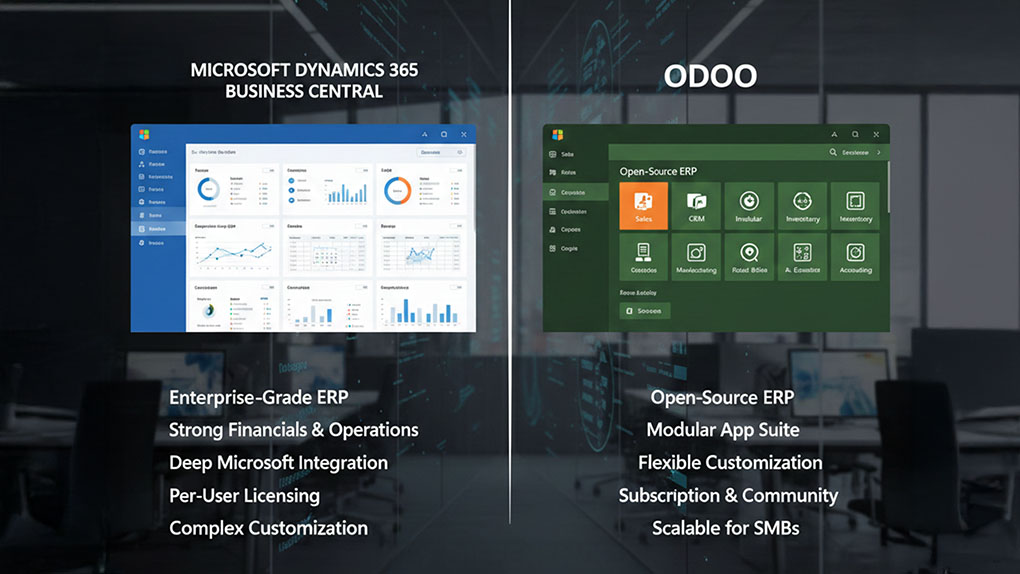
Choosing between Dynamics 365 BC and Odoo is a big decision for companies, especially those seeking strategic alignment and operational efficiency. This section explores a thorough comparison of Dynamics 365 BC and Odoo in a number of important areas.
Ease of Implementation
The onboarding process with Business Central is facilitated with clearly defined Microsoft training materials, like as user manuals, FAQs, and video tutorials. New users can more easily grasp the intricacies of the system thanks to this planned learning path, which offers a steady learning curve. For businesses that wish to deploy the system independently, this is crucial.
Odoo’s enormous community, which includes several forums, blogs, and wikis, tremendously aids in its adoption. Although this provides a multitude of viewpoints and practical solutions, new users might need to be more proactive. The learning process will become more complicated as they will have to actively search for material that might be dispersed across several platforms.
Key Capabilities
As a part of Microsoft Dynamics 365, Business Central provides robust features, such as warehouse management, supply chain management, finance management, seamless customisations, connectivity with native and third-party integrations, and more, to manage the entire company from a single dashboard.
While Odoo and D365 Business Central provide nearly identical features, Odoo’s capabilities fall short. Furthermore, there are no native connectors accessible to raise productivity and efficiency levels.
User Interface
D365 Business Central is the best when it comes to providing a user-friendly interface. Users don’t need a Microsoft Certified Dynamics 365 implementation partner to comprehend the entire solution.
BC’s user interface is simpler than Odoo’s. The user will want training from a partner to comprehend the usability because the functions and options are not positioned correctly. In Odoo, the user interface and functionalities can vary significantly between modules, which may lead to inconsistencies in user experience. Odoo does offer a modern, modular user interface, but its consistency can vary between different modules.
Planning to scale and want an ERP that grows with you?
Our Business Central specialists help you evaluate, implement, and optimise ERP for sustainable growth.
Support
Business Central’s extensive network of approved partners makes it accessible everywhere. Microsoft office has more than 70 recognised partners in the UK alone, some of which, like Mercurius IT, are award-winning certified partners. If you experience any problems with your current Microsoft ERP or CRM, you can obtain immediate and comprehensive support by contacting any partner.
There aren’t many Odoo certified partners in the UK, so you can have to deal with a lot of problems when trying to get your company back on track with immediate support.
Customisation & Flexibility
Business Central provides low-code customisation using the Microsoft Power Platform (Power Automate, Power Apps) and AL extensions. It is perfect for small and medium businesses that desire agility without jeopardising system stability because it is structurally flexible. Extensions in Business Central are designed to avoid changes to the core code, ensuring safe upgrades and preserving the integrity of the underlying system.
Odoo is notable for its extensive customisation capabilities, particularly in its Community Edition, where developers can customise almost every feature with complete access to source code. Odoo’s open-source nature allows for a high level of customisation, but this flexibility can increase costs and complexity as businesses scale and evolve. Modifying Odoo’s core code can complicate future updates, as custom developments are not included in future releases from Odoo.
Data Security and Compliance
With Microsoft’s longstanding reputation for enterprise software supporting it, security is a key component of Business Central. It offers an additional layer of protection for companies worried about data integrity by adhering to a variety of industry standards and laws, including data encryption and compliance certificates.
With built-in safeguards and GDPR compliance, Odoo also takes security seriously, but its reach might not be as extensive as BC’s. Business Central’s capabilities could be crucial for companies that must adhere to numerous rules.
Integration Capabilities
When it comes to seamless integration capabilities, this is where Microsoft shines. Outlook, Teams, Excel, Power BI, and other Microsoft tools are all natively integrated with Business Central. It’s a real plug-and-play ecosystem that improves daily workflows and reduces IT overhead.
Although Odoo provides connections for widely used tools and allows API-based integrations, it may need third-party middleware to communicate with popular platforms like Office 365 or Google Workspace.
Deployment Type
Business Central can be deployed on cloud servers using Microsoft Azure to offer data availability in real-time. Also, if you have data concerns, you can deploy Business Central using on-premises servers. Odoo offers a web-based platform that can only be accessed via a cloud-based ERP deployment.
Total Cost of Ownership
One of the features of Business Central is its predictable, subscription-based pricing model. This allows for more efficient budgeting as businesses can anticipate their monthly or annual expenditure without worrying about unexpected charges. This transparency in pricing facilitates clear budgeting and control of the implementation project.
Odoo starts with a freemium model, which may seem attractive and inexpensive at first glance. Odoo’s subscription pricing is flexible, allowing businesses to pay only for the modules they use, but costs can increase as more users and modules are added. The reality is that businesses often need additional costs for hosting, customisation, maintenance, and support, which can significantly increase the total cost of ownership. Therefore, what starts as a budget-friendly solution can turn into a more expensive one as your business scales.
Concerned about ERP costs beyond licensing?
Understand the true total cost of ownership for Business Central vs Odoo before you commit.
How to Decide Which Option Fits Your Needs: Business Central vs Odoo?
If your manufacturing business values advanced planning, strong financial control, and works well with Microsoft products, Dynamics 365 Business Central offers clear long-term benefits.

While it costs more upfront, lower maintenance and easier upgrades make it a cost-effective option for businesses focused on growth. Choose Business Central if you need enterprise-grade ERP, advanced reporting, Microsoft ecosystem integration, and long-term scalability.
On the other hand, if your processes are extremely niche and demand high levels of customisation, Odoo’s flexibility could be appealing, provided you’re prepared to manage the associated upgrade complexities. Choose Odoo if you want a budget-friendly, open-source solution with flexibility and don’t mind managing customisations in-house.
Bottom Line
When you compare Business Central vs Odoo, the real difference isn’t just about features. It is about where your business is headed. Both systems help streamline operations, but they are built with different goals in mind. One focuses on structured growth, control, and scalability, while the other is intended toward flexibility and modular freedom.
As a business expands, essentials like compliance, system reliability, smooth integrations, and overall cost over time become more important than the initial setup cost. This is where Microsoft Dynamics 365 Business Central stands out. It is a highly structured, enterprise-grade ERP solution that offers a stable, future-ready ERP platform designed to support growth without adding complexity or risk.
In fact, choosing the right ERP is only the first step. The real value comes from how well the system is implemented and supported over time. Working with a trusted Microsoft partner, like Mercurius IT, ensures that your Business Central implementation is reliable and fully supported, helping businesses turn Business Central into a solution that delivers real results and continues to evolve as business needs change.
Frequently Asked Questions
Which ERP is more suitable for small and medium-sized businesses?
Business Central and Odoo both serve small and medium-sized enterprises. Businesses looking for an affordable, open-source solution with customisable options will find Odoo to be perfect. Business Central is a cloud-based ERP that is fully integrated with AI-driven automation, making it appropriate for companies seeking a more organised and scalable solution within Microsoft’s ecosystem.
What's the real cost difference between Business Central and Odoo?
Business Central offers predictable monthly subscriptions, typically ranging from £50 to £150 per user monthly. Odoo starts free, but custom development and hosting can quickly add £10,000+ annually for medium businesses.
Can I switch from Odoo to Business Central later?
Yes, but data migration requires planning. Business Central’s migration tools help, though complex customisations in Odoo can complicate the process. Factor in 2-3 months for a smooth transition.
Which system handles UK compliance better, Business Central or Odoo?
Business Central includes UK-specific features like Making Tax Digital compliance and UK payroll out the box. Odoo requires additional modules and configuration for UK regulatory requirements.
Business Central or Odoo, which provides better reporting capabilities?
Business Central integrates natively with Power BI, offering advanced analytics and real-time dashboards. Odoo includes basic reporting, with advanced analytics requiring additional modules or third-party tools.
How do updates and maintenance differ in Business Central and Odoo?
Microsoft handles all updates and maintenance for Business Central cloud-based versions automatically. Odoo requires you to manage updates, test customisations, and handle maintenance, either internally or through partners.
Is Dynamics 365 ERP suitable for small businesses?
Yes, Dynamics 365 Business Central is specifically designed for small and medium-sized businesses looking for a scalable and user-friendly ERP.
Which ERP is easier to customise, Business Central or Odoo?
Odoo offers more open-source flexibility, while Business Central focuses on upgrade-friendly customisations through extensions.
Which ERP provides better security and compliance?
Odoo offers industry-standard security measures and compliance frameworks to meet tax regulations and data protection standards. Business Central benefits from Microsoft’s Azure security infrastructure, ensuring robust protection of business data while maintaining compliance with global regulatory standards.
Get Expert Advice on Business Central vs Odoo