
Quick Summary
AI-powered automation in Microsoft Dynamics 365 helps large organisations see real returns by taking over manual, repetitive tasks and using data-driven processes instead.Key Takeaways
- AI automation in Dynamics 365 enables enterprises to move from manual to predictive, data-driven operations.
- Built-in AI, Copilot, and agents automate workflows, improve decisions, and reduce operational inefficiencies.
- Real-world use cases across supply chain, finance, sales, service, and field operations deliver measurable ROI.
- Enterprises can reduce costs, improve accuracy, and enhance customer experience through AI-powered automation.
- A strategic, phased approach with strong data foundations maximises ROI from Dynamics 365 AI adoption.
Today’s enterprise operations handle large amounts of data, transactions, and decisions in areas like finance, supply chain, sales, and customer service. Still, many organizations face challenges with manual work, scattered data, and outdated systems that slow things down and make it hard to see the full picture.
This is the place where AI automation for business operations is making a significant impact. With AI automation in Dynamics 365, enterprises can move beyond reactive workflows to predictive and intelligent operations. By enabling AI-powered automation with Dynamics 365, organisations can embed intelligence directly into everyday processes. This helps teams automate tasks, improve decision-making, and optimise performance at scale.
In this blog, we’ll explore how enterprises are using AI automation in Dynamics 365 and the real ROI-driven use cases transforming large-scale operations.
Understanding AI Automation in Dynamics 365
AI automation in enterprise ERP and CRM systems goes beyond simple task automation. In Dynamics 365, AI is embedded directly into business workflows to analyse data, predict outcomes, and automate operational decisions. This allows organisations to move from manual, reactive processes to smarter, data-driven operations.
What AI Automation Looks Like in Enterprise ERP and CRM?
In enterprise settings, AI tools in Dynamics 365 Business Central improves key operations by:
- Workflow automation to streamline business processes like invoice processing and approvals
- Predictive insights for demand forecasting and sales planning
- Anomaly detection to identify unusual financial or operational activities
- Intelligent recommendations that guide sales, finance, and service teams
- Autonomous decision support that triggers actions based on real-time data
For example, businesses use AI-powered automation in Dynamics 365 to forecast supply chain demand, automate financial reconciliation, and solve customer issues more quickly. This transforms traditional ERP and CRM systems into smart platforms for large enterprises.
The Role of AI Copilot and AI Agents in Dynamics 365
Microsoft Copilot and AI agents in Dynamics 365 bring intelligence directly into everyday business workflows. Instead of manually analysing data or performing repetitive tasks, teams can rely on AI automation with Dynamics 365 for enterprises to generate insights, automate routine work, and trigger actions in real time.
For example, Copilot capabilities in finance can help analyse financial data and automate reconciliation. In sales, Microsoft Copilot can suggest the next best steps for opportunities. In customer service, it can recommend responses and help resolve cases more quickly. AI agents can also start automated workflows when certain conditions are met, which means less manual work for teams.
The impact is already visible across organisations. In fact, studies show that 78% of businesses using Copilot report productivity improvements, as AI provides teams with actionable insights, automates tasks, and enables faster decision-making.
By using AI-powered automation in Dynamics 365, businesses can become more intelligent, responsive, and able to grow more easily.
Key AI Automation Capabilities in Dynamics 365 for Enterprises
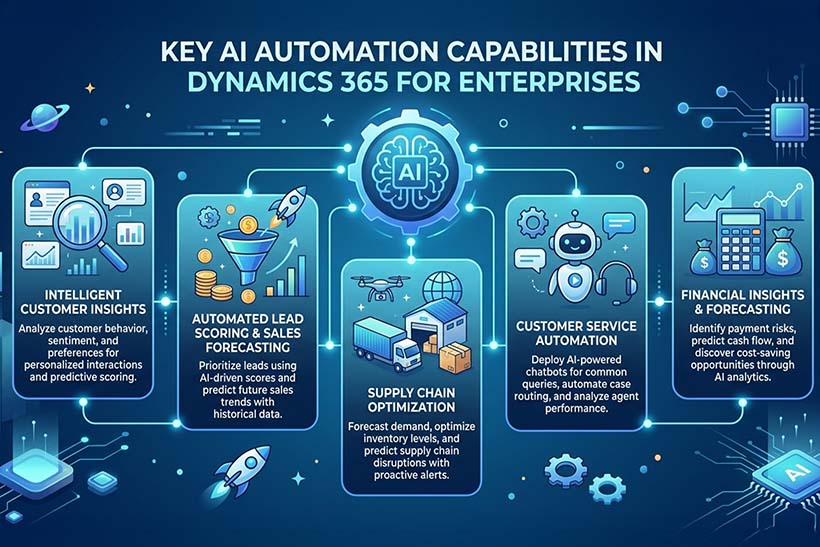
Modern enterprises are adopting AI automation with Dynamics 365 to accelerate, optimise, and predict operations. By embedding AI across ERP systems and CRM data, Dynamics 365 enables organisations to automate decisions, detect risks early, and optimise workflows at scale.
Core AI Automation Capabilities
- Predictive analytics for operational decisions– Use historical and real-time data to predict demand, customer behaviour, and operational risks.
- Intelligent workflow automation- Automate routine processes like approvals, order management, and financial reconciliation.
- Anomaly detection in financial and operational data- Identify unusual transactions, fraud risks, or operational disruptions early.
- AI-driven forecasting and planning- Improve the accuracy of demand forecasting, budgeting, and inventory planning.
- Natural language AI assistants (Copilot)- Natural language understanding allows users to query business data, generate reports, and automate tasks using simple prompts.
- Autonomous agents for task execution- AI agents trigger actions automatically based on predefined rules and data signals.
- Data-driven decision recommendations- Provide contextual insights to help leaders make faster and more informed decisions.
Together, these capabilities enable enterprises to move beyond traditional automation and build autonomous operations that continuously optimise performance and decision-making.
Are you fully leveraging AI in your CRM, or just scratching the surface?
Discover how leading enterprises are transforming customer engagement with AI and automation in Dynamics 365 CRM.
Real AI Automation Use Cases in Large-Scale Operations
AI automation brings the most value to business operations when used in large & complex enterprise processes. Even small improvements in these areas can have a big financial impact. With Dynamics 365 automation solutions, organisations can automate planning, identify disruptions early, and improve operations across departments. This leads to clear efficiency gains and a measurable return on investment.
1. Supply Chain and Inventory Optimisation
Large enterprises often face challenges like unpredictable demand, excess inventory, supply disruptions, and inefficient planning. With AI-powered features, Dynamics 365 helps by providing demand forecasting, automated restocking plans, supplier risk alerts, and better logistics. AI reviews operational data in real time to predict demand and automatically manage inventory and supply chain actions.
AI-powered forecasting significantly improves planning accuracy, increases efficiency, and supply chain responsiveness. According to McKinsey & Company, AI in supply chain management can lessen manual effort and reduce errors by 20–50%.
Measurable ROI in Supply Chain & Management
Better forecasting and automated inventory decisions help enterprises reduce working capital tied up in inventory and improve order fulfilment performance.
2. Finance Operations and Autonomous Accounting
Finance teams in large enterprises often spend significant time on manual reconciliation, invoice processing delays, and correcting reporting errors. With AI-powered automation in Dynamics 365, finance teams can automate invoice matching, reconciliation workflows, anomaly detection in financial transactions, and AI-driven financial forecasting. AI continuously analyses financial data and flags discrepancies or risks before they affect reporting.
According to PWC, organisations using AI agents in finance can gain up to 40% improvement in forecasting accuracy and speed.
Measurable ROI of AI based Dynamics 365 in Finance and Operations
By automating core finance operations using Dynamics 365 Finance, enterprises can lower operational costs, reduce manual workloads, and gain greater financial visibility for more informed strategic decision-making.
Missed the live session? Catch the insights that matter
Watch how AI-powered Dynamics 365 is transforming finance and supply chain operations for enterprises.
3. Customer Service and Intelligent Support
Enterprise support teams often face high ticket volumes, slow response times, and inconsistent service quality. These issues can harm customer experience and operational efficiency.
By using Dynamics 365 Business Central, companies can sort cases, send automatic replies, suggest helpful information, do faster case resolutions, and offer AI chat support. IBM reports that 70% of customer service managers worldwide now use generative AI to understand how customers feel.
Measurable ROI
By automating routine support tasks and speeding responses with Dynamics 365 customer service, enterprises can reduce service costs per ticket while improving customer satisfaction and overall support performance. In fact, conversational AI directly interacting with external customers has reduced cost per contact by 23.5% and increased annual revenue by 4% on average.
4. Sales Productivity and Agentic CRM
Sales teams in large enterprises often struggle with inefficient pipeline management, low sales productivity, and missed revenue opportunities due to manual tracking and limited visibility. AI-powered automation in Dynamics 365 provides sales teams with predictive lead scoring, automated follow-ups, AI-driven sales recommendations, and pipeline risk alerts. This AI-driven sales intelligence helps teams focus on the most promising deals, manage sales orders, and improve sales efficiency. According to McKinsey & Company, organisations using AI in sales can increase leads and appointments by more than 50% and reduce sales call time by up to 70%.
Measurable ROI
By automating pipeline insights and sales activities, enterprises can accelerate deal cycles, improve conversion rates, and significantly increase revenue productivity.
5. Field Service and Predictive Maintenance
Enterprises that rely on physical assets often face unplanned equipment downtime and inefficient technician scheduling. This leads to service disruptions, higher maintenance costs, and reduced operational efficiency.
Using AI automation in Dynamics 365, organisations can set up predictive maintenance, automate service scheduling, and use remote diagnostics. IoT sensors on machinery send real-time performance data to Dynamics 365 Field Service. The system uses AI to identify potential failures early, then schedules maintenance and automatically sends technicians.
Measurable ROI in Microsoft Dynamics 365 for Field Service
By stopping unexpected breakdowns and improving technician scheduling, companies can cut maintenance costs and boost both asset performance and service efficiency.
Measuring the ROI of AI Automation in Dynamics 365
For enterprise leaders, the biggest question around AI adoption is whether it delivers measurable business value. The ROI of AI automation in Dynamics 365 goes beyond cost savings. It improves operational efficiency, financial performance, decision-making, and customer experience.
| ROI Dimension | How AI Automation Delivers Value |
|---|---|
| Operational Efficiency | Automates repetitive tasks and reduces manual processes, enabling faster operational cycle times and improved productivity. |
| Financial Performance | Optimizes operational workflows across finance, sales, and supply chain, helping organizations reduce operational costs and improve revenue productivity. |
| Decision Quality | Provides predictive insights and real-time analytics that enable leaders to make faster, data-driven strategic decisions. |
| Customer Experience | AI-powered automation improves response times, service efficiency, and issue resolution, leading to stronger customer satisfaction and retention. |
Turn AI Automation Into Measurable Business Value
Build smarter workflows, improve operational visibility, and scale enterprise performance with Dynamics 365 AI automation.
Best Practices to Maximise ROI from AI Automation in Dynamics 365
A strategic and phased approach is essential for successful AI automation. Organisations that target high-impact processes, establish strong data foundations, and use scalable models achieve the highest ROI in Dynamics 365 Business Central.
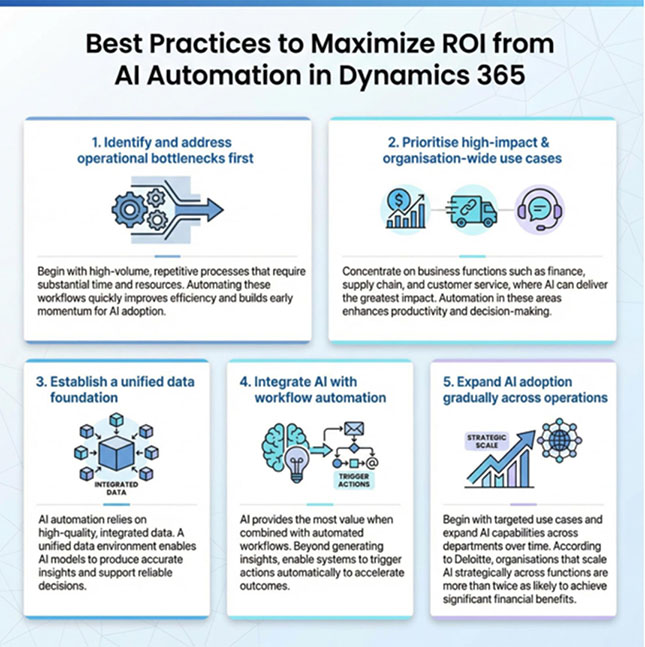
- Identify and address operational bottlenecks first – Begin with high-volume & repetitive processes that require substantial time and resources. Automating these workflows quickly improves efficiency and builds early momentum for AI adoption.
- Prioritise high-impact & organisation-wide use cases – Concentrate on business functions such as finance, supply chain, and customer service, where AI solutions can deliver the greatest impact. Automation in these areas enhances productivity and decision-making.
- Establish a unified data foundation – AI automation relies on high-quality, integrated data. A unified data environment enables AI models to produce accurate insights and support reliable decisions.
- Integrate AI with workflow automation – AI implementation provides the most value when combined with automated workflows. Beyond generating insights, enable systems to trigger actions automatically to accelerate outcomes.
- Expand AI adoption gradually across operations – Begin with targeted use cases and expand AI capabilities across departments over time. According to Deloitte, organisations that scale AI strategically across functions are more than twice as likely to achieve significant financial benefits.
The Future of Enterprise Operations: Autonomous Businesses
The future of artificial intelligence in Microsoft Dynamics 365 seems quite bright, with several exciting innovations coming up.
Microsoft intends to progressively include artificial intelligence into every Dynamics 365 business process and workflow. In fact, it is all set to include artificial intelligence agents in business applications increasingly in the future, hence changing how these programs operate and interact with people.
Enterprise operations are moving beyond traditional automation toward Agentic AI systems that can anticipate issues, optimise processes, and act in real time. Platforms like Dynamics 365 are enabling organisations to embed AI directly into daily operations.
With AI automation, businesses are shifting toward predictive operations, self-optimising supply chains, autonomous financial processes, and more intelligent customer engagement. This allows leaders to respond faster to disruptions, improve operational efficiency, and scale decision-making across the enterprise.
This trend is picking up speed. McKinsey & Company reports that organisations using AI widely across their business are more than twice as likely to see major revenue growth from their AI investments.
By using Dynamics 365, companies can get closer to fully autonomous operations, where systems keep learning, improve performance, and help make better decisions across the business.
AI Automation Is Reshaping Enterprise Operations
Discover how organisations are improving finance, supply chain, sales, and service performance with Dynamics 365 AI.
Conclusion
AI automation is changing the way large companies handle complex tasks. With Dynamics 365, organisations can move from reacting to problems to using data to predict and solve them. By adding artificial intelligence to different business areas, companies can work more efficiently, make faster decisions, and see real results.
As a trusted Microsoft Dynamics partner, we help organisations get the most out of built-in AI automation in Dynamics 365. Our team supports you from planning and setup to ongoing improvements, working together to create smart solutions that boost efficiency, flexibility, and growth.
Frequently Asked Questions
What is AI automation in Dynamics 365?
AI automation in Dynamics 365 combines AI, machine learning, Copilot, and workflow automation to improve operational efficiency and automate business processes.
How does AI automation improve enterprise operations?
AI automation improves forecasting, reduces manual tasks, accelerates workflows, and enables faster data-driven decisions across departments.
What business areas benefit most from Dynamics 365 AI automation?
Finance, supply chain, customer service, sales, and field operations benefit significantly from AI-powered automation and predictive insights.
What is the role of Copilot in Dynamics 365 automation?
Copilot helps users automate tasks, analyse business data, generate insights, and improve operational decision-making using natural language AI.