
Quick Summary
Dynamics 365 FSCM automates finance operations to improve accuracy, accelerate reporting, strengthen compliance, and increase operational efficiency.Key Takeaways
- Automate invoice processing and approvals to reduce finance delays.
- Improve cash flow visibility with AI-driven forecasting capabilities.
- Reduce reconciliation effort using intelligent financial automation.
- Strengthen compliance with automated tax and reporting processes.
- Streamline global finance operations with intercompany automation.
A recent CFO survey found that nearly 90% of finance leaders view manual processes and limited automation as key obstacles to an efficient financial close. As transaction volumes, compliance demands, and reporting requirements grow, finance teams face increasing pressure to improve accuracy, reduce delays, and achieve real-time financial visibility.
This is where automation in Microsoft Dynamics 365 Finance & Supply Chain Management offers a strategic advantage. By automating invoice processing, approvals, reporting, reconciliations, and cash flow management, businesses can improve efficiency and enable finance teams to focus on higher-value activities.
This blog explores top finance automation strategies in Dynamics 365 FSCM to help organisations reduce manual effort, improve accuracy, and enhance operational efficiency.
Finance Automation Strategies in Dynamics 365 FSCM to Improve Efficiency
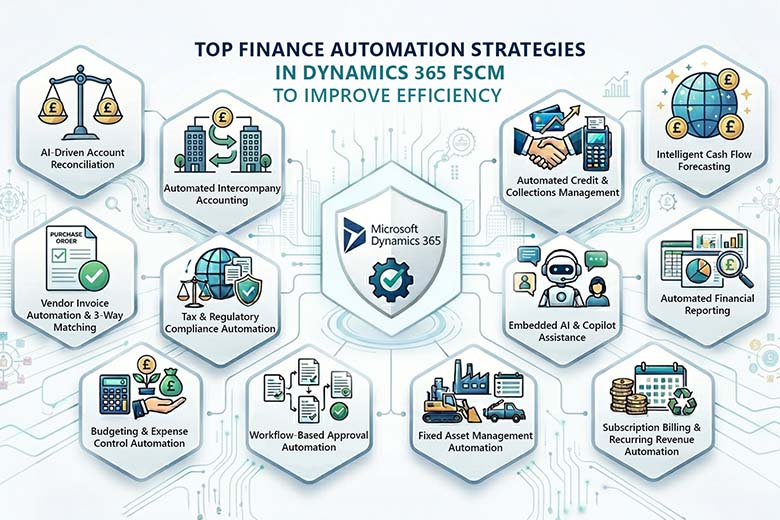
Modern finance teams must handle growing transaction volumes, maintain compliance, enhance reporting accuracy, and deliver timely business insights while controlling costs. Dynamics 365 Finance & Supply Chain Management (FSCM) enables organisations to automate repetitive financial processes, support better decision-making, and build a more agile, scalable finance function. Below are key finance automation strategies that can improve efficiency and financial control.
1. Vendor Invoice Automation & 3-Way Matching
Manual invoice processing can cause delays, duplicate entries, and approval bottlenecks. Dynamics 365 FSCM automates invoice capture and validates invoices using 3-way matching with purchase orders, receipts, and invoices. This reduces manual effort, increases accuracy, and speeds up payment cycles.
2. AI-Driven Account Reconciliation
Manual reconciliation of bank accounts, ledgers, and subledgers can delay month-end closing. Dynamics 365 FSCM uses AI to match transactions, identify anomalies, and highlight exceptions for review. This reduces reconciliation effort and enables faster book closing.
3. Automated Credit & Collections Management
Delayed customer payments affect cash flow and operational planning. Dynamics 365 FSCM automates collections using predefined rules, customer risk scoring, payment reminders, and collection workflows. Finance teams gain better control over receivables and improve payment recovery timelines.
Modernise finance operations with intelligent automation.
Reduce manual effort, improve visibility, and accelerate financial processes with Dynamics 365 FSCM.
4. Intelligent Cash Flow Forecasting
Limited visibility into future cash positions complicates financial planning. Dynamics 365 FSCM leverages historical trends, open transactions, and predictive insights to forecast cash inflows and outflows more accurately. This enables finance leaders to make proactive decisions on liquidity, investments, and spending.
5. Automated Intercompany Accounting
Managing financial transactions across multiple legal entities is complex without automation. Dynamics 365 FSCM streamlines intercompany accounting by automating postings, settlements, eliminations, and currency adjustments. This reduces reconciliation errors and improves financial consistency across global operations.
6. Tax & Regulatory Compliance Automation
Frequent tax regulation changes create compliance risks for finance teams operating in multiple regions. Dynamics 365 FSCM automates tax calculations, supports country-specific compliance, and standardises reporting. This reduces compliance gaps and minimises manual corrections.
7. Embedded AI & Copilot Assistance
Finance users often spend considerable time on reports, workflows, and repetitive tasks. With Microsoft Copilot in Dynamics 365 FSCM, users can generate reports, access financial insights, automate routine actions, and receive workflow guidance using natural language prompts. This increases productivity and simplifies daily financial operations.
8. Automated Financial Reporting
Manual financial reporting is time-consuming and increases the risk of inconsistencies. Dynamics 365 FSCM automates report generation by consolidating financial data in real time across departments and entities. Finance leaders gain faster access to accurate insights for strategic and regulatory reporting.
9. Budgeting & Expense Control Automation
Manual budget tracking limits visibility into overspending and inefficiencies. Dynamics 365 FSCM provides automated budget monitoring, approval workflows, and expense policy enforcement. This supports stronger financial discipline and better cost management.
10. Workflow-Based Approval Automation
Manual approval chains for invoices, expenses, and financial requests can slow finance operations. Dynamics 365 FSCM enables organisations to set up automated approval workflows based on predefined rules, hierarchy, and thresholds. This increases process consistency and reduces approval delays.
11. Fixed Asset Management Automation
Manual management of asset acquisition, depreciation, transfers, and disposal can cause accounting inaccuracies. Dynamics 365 FSCM automates the fixed asset lifecycle, ensuring accurate depreciation, asset tracking, and compliance reporting with minimal manual effort.
12. Subscription Billing & Recurring Revenue Automation
Businesses with recurring revenue models often face challenges with manual billing and revenue recognition. Dynamics 365 FSCM automates recurring invoicing, payment schedules, and revenue recognition, helping organisations improve billing accuracy and financial transparency.
Build a more agile and scalable finance function.
Implement Dynamics 365 FSCM to improve financial accuracy, control, and operational efficiency.
Conclusion
Finance automation has become a critical priority for organisations looking to improve operational efficiency, reduce manual workloads, and strengthen financial decision-making. With advanced capabilities in AI-driven forecasting, automated reconciliations, compliance management, and intelligent workflows, Microsoft Dynamics 365 FSCM enables finance teams to operate with greater accuracy, agility, and control.
However, achieving long-term value from finance automation depends on selecting the right implementation approach and technology partner. Mercurius IT helps businesses successfully implement and optimise Dynamics 365 FSCM solutions tailored to their operational and financial goals. From process automation to system integration and ongoing support, the team helps organisations build scalable and future-ready finance operations.
Frequently Asked Questions
How does Dynamics 365 FSCM improve finance automation?
Dynamics 365 FSCM automates invoice processing, reconciliations, approvals, reporting, budgeting, tax management, and forecasting. This reduces manual effort, improves accuracy, and enhances financial visibility.
What are the benefits of finance automation in Dynamics 365 FSCM?
Finance automation helps organisations reduce operational costs, improve compliance, accelerate financial close processes, strengthen cash flow management, and improve decision-making through real-time insights.
Can Dynamics 365 FSCM automate financial reporting and compliance?
Yes. Dynamics 365 FSCM automates financial reporting, tax calculations, audit trails, and regulatory compliance processes while consolidating financial data across entities in real time.
How does AI support finance operations in Dynamics 365 FSCM?
AI capabilities in Dynamics 365 FSCM help automate forecasting, account reconciliation, collections management, anomaly detection, reporting, and financial analysis to improve productivity and accuracy.
What finance processes can be automated in Dynamics 365 FSCM?
Businesses can automate invoice management, approvals, budgeting, expense control, fixed asset management, subscription billing, cash flow forecasting, intercompany accounting, and compliance reporting.
Why should businesses work with a Dynamics 365 FSCM implementation partner?
An experienced implementation partner helps configure automation workflows, optimise finance processes, integrate systems, reduce project risks, and maximise return on investment.