
Quick Summary
Dynamics 365 CRM helps B2B organisations improve sales efficiency, automate workflows, strengthen customer visibility, and drive predictable revenue through AI-powered insights and collaboration.
Key Takeaways
- Dynamics 365 CRM helps B2B teams reduce manual sales administration.
- AI-powered insights improve forecasting accuracy and sales prioritisation.
- Unified customer visibility strengthens long-term B2B relationship management.
- Workflow automation improves sales efficiency and operational consistency.
- Dynamics 365 integrates sales, service, and collaboration within one platform.
According to Microsoft, sellers dedicate up to 66% of their time to administrative tasks and email rather than direct selling. Furthermore, Gartner research cited by Microsoft indicates that 79% of sales professionals are now responsible for more accounts than in the previous year. These challenges underscore the limitations of traditional customer relationship management (CRM) systems for B2B organisations, as they often serve as data repositories rather than tools for revenue generation.
Modern buyers expect faster responses, personalised engagement, and seamless interactions at every touchpoint. Meanwhile, sales teams face longer buying cycles, larger buying committees, and more complex customer data. This is why business leaders are turning to Microsoft Dynamics 365 CRM, which offers an operational platform powered by AI, automation, analytics, and integration with the broader Microsoft ecosystem.
From AI-assisted selling with Copilot to predictive forecasting and workflow automation, this blog explores the top Dynamics 365 CRM features B2B companies actually use to improve sales efficiency, strengthen customer relationships, and drive more predictable revenue growth.
Top Dynamics 365 CRM Features B2B Companies Actually Use
The most valuable CRM features are rarely the ones that look the most sophisticated in a product demo. In reality, B2B organisations see the greatest impact from features that become part of everyday sales operations. This helps teams respond faster, collaborate better, reduce manual work, and improve visibility across the customer lifecycle. Here is how B2B companies use these tools to close deals faster and build stronger client relationships.
AI-Powered Copilot for Sales Productivity
One of the most widely adopted Dynamics 365 capabilities is Microsoft Copilot for Sales. Instead of requiring sales teams to manually prepare for meetings, draft follow-up emails, or update CRM records, Copilot assists with AI-generated opportunity summaries, meeting preparation insights, CRM record summarisation, and recommended next actions directly within the workflow.
For B2B sales teams managing large account portfolios and long buying cycles, this significantly reduces administrative overload and allows sellers to focus more on customer conversations and relationship-building.
Unified Customer Timeline & Relationship Visibility
B2B sales rarely involve a single decision-maker. Sales teams often manage multiple stakeholders, extended deal cycles, and ongoing account interactions across departments. Dynamics 365 CRM helps centralise customer records, emails, meetings, support history, opportunities, notes, and activities into a unified timeline that gives teams complete relationship visibility.
Modernise Your B2B Sales Operations with Dynamics 365
Eliminate disconnected workflows and empower teams with AI-driven sales and customer insights.
Sales Pipeline & Forecasting Dashboards
CRM value is often measured by how effectively it improves forecasting accuracy and revenue visibility. Dynamics 365 provides real-time pipeline dashboards, opportunity scoring, deal health tracking, and forecast categorisation that help leadership teams monitor sales performance more proactively.
Sales executives use these dashboards not just to review pipeline numbers, but to
- Identify stalled opportunities
- Evaluate territory performance
- Assess revenue risks
- Improve forecasting confidence
Workflow Automation & Process Standardisation
Many B2B organisations adopt Dynamics 365 CRM automation features to remove operational bottlenecks that slow down sales execution. Automated lead routing, follow-up reminders, approval workflows, notifications, and task automation help standardise processes across teams while reducing dependence on manual intervention.
Workflow automation helps organisations improve lead engagement speed, maintain SLA consistency, and reduce human error without increasing operational complexity.
Seamless Integrations with Other Microsoft Tools
One of the most practical reasons B2B organisations adopt Dynamics 365 CRM is its deep integration with Microsoft tools that employees already use daily. Sales representatives can access CRM insights in Outlook, automatically track customer emails, prepare for meetings with Teams intelligence, and update CRM records without constantly switching platforms.
This reduces workflow friction and improves CRM adoption rates significantly because users are not forced to operate inside disconnected systems. For leadership teams, this translates into better CRM data accuracy, improved user engagement, and stronger visibility into customer activity across the organisation.
Copilot Studio & Custom AI Agents
Custom AI agents can automate repetitive operational tasks, support internal processes, and directly support industry-specific workflows within the Dynamics 365 environment.
AI-Based Lead & Opportunity Prioritisation
As B2B sales pipelines grow larger and more complex, sales teams cannot realistically pursue every lead or opportunity with equal attention. Dynamics 365 uses AI-driven lead scoring, relationship insights, sales signals, and predictive recommendations to help teams prioritise opportunities with the highest potential value.
This enables sales managers to allocate resources more effectively, improve qualification speed, and focus on deals with higher conversion potential. Over time, this enhances pipeline quality and forecasting reliability.
Customer Service Integration for Relationship Retention
In enterprise B2B environments, customer relationships extend far beyond the initial sale. Dynamics 365 connects sales and customer service operations through unified account visibility, integrated case management, and account health monitoring.
In B2B settings, meeting notes, pricing discussions, and follow-up actions are automatically recorded in the account record. This improves audit trails and supports successor planning when account ownership changes.
This helps sales and account management teams identify relationship risks earlier, particularly when unresolved service issues begin affecting renewals, expansion opportunities, or long-term customer satisfaction. So, instead of operating in separate silos, sales and service teams can work from a shared understanding of the customer relationship.
Lead and Opportunity Pipeline Management
B2B sales teams leverage lead-to-opportunity conversion, stage-based pipelines, and probability tracking to manage complex, long-cycle deals. The platform centralises information on deal size, stage, next steps, and ownership, allowing managers to identify bottlenecks, such as stalled proof-of-concept stages, and deliver targeted coaching.
Sales Forecasting and Dashboards
Customisable dashboards and forecasting tools offer real-time visibility into pipeline health, revenue by stage, and territory performance. B2B sales leaders use these insights to model scenarios, monitor progress toward quotas, and adjust hiring or discounting strategies before quarter-end.
Account-Based Sales and Enrichment
Features including LinkedIn Sales Navigator integration, account scoring, and sales accelerators enable B2B teams to systematically research and prepare for key accounts. Representatives can efficiently identify decision makers, track firmographic data, and align campaigns with relevant use cases prior to each engagement.
Reporting, Power BI, and Analytics
Standard reports and Power BI connectivity enable B2B companies to analyse data by region, industry, product line, or sales stage. Sales operations teams can subsequently build dashboards on win/loss reasons, sales cycle times, and Net Promoter Score (NPS) by account to inform playbooks and relationship management strategies.
Customer Insights & Personalisation
Dynamics 365 helps organisations move beyond generic engagement by combining customer data, behavioural insights, and AI-driven analysis to create more personalised sales and marketing experiences.
D365 also integrates sales data with Customer Insights – Journeys, enabling precise tracking of marketing collateral, such as whitepapers, webinars, and landing pages, engaged by prospects before a sales call.
Using segmentation and intent analysis, businesses can identify which accounts are actively engaging with campaigns, revisiting specific products, or showing stronger buying signals. This allows sales teams to prioritise outreach more effectively and tailor conversations based on actual customer behaviour rather than assumptions.
Improve Sales Efficiency and Customer Visibility
Connect your sales, service, and operations teams through a unified Dynamics 365 CRM platform.
What Separates High-Performing Dynamics 365 CRM Deployments?
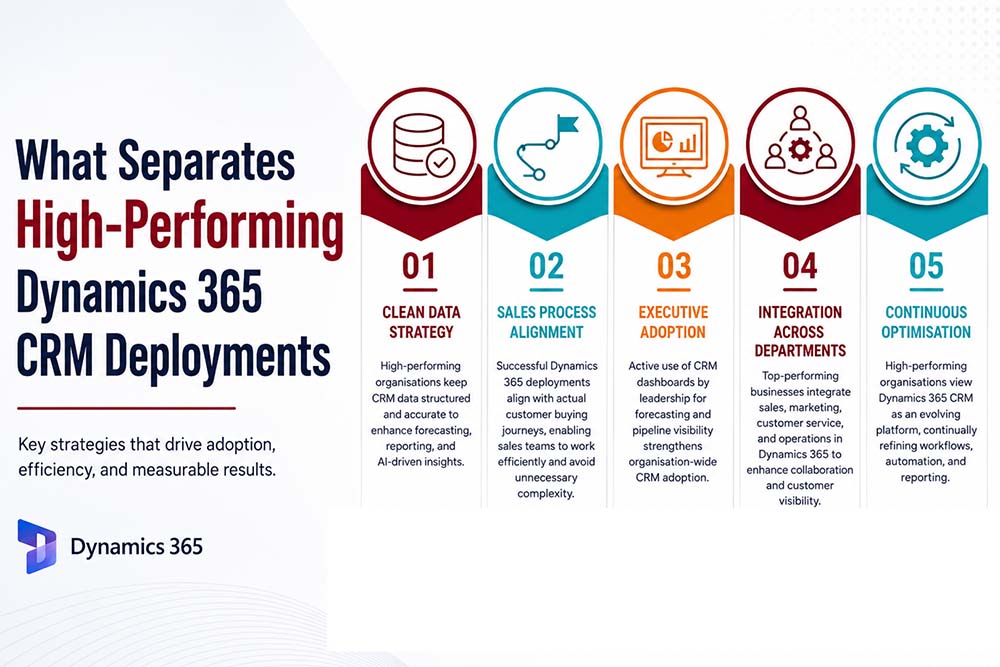
Successful Dynamics 365 CRM deployments are defined by how well the platform supports daily business operations, not by the number of features implemented. High-performing B2B companies prioritise data quality, process alignment, cross-functional collaboration, and continuous optimisation to ensure the CRM delivers measurable value over time.
- Clean Data Strategy- High-performing organisations keep CRM data structured and accurate to enhance forecasting, reporting, and AI-driven insights.
- Sales Process Alignment- Successful Dynamics 365 deployments align with actual customer buying journeys, enabling sales teams to work efficiently and avoid unnecessary complexity.
- Executive Adoption- Active use of CRM dashboards by leadership for forecasting and pipeline visibility strengthens organisation-wide CRM adoption.
- Integration Across Departments- Top-performing businesses integrate sales, marketing, customer service, and operations in Dynamics 365 to enhance collaboration and customer visibility.
- Continuous Optimisation- High-performing organisations view Dynamics 365 CRM as an evolving platform, continually refining workflows, automation, and reporting.
Conclusion
The true value of Dynamics 365 CRM lies not merely in the deployment of advanced technology, but in the effective integration of these capabilities into daily business operations. The most impactful features for B2B organisations are those that enable sales teams to operate more efficiently, enhance customer visibility, automate routine tasks, and facilitate rapid, data-driven decision-making.
However, achieving long-term CRM success requires the right strategy, aligned processes, data governance, and an adoption framework. This is where Mercurius IT supports organisations as a trusted Dynamics 365 implementation and transformation partner. This helps businesses design scalable CRM environments aligned with operational goals, user adoption, and future growth.
Transform Dynamics 365 CRM Into a Revenue Growth Platform
Develop an AI-enabled CRM strategy to enhance sales productivity, customer engagement, and operational visibility throughout the organisation.
Frequently Asked Questions
How can CRM improve B2B relationships?
CRM improves B2B relationships by helping organisations centralise customer information, track interactions across teams, and deliver more personalised engagement throughout the customer lifecycle. D365 CRM systems provide visibility into customer history, buying behaviour, support issues, and ongoing opportunities. This helps sales, marketing, and service teams communicate more consistently, respond faster, and build stronger long-term customer relationships.
What is Dynamics 365 CRM Sales?
Microsoft Dynamics 365 Sales is Microsoft’s AI-powered CRM solution designed to help businesses manage leads, opportunities, customer relationships, sales forecasting, and pipeline activities within a unified platform. It combines sales automation, customer data management, AI-driven insights, workflow automation, and Microsoft ecosystem integration to improve sales productivity and revenue visibility.
Which Dynamics 365 CRM features are most useful for B2B sales teams?
Some of the most valuable Dynamics 365 CRM features for B2B sales teams include AI-powered Copilot assistance, unified customer timelines, sales forecasting dashboards, workflow automation, lead and opportunity scoring, Outlook and Teams integration, and customer service visibility. These features help organisations reduce administrative workload, improve pipeline visibility, automate repetitive processes, prioritise high-value opportunities, and strengthen customer engagement across long and complex buying cycles.