
Quick Summary
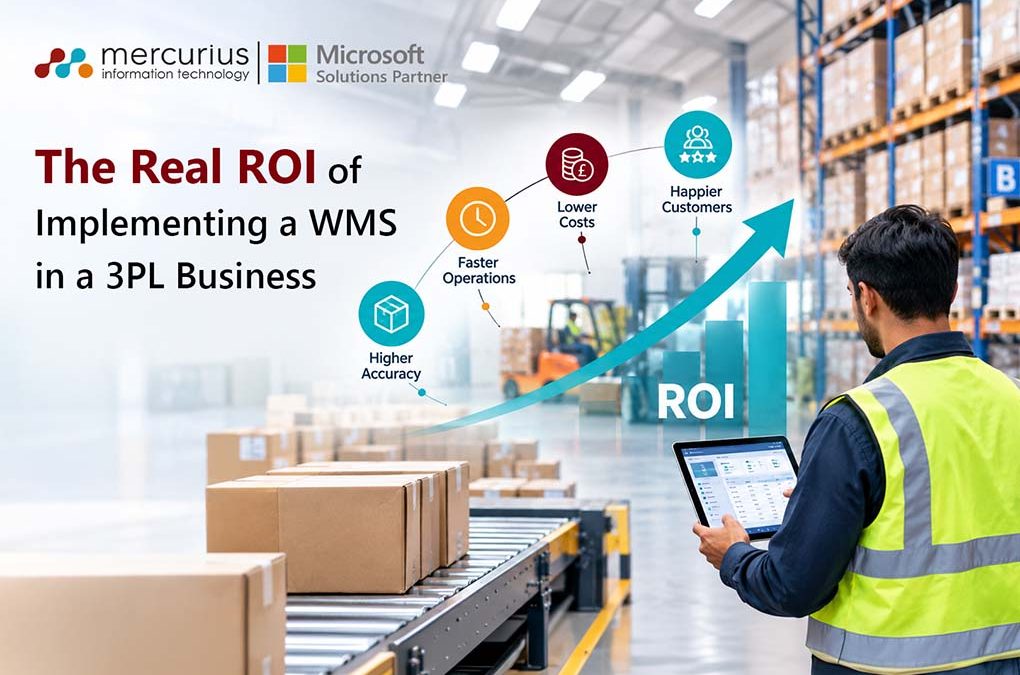
The ROI of a Warehouse Management System in a 3PL business extends beyond labour savings, helping logistics providers improve inventory accuracy, billing, customer retention, warehouse productivity and scalable growth through Boltrics WMS.
Key Takeaways
- WMS ROI extends beyond labour savings to include customer retention, contract profitability and operational scalability.
- Better inventory and order accuracy can reduce disputes, claims, adjustments and operational waste.
- Automated billing helps 3PLs capture billable warehouse activities and reduce revenue leakage.
- Real-time warehouse visibility supports faster decisions and more proactive performance management.
- Boltrics WMS is purpose-built for 3PLs and integrates warehouse, transport, finance and customer processes through Dynamics 365 Business Central.
- Most 3PL organisations can achieve WMS payback within 12–36 months, depending on complexity, labour costs, customer volume and implementation factors.
- Implementation quality, user adoption, data quality and continuous optimisation have a direct impact on the ROI achieved.
Why 3PLs Are Rethinking Warehouse Technology
The pressure on third-party logistics providers has never been greater.
Customers increasingly expect real-time inventory visibility, rapid fulfilment, accurate billing, value-added services and seamless communication. At the same time, logistics operators are battling persistent labour shortages, rising operating costs, growing stock complexity and relentless pressure on margins.
The warehousing sector itself continues to expand rapidly. According to the UK Warehousing Association (UKWA), the sector has grown by more than 61% over the past decade and now employs more than 650,000 people across the UK. UKWA’s more recent workforce analysis suggests the true figure could be closer to 760,000 employees, highlighting both the scale and strategic importance of warehousing within the UK economy.
While many 3PLs recognise the need for digital transformation, a surprising number still evaluate Warehouse Management Systems (WMS) using overly simplistic ROI calculations focused primarily on labour reductions.
That approach significantly underestimates the true business value.
For modern logistics providers, the real ROI of a WMS comes from improving operational performance, enhancing customer experience, protecting margins and enabling scalable growth. This is where Boltrics WMS, built specifically for logistics service providers on Microsoft Dynamics 365 Business Central, delivers measurable impact.
Why Traditional WMS ROI Calculations Are Too Narrow
When evaluating a WMS investment, most organisations start by analysing easily measurable metrics:
- Reduced labour hours
- Faster picking rates
- Lower inventory carrying costs
- Fewer warehouse errors
- Reduced paperwork
These benefits are certainly important.
For example, improved picking efficiency alone can reduce labour expenditure significantly in high-volume warehouse operations. Likewise, inventory accuracy improvements can reduce costly adjustments, stock write-offs and customer disputes.
However, focusing solely on operational cost savings creates an incomplete picture.
The Hidden Areas of ROI Most 3PLs Overlook

Customer Retention
In logistics, service failures directly affect contract renewals.
A WMS that improves order accuracy, real-time visibility and reporting can strengthen customer relationships and reduce attrition.
Retaining a major logistics contract often delivers far greater value than incremental labour savings.
Contract Profitability
Many 3PLs struggle to identify the true profitability of individual customers.
When warehouse activity is accurately captured and connected to billing processes, organisations gain visibility into which contracts generate profit and which erode margins.
Operational Scalability
Without automation, growth often requires proportional increases in headcount.
A modern WMS enables businesses to handle more customers, more inventory and more transactions without equivalent labour increases.
Customer Service Efficiency
Customers increasingly expect self-service access to inventory levels, shipment status and performance metrics.
Providing this visibility reduces administrative effort while improving client satisfaction.
Management Visibility
Warehouse managers can only improve what they can measure.
Real-time KPI monitoring enables faster intervention, continuous optimisation and better strategic decision-making.
For most successful 3PLs, these strategic benefits frequently exceed direct labour savings over the lifetime of the system.
Are You Measuring the Full ROI of Your WMS?
Look beyond labour savings and identify the impact a modern WMS can have on customer retention, billing accuracy, contract profitability and warehouse scalability.
What Is the ROI of a Warehouse Management System?
A Warehouse Management System generates ROI by improving warehouse productivity, inventory accuracy, fulfilment quality, billing efficiency and customer service while creating the operational foundation required for scalable growth.
The highest-performing logistics providers view WMS ROI as a combination of:
- Labour efficiency gains
- Inventory improvements
- Reduced errors and claims
- Higher contract profitability
- Improved customer retention
- Better resource utilisation
- New revenue opportunities
In other words, the true ROI of a WMS is measured not only by cost reduction but also by revenue protection and business growth.
The Operational ROI Drivers Behind Boltrics WMS
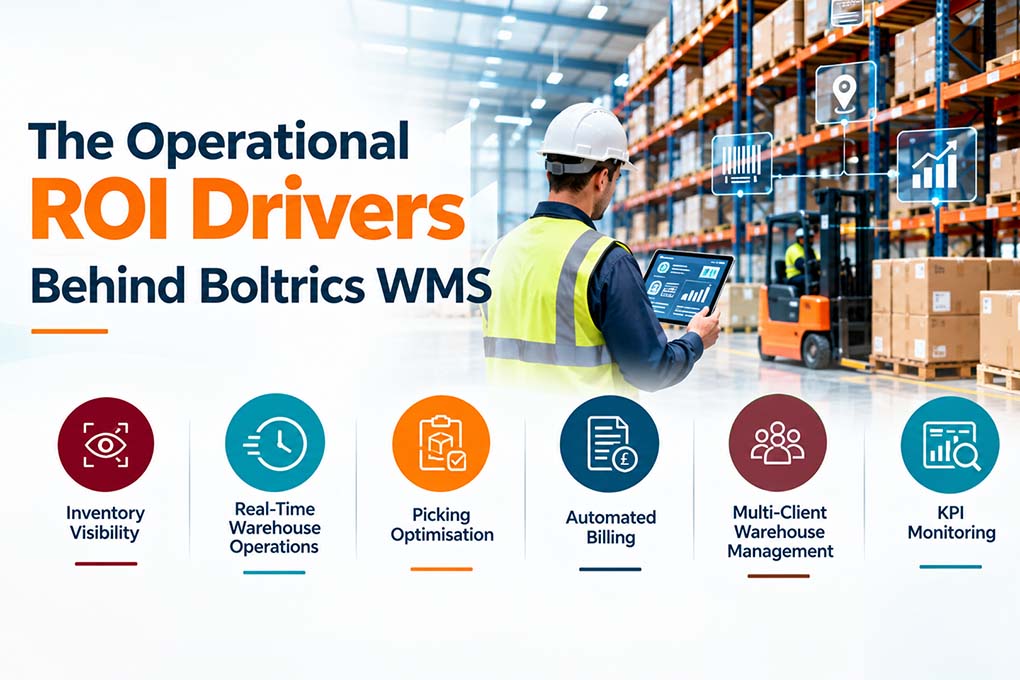
Boltrics WMS was developed specifically for logistics service providers rather than adapted from manufacturing or retail software models.
Built on Microsoft Dynamics 365 Business Central, the 3PL solution connects warehouse operations, transport processes, finance and customer billing within a single platform.
Inventory Visibility
Inventory discrepancies create operational disruption, customer dissatisfaction and unnecessary investigation work.
Boltrics provides real-time inventory visibility across:
- Multiple customers
- Multiple facilities
- Multiple stock statuses
- Batch and lot tracking
- Storage locations
This visibility improves warehouse control while supporting regulatory and customer compliance requirements.
Real-Time Warehouse Operations
RF scanning capabilities help eliminate manual data entry and reduce processing delays. Warehouse activities are captured as they occur, creating a single version of operational truth.
Picking Optimisation
Improved picking routes, location accuracy and workflow automation help increase throughput while reducing travel time and warehouse congestion.
For larger multi-client facilities, these efficiencies compound significantly.
Automated Billing
One of the most overlooked drivers of WMS implementation ROI is billing accuracy.
Operational activities such as:
- Storage
- Handling
- Cross-docking
- Value-added services
- Transport charges
can be automatically captured and converted into billable transactions.
This reduces revenue leakage and accelerates cash collection.
Multi-Client Warehouse Management
Managing multiple customers within a shared warehouse environment introduces complexity.
Boltrics enables customer-specific:
- Receiving processes
- Labelling requirements
- Picking rules
- Documentation
- Value-added services
- Billing methodologies
while maintaining operational consistency.
KPI Monitoring
Operational leaders gain access to real-time performance data covering:
- Picking productivity
- Inventory accuracy
- Order throughput
- Space utilisation
- Service performance
- Labour efficiency
This supports proactive warehouse management rather than retrospective problem-solving.
Quantifying the Real Impact
Consider a typical UK 3PL operator with:
- 100 warehouse employees
- 30 active customers
- 25,000 order lines processed weekly
- 40,000 pallet locations
- £15 million annual turnover
Following a successful Boltrics WMS implementation, reasonable operational improvements could include:
| KPI | Before WMS | After WMS | Business Impact |
|---|---|---|---|
| Inventory Accuracy | 96% | 99.5%+ | Fewer disputes and adjustments |
| Order Accuracy | 97.5% | 99.8% | Reduced claims and chargebacks |
| Picking Productivity | Baseline | +20–30% | Higher throughput without extra labour |
| Billing Accuracy | Manual reconciliation | Automated capture | Reduced revenue leakage |
| Warehouse Utilisation | 80% | 90%+ | Delayed expansion expenditure |
| Customer Reporting | Manual | Real-time | Improved customer satisfaction |
| Customer Onboarding | Several weeks | Faster standardised setup | Increased growth capacity |
While actual results differ between operations, these are the metrics that typically determine long-term WMS implementation ROI.
The key observation is that profit impact comes from multiple improvement areas simultaneously rather than one isolated efficiency gain.
How Does a WMS Improve Profitability in a 3PL?
A WMS improves profitability by increasing revenue capture, reducing operational waste and enabling higher volumes to be processed with existing resources.
The most significant profitability drivers include:
- Improved labour efficiency.
- Reduced order errors and claims.
- Increased inventory accuracy.
- Automated customer billing.
- Reduced administrative effort.
- Better warehouse capacity utilisation.
- Faster customer onboarding.
- Improved contract visibility and margin analysis.
For many logistics providers, billing automation alone uncovers previously unbilled warehouse activities that directly improve financial performance.
Turn Warehouse Improvements Into Measurable Returns
See where better inventory accuracy, picking productivity, billing automation and warehouse utilisation can improve the financial performance of your 3PL operation.
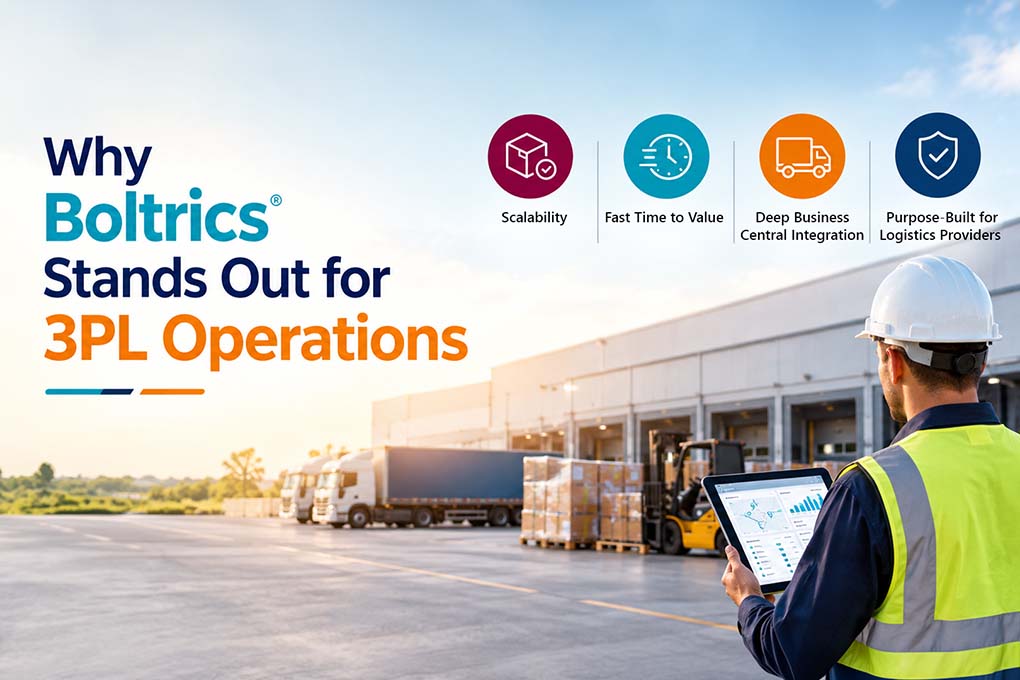
Why Boltrics Stands Out for 3PL Operations
Not all warehouse management systems are designed for third-party logistics operations.
Many solutions require extensive modification to accommodate multi-client warehousing, customer-specific charging structures and logistics-specific workflows.
Boltrics takes a different approach.
Purpose-Built for Logistics Providers
The platform is developed specifically for:
- 3PL providers
- Warehousing companies
- Freight forwarders
- Logistics service providers
with input from hundreds of logistics operators globally.
Deep Business Central Integration
Unlike standalone warehouse solutions, Boltrics operates within the Dynamics 365 Business Central platform.
This creates a connected operational environment where warehouse, transport, finance and customer processes work together seamlessly.
Fast Time to Value
Boltrics promotes a standardised implementation philosophy designed to accelerate deployment while reducing customisation complexity. Official resources consistently highlight go-live timeframes measured in months rather than years.
Scalability
As customer requirements evolve, organisations can expand functionality without replacing core systems.
This protects long-term technology investment while supporting business growth.
How Long Does WMS Implementation Take to Pay Back?
Most 3PL organisations achieve payback within 12 to 36 months, depending on:
- Warehouse complexity
- Existing operational inefficiencies
- Labour costs
- Customer volume
- Billing leakage
- User adoption levels
Highly manual operations often see faster returns because they have greater opportunities for process improvement.
However, the largest long-term gains typically emerge after implementation through continuous optimisation rather than immediately at go-live.
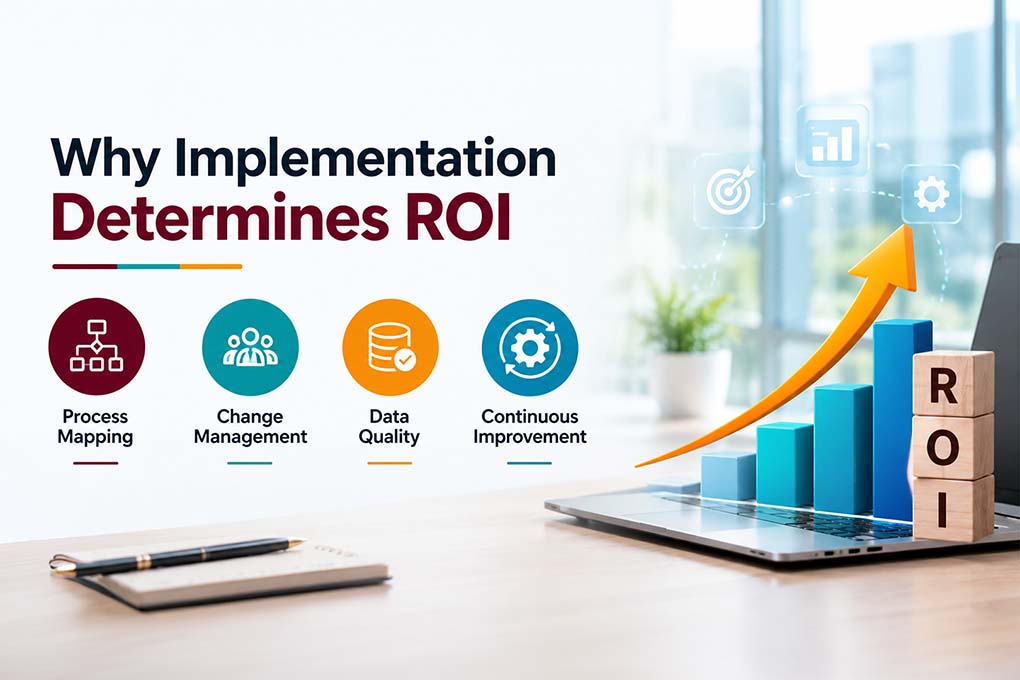
Why Implementation Determines ROI
Technology alone does not create business value.
Implementation quality determines whether expected benefits become measurable outcomes.
Process Mapping
Organisations must clearly understand existing workflows before introducing new technology.
Poorly defined processes often become digitised inefficiencies.
Change Management
Warehouse teams need to understand not only how the system works but why new processes matter.
User resistance is one of the biggest causes of delayed ROI.
Data Quality
Accurate master data supports accurate warehouse operations.
Weak data migration strategies frequently undermine implementation success.
Continuous Improvement
The most successful organisations treat implementation as the beginning of optimisation, not the end.
Regular KPI reviews and process enhancements help maximise long-term returns.
Why Do Logistics Businesses Invest in Boltrics WMS?
Logistics providers typically invest in Boltrics because they need:
- Better multi-client warehouse management
- Real-time inventory visibility
- Automated billing processes
- Improved productivity
- Faster customer response times
- Greater operational scalability
- End-to-end logistics process integration
The platform aligns particularly well with growing 3PL businesses seeking operational standardisation without sacrificing flexibility.
Why Mercurius IT is the Ideal 3PL Partner?
Even the most capable software platform will struggle to deliver expected outcomes without the right implementation partner.
Mercurius IT combines logistics process expertise with Microsoft and Boltrics implementation capabilities to help organisations achieve measurable business results.
- Deep Logistics Experience: Mercurius IT has extensive experience delivering warehouse, logistics and supply chain technology solutions across the UK and international markets.
- Business-Led Transformation: Successful warehouse transformation requires more than software deployment. Mercurius IT focuses on aligning technology with operational objectives, commercial goals and long-term growth strategies.
- Microsoft Ecosystem Expertise : By leveraging Dynamics 365 Business Central, Power Platform and Azure services where appropriate, Mercurius IT helps create a connected technology ecosystem that supports business-wide visibility and automation
- Ongoing Optimisation: The journey does not end after go-live. Mercurius IT provides continued support, optimisation and strategic guidance to help businesses sustain and expand the value delivered by their WMS investment.
Build a WMS Strategy Around Your Growth Goals
Mercurius IT combines logistics expertise, Microsoft technology and Boltrics implementation capabilities to help 3PLs achieve measurable operational and commercial results.
Future Outlook: The Next Phase of Warehouse ROI
The next generation of warehouse performance will be increasingly driven by:
Artificial Intelligence
AI-powered insights will help predict bottlenecks, optimise resource allocation and improve planning decisions.
Predictive Warehousing
Organisations will use historical and real-time data to anticipate inventory movements before issues occur.
Warehouse Automation
Integration between WMS platforms and automation technologies will become increasingly important as labour pressures persist.
Data-Driven Logistics
Competitive advantage will increasingly depend on how effectively logistics providers transform operational data into business intelligence.
The future belongs to organisations that combine operational expertise with digital capability.
Conclusion
The real ROI of WMS in 3PL operations extends far beyond labour savings.
While improvements in warehouse productivity, inventory accuracy and order fulfilment remain important, the largest value drivers often come from customer retention, billing accuracy, operational scalability and visibility.
Boltrics WMS provides a purpose-built platform for logistics service providers seeking to modernise warehouse operations, improve profitability and support future growth. Built on Dynamics 365 Business Central, it offers the integration, flexibility and industry-specific functionality required by modern 3PL businesses.
However, technology alone is not enough.
Achieving measurable ROI requires effective implementation, strong change management and ongoing optimisation. That is where Mercurius IT delivers additional value, acting not simply as a software provider but as a strategic transformation partner.
For logistics organisations looking to scale sustainably, improve margins and strengthen customer relationships, the combination of Boltrics WMS and Mercurius IT provides a proven foundation for long-term success.
Frequently Asked Questions
What is the ROI of a warehouse management system?
The ROI of a warehouse management system comes from improved labour productivity, inventory accuracy, order accuracy, billing efficiency, customer satisfaction and business scalability.
How long does WMS implementation take to pay back?
Most 3PL organisations achieve payback within 12 to 36 months, depending on operational complexity and the scale of efficiency improvements achieved.
How does a WMS improve profitability in a 3PL?
A WMS improves profitability by reducing operational waste, improving billing accuracy, increasing warehouse productivity and supporting scalable growth without proportional increases in labour.
Why do logistics businesses invest in Boltrics WMS?
Boltrics WMS is designed specifically for logistics service providers and supports inventory visibility, warehouse control, automated billing, multi-client management and integrated logistics operations.
What KPIs improve after WMS implementation?
Commonly improved KPIs include inventory accuracy, order accuracy, pick rates, labour productivity, warehouse utilisation, billing accuracy and customer service response times.
Is Boltrics suitable for multi-client warehousing?
Yes. Boltrics supports customer-specific processes, inventory segregation, value-added services, contract-specific billing and real-time customer visibility.
Why is implementation important for WMS ROI?
Implementation determines how effectively technology aligns with operational processes, user adoption and long-term business objectives. Poor implementation often limits realised benefits.
Why choose Mercurius IT for Boltrics implementation?
Mercurius IT combines logistics expertise, Microsoft technology knowledge, process consultancy and ongoing optimisation services to help organisations maximise their WMS investment.