
Quick Summary
A reliable Dynamics 365 CRM implementation partner helps organisations streamline operations, improve user adoption, and build scalable CRM systems aligned with business goals.
Key Takeaways
- The right implementation partner significantly influences CRM success.
- Industry expertise helps align CRM with business processes and compliance requirements.
- A structured implementation approach improves adoption and project outcomes.
- Strong integration and data migration capabilities support long-term scalability.
- Post-go-live support is essential for continuous CRM optimisation.
- Microsoft Solutions Partner status is an important evaluation criterion.
A successful Dynamics 365 CRM implementation depends not only on the software, but also on the expertise of the implementation partner. The right partner is essential for effective process mapping, integrations, user adoption, and long-term scalability, ensuring the platform delivers measurable business value.
As CRM transformation projects grow more complex, many organisations face delayed deployments, budget overruns, poor adoption, and disconnected workflows due to weak implementation strategies. Gartner-backed industry estimates indicate that nearly 70% of ERP and CRM projects fail to meet their original business objectives because of poor planning, implementation gaps, and low user adoption.
Selecting the wrong Dynamics 365 CRM partner can turn a strategic investment into an operational challenge. This blog explores the key factors business leaders should consider when choosing a Dynamics 365 CRM implementation partner to maximise CRM success.
The Importance of Selecting the Right Implementation Partner
A Dynamics 365 CRM implementation directly influences sales visibility, customer experience, reporting accuracy, operational workflows, and user adoption throughout the organisation. Even the most advanced CRM platform may fail to deliver value if implementation is not executed effectively.
Choosing the wrong implementation partner can lead to budget overruns, project delays, unnecessary customisation, integration problems, and low user adoption. These issues may increase operational costs and restrict CRM scalability.
Industry reports indicate that 30 to 50% of projects experience delays or budget overruns due to poor planning, integration gaps, and weak implementation governance.
Key Factors to Evaluate Before Choosing a Dynamics 365 CRM Implementation Partner
Selecting a Dynamics 365 CRM implementation partner requires careful evaluation of both pricing structures and technical competencies. Business leaders should assess the partner’s industry expertise, implementation methodology, scalability, and long-term support to facilitate successful CRM adoption and achieve measurable outcomes.
1. Microsoft Solutions Partner Designation
Microsoft’s recognition is a strong indicator of a partner’s capabilities. The Solutions Partner designation for Business Applications is especially relevant for Dynamics CRM. Partners with this status have proven their ability to meet customer needs using Dynamics 365 and Power Platform. Ensure that your prospective partner holds this designation, which reflects Microsoft’s confidence in their expertise.
A qualified team is more likely to deliver a scalable, secure, and future-ready CRM environment aligned with Microsoft best practices.
2. Advanced Technical Expertise for Comprehensive Implementation
Modern CRM implementations encompass much more than basic contact management. An effective partner offering CRM implementation services should demonstrate proficiency in the following areas:
- Power Platform integration: Proficiency in developing custom applications, automating workflows with Power Automate, and building interactive dashboards in Power BI enhances CRM system value.
- Data migration and integration: Successful data transfer from legacy systems and integration with current business applications demand advanced technical skills and proven methodologies.
- Customisation and development: While Dynamics 365 CRM offers robust out-of-the-box features, most organisations need customisations to fit their processes. Implementation partners should balance standard functionality with necessary customisations to avoid over-engineering.
- Industry-Specific Experience: A partner with industry-specific experience possesses an understanding of unique operational challenges, compliance requirements, and customer expectations within the relevant sector. Such partners can recommend established CRM workflows, automation strategies, and best practices based on prior projects. Reviewing case studies and real-world examples serves to validate their expertise and delivery capabilities.
3. CRM Discovery & Requirement Mapping Process
Effective CRM implementations commence with a comprehensive discovery process. Reliable implementation partners dedicate time to understanding business objectives, operational workflows, reporting requirements, and user expectations prior to platform configuration. Structured workshops and fit-gap analyses ensure that the CRM supports existing business processes rather than requiring teams to adapt to inefficient systems.
4. Balance Between Customisation & Standardisation Approach
Excessive CRM customisation may increase implementation complexity, elevate maintenance costs, and introduce future upgrade challenges. An effective Dynamics 365 partner prioritises balancing customisation with platform standardisation to promote long-term scalability, flexibility, and streamlined system enhancements as business requirements evolve.
5. Integration & Data Migration Capabilities
Dynamics 365 CRM often needs to connect with ERP systems, marketing platforms, customer service tools, and other third-party applications. Implementation partners should have proven experience managing integrations and executing structured data migration strategies. Clean, accurate, and well-governed data migration is essential for maintaining reporting accuracy and user trust after go-live.
6. Change Management & User Adoption Strategy
CRM project success is closely linked to user adoption. Effective implementation partners prioritise training, onboarding, stakeholder engagement, and change management throughout the project lifecycle. When employees understand the operational benefits of the CRM, organisations are more likely to achieve higher adoption rates and improved return on investment.
7. Post-Go-Live Support & Long-Term Partnership
CRM implementation extends beyond initial deployment. Organisations should assess the partner’s post-go-live support model, service level agreement (SLA) commitments, optimisation services, and long-term engagement strategy. A reliable support partner enables continuous improvement of CRM performance, rapid issue resolution, and scalable platform growth as business requirements evolve.
Avoid costly CRM implementation mistakes
Get expert guidance on planning, integrations, migration, and post-go-live optimisation for long-term CRM success.
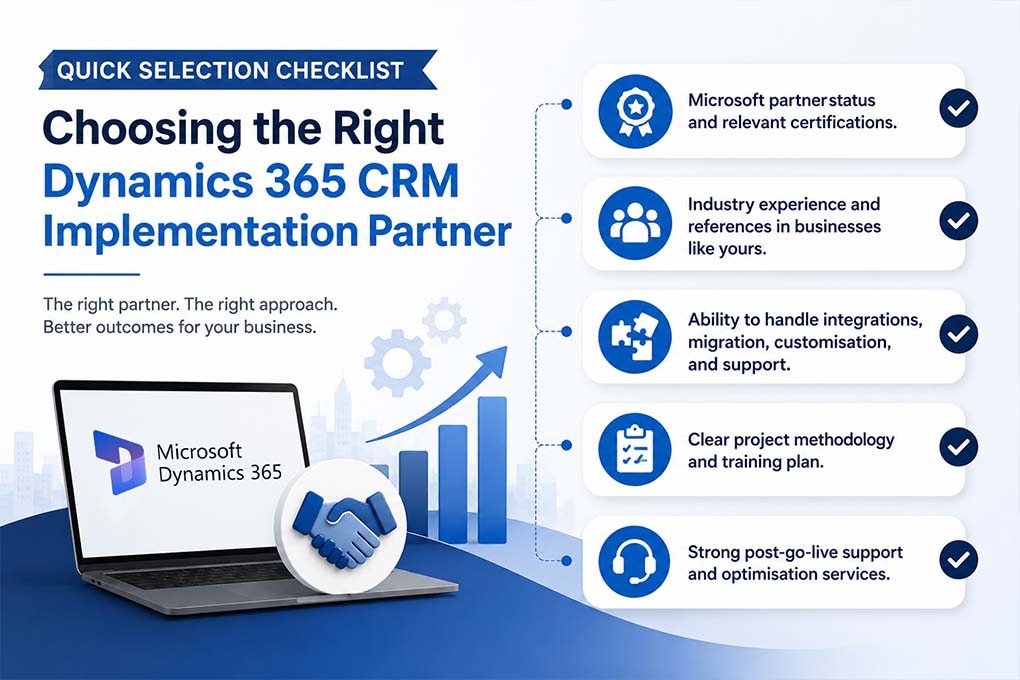
A Quick Selection Checklist for Choosing the Right Dynamics 365 CRM Implementation Partner
Use this shortlist when comparing the Microsoft Dynamics 365 CRM implementation partners:
Questions Business Leaders Should Ask Before CRM Implementation Partner Selection
Before finalising a Dynamics 365 CRM implementation partner, business leaders should assess more than technical expertise alone. Asking the right questions helps evaluate the partner’s industry knowledge, delivery approach, scalability mindset, and long-term support capabilities.
Key questions to consider include:
- What industries have you implemented Dynamics 365 CRM for, and can you share relevant case studies?
- What implementation methodology do you follow to manage timelines, risks, and adoption?
- How do you approach integrations, customisations, and future scalability?
- What does your post-go-live support and optimisation model include?
- Can you share measurable client outcomes related to productivity, adoption, or operational efficiency?
Clear answers to these questions can help organisations identify partners that align with their long-term business and transformation goals.
Reduce CRM implementation risks before they impact operations
Work with Dynamics 365 specialists who align CRM strategy with your business goals, integrations, and long-term scalability.
Bottom Line
Choosing the right Dynamics 365 CRM partner turns a software purchase into a strategic investment. An experienced partner offers industry knowledge, technical skill, and proven implementation, helping you achieve faster results and greater returns.
A reliable partner works as an extension of your team, understands your organisational goals, and provides ongoing guidance to help you take advantage of new Dynamics 365 features as they become available.
Your CRM implementation is too important to leave to chance. Carefully evaluate potential partners, ask detailed questions, and confirm their expertise through references, case studies and Dynamics 365 implementation best practices. As a reliable Microsoft Solutions Partner, Mercurius IT delivers value throughout your CRM system’s lifecycle.
Frequently Asked Questions
Why is choosing the right Dynamics 365 CRM implementation partner important?
The right Dynamics 365 CRM implementation partner reduces deployment risks, increases user adoption, streamlines integrations, and maximises long-term CRM ROI. An experienced partner ensures the CRM supports your business processes, reporting needs, and future scalability.
What should businesses look for in a Dynamics 365 CRM implementation partner?
When selecting a Dynamics 365 CRM partner, businesses should assess industry expertise, Microsoft certifications, implementation methodology, integration capabilities, data migration experience, change management strategies, and post-go-live support.
How long does a Dynamics 365 CRM implementation take?
The implementation timeline depends on project complexity, customisation, integrations, and data migration. Small to mid-sized CRM projects may take several months, while enterprise deployments often require more time.