
Key Takeaways
- What Foundry IQ and Fabric IQ are, and why they matter together.
- How semantics and engineered guardrails turn AI into predictable outcomes.
- Core capabilities across ontology, graph reasoning, pipelines, policies, and observability.
- Practical, non industry specific use cases with example prompts.
- Governance and responsible AI safeguards for safe scaling.
- A 90 day implementation plan with measurable KPIs.
Bottom line
Foundry IQ and Fabric IQ combine shared business meaning with engineered controls, converting insights into consistent and auditable results.Introduction: From Clever Prototypes to Predictable Outcomes
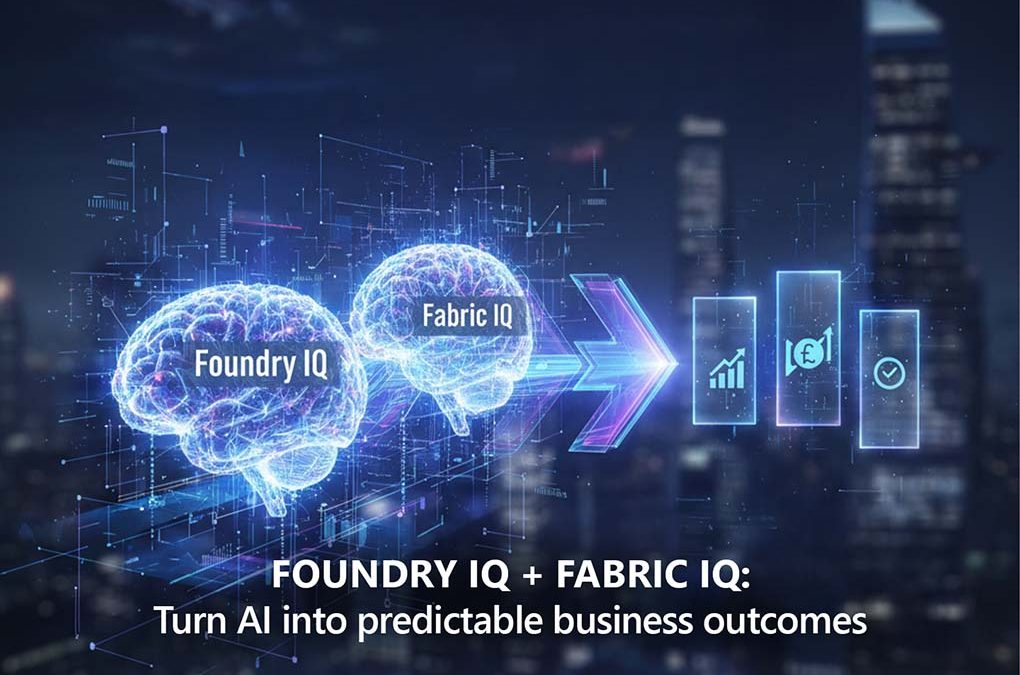
Many AI pilots stall because agents lack consistent context and enforceable guardrails. Enter Fabric IQ and Foundry IQ, two complementary layers that make agents trustworthy. Fabric IQ supplies business semantics that explain what data means and how it relates. Foundry IQ supplies knowledge retrieval, pipelines, policies, and operational discipline. Together they shift AI from interesting demos to dependable, repeatable business outcomes.
Why Pilots Fail Without Semantics and Engineering Discipline?
Agents misinterpret data when business meaning is fragmented across teams and systems. They also drift when retrieval pipelines, policies, and audits remain inconsistent. Predictability requires shared semantics and an engineered lifecycle for agents. Fabric IQ and Foundry IQ jointly address both requirements across the stack.
Where These Layers Sit in Microsoft’s Intelligence Stack?
Fabric IQ elevates Microsoft Fabric from a data platform to an intelligence platform. Foundry IQ lives in Microsoft Foundry as the unified knowledge and governance layer. Work IQ complements both by modelling how work happens across everyday applications. Our focus here is the Fabric IQ and Foundry IQ pairing for operational outcomes.
Fix the Foundations Behind Your AI
Identify where missing semantics, weak pipelines, or unclear controls are making your AI outcomes inconsistent and hard to trust.
Fabric IQ: The Semantic Foundation
Fabric IQ introduces a governed ontology that represents business entities and rules. It binds real data to shared concepts, eliminating conflicting definitions across teams. A native graph engine enables multi hop reasoning across relationships and events. Semantic models extend analytics definitions into operations and agent decisions.
Ontology and Unified Semantic Models
The ontology defines entities, relationships, properties, constraints, and objectives. Semantic models align trusted measures and KPIs with operational decision points. Agents reason over concepts like order, shipment, or customer rather than raw tables. This creates a single language for analytics, applications, and agents across domains.
Graph Reasoning and Event Context
Graph reasoning connects causes and effects across processes and time windows. Event streams provide live context, enabling agents to detect and explain changes. Agents answer questions about relationships, dependencies, and cascading impacts. Decisions become transparent and reproducible because semantics are consistent.
Alignment with OneLake and Existing Analytics
Fabric IQ binds ontology concepts to sources in OneLake and existing semantic models. Teams reuse Power BI modelling work while adding operational relationships and rules. Analytics and agents now share a single semantic backbone for decisions and actions.
Foundry IQ: Engineered Patterns for Agent-Native Systems
Foundry IQ abstracts retrieval, pipelines, policies, and observability into reusable blocks. It turns knowledge access into a managed service with permission-aware grounding. Agent registries and identities standardise scopes, approvals, and accountability. Telemetry, lineage, and audits create traceability from question to action and outcome.
Reference Architectures, Pipelines, and Policy Enforcement
Foundry IQ offers reference patterns for ingestion, enrichment, and retrieval orchestration. Pipelines unify connectors, indexing, and routing with security and governance built in. Policies control sources, action scopes, approvals, risk thresholds, and escalation. Teams ship agents faster while improving reliability and compliance posture.
Registries, Identities, Scopes, and Approvals
Each agent receives an identity, a registry entry, and defined scopes to act. Approvals and human checkpoints are configured per workflow and risk category. This reduces shadow agents and ensures least privilege behaviour by default. Executives gain visibility into every agent and its allowed operations.
Observability, Lineage, Auditing, and Reliability Practices
Foundry IQ collects telemetry, prompts, sources, decisions, approvals, and outputs. Lineage links knowledge, semantics, and actions for end-to-end traceability. SLOs, evaluations, and rollbacks support reliability and incident management. This transforms AI from opaque systems into accountable operational components.
Working Together: From Insight to Governed Action

Fabric IQ supplies shared semantics and explainable analysis across the data estate. Foundry IQ turns those insights into governed actions with approvals and audits. Data agents answer business questions using Fabric IQ semantics and definitions. Operational agents execute actions under Foundry IQ policies and observability.
Flow of Value
- Ask a question using business concepts, not column names.
- Receive an explainable answer grounded in Fabric IQ semantics.
- Propose actions with objectives, constraints, and policy checks.
- Execute approved changes with lineage, logging, and rollback plans.
Continuous Feedback Loops
Outcomes feed back into models, prompts, and policies for ongoing improvement. Executives review dashboards showing value delivered and risks mitigated. Semantics evolve safely through versioning, testing, and controlled releases.
Comparison
| Capability | Fabric IQ | Foundry IQ | Traditional BI Layer | Plain RAG Pipelines |
|---|---|---|---|---|
| Business ontology and shared semantics | Yes, governed ontology and models | Uses semantics from Fabric IQ | Limited to analytics definitions | None without heavy curation |
| Multi hop graph reasoning | Native graph traversal and inference | Consumes graph context | Rare or external add ons | Embedding proximity only |
| Real time operational triggers | Event streams and rules | Policies and approvals on actions | Typically batch oriented | Possible, weak governance |
| End to end agent orchestration | Analysis to action via agents’ end-to-end orchestration when integrated with Fabric Pipelines, Power Automate, or workflow engines. | Registries, scopes, audits, rollbacks | Outside scope | Outside scope, ad hoc glue |
| Governance and auditability | Lineage, labels, constraints | Identity, telemetry, policy enforcement | Analytics focused | Minimal provenance controls |
| Alignment with analytics and ERP data | Unified in Fabric and OneLake | Connects across sources and apps | Analytics only | Unstructured text dominant |
| Effort to implement and scale | Moderate with reuse and patterns | Moderate, engineered lifecycle | Moderate, analytics centric | High curation and fragility |
Practical Use Cases and Prompts
Planning and Operations
- Detect signals that justify plan changes under defined objectives.
- Propose adjustments with clear tradeoffs and required approvals.
Prompts - Explain demand shifts across periods and recommend compliant plan changes.
- Simulate service level impact if reorder policies tighten by ten percent.
Finance Operations
- Surface material variances and route reconciliations with context.
- Draft entries and collections messages for approval before posting.
Prompts - Identify drivers behind this month’s expense variance and propose entries.
- Prioritise collections by risk and prepare three polite outreach templates.
Service Operations
- Predict SLA risks and route cases using skills, capacity, and priority.
- Generate responses aligned to approved knowledge and tone guidance.
Prompts - List cases likely to breach SLA and recommend reassignment with reasons.
- Draft responses aligned with knowledge and policy for manager review.
Project and Field Operations
- Resolve scheduling conflicts while respecting contractual commitments.
- Notify stakeholders and capture approvals with full audit trails.
Prompts - Propose rescheduling to meet milestones without exceeding cost limits.
- Optimise tomorrow’s dispatch plan and list required approvals.
Governance, Security, and Responsible AI

Semantic Ownership and Lifecycle
- Assign owners, version models, and test changes before release.
- Prevent vocabulary drift that confuses agents and stakeholders.
Policies, Approvals, and Human Oversight
- Define scopes, thresholds, and escalation paths per workflow.
- Require approvals for actions that exceed risk or policy limits.
Protection, Access, and Lineage
- Classify sensitive data, apply labels, and enforce least privilege access.
- Capture lineage across semantics, sources, decisions, and outputs.
Measurement and Trust
- Track reliability, safety, and value using balanced scorecards.
- Publish outcomes and mitigations to build confidence and accountability.
Implementation Plan and KPIs
Weeks 1 to 4: Semantic Design and Environment Setup
- Run ontology workshops and align semantics with existing metrics.
- Inventory sources, set lineage, and prepare OneLake bindings.
- Establish governance roles, approvals, and change control.
Weeks 5 to 8: Data Agents and Validation
- Build data agents that answer business questions with explanations.
- Validate accuracy, latency, and coverage versus real questions.
- Instrument observability and evaluation pipelines for continuous improvement.
Weeks 9 to 12: Operational Agents, Scopes, and Rollback
- Pilot operational agents with controlled scopes and approvals.
- Configure triggers, policies, rollbacks, and incident procedures.
- Gather feedback from operators and review decision quality.
Weeks 13 to 16: Metrics, Scaleout, and Governance Reviews
- Extend agents to adjacent processes sharing the same semantics.
- Review risk, compliance, and value with stakeholders monthly.
- Plan staged scaleout informed by measured outcomes and guardrails.
KPIs
- Cycle time reduction and throughput improvements across workflows.
- Accuracy uplift in classifications, matches, and proposed actions.
- Override rates, rollback events, and policy violations trending down.
- Compliance posture, label coverage, and audit completeness rising.
- Outcome attainment tied to service levels, margins, and customer experience.
Move From Insight to Governed Action
See how insights grounded in shared semantics can execute safely under policies, approvals, and full auditability.
Conclusion
Outcome driven AI needs shared semantics and engineered controls to stay predictable. Fabric IQ provides the semantics and reasoning that make insights trustworthy. Foundry IQ provides the governance and pipelines that make actions accountable. Together they convert analysis into measurable results, safely and consistently. Start small with clear KPIs, then scale under policies that build confidence over time.
Frequently Asked Questions
What problems do Foundry IQ and Fabric IQ actually solve?
They solve semantic fragmentation and operational inconsistency across agents and data. They create shared business meaning and engineered guardrails for safe automation.
Do existing BI models need rebuilding?
No, they can be imported and extended with operational relationships and rules.
Expect refinement where operational context demands additional semantics and constraints.
How does this relate to Work IQ and Microsoft 365 Copilot?
Work IQ models how work happens across everyday applications and collaboration. Fabric IQ and Foundry IQ handle business semantics and agent operations at scale.
Can this run with Dynamics 365 and other systems?
Yes, connectors and policies integrate agents across ERP, CRM, and line of business. Shared semantics prevent mismatched definitions and unpredictable behaviour.
What governance must be in place before actions execute?
Define scopes, thresholds, approvals, lineage, and rollback procedures. Establish human checkpoints for decisions impacting customers or compliance.
Design AI That Delivers Predictable Results