

Quick Summary
Streamline your CRM processes, improve forecasting accuracy, and accelerate sales engagement with practical strategies that eliminate operational gaps and protect revenue opportunities.Key Takeaways
- Keep your CRM configuration straightforward and purpose-driven.
- Automate repetitive tasks to optimise resource allocation and increase operational efficiency.
- Maintain accurate and up-to-date data to support informed decision-making.
- Provide comprehensive training to staff to facilitate complete CRM adoption.
- Integrate the CRM system with complementary tools to establish a cohesive workflow.
Despite significant investments in CRM platforms, many businesses continue to lose valuable sales opportunities. Do you know the issue? Well, it is not the technology alone.
In fact, studies suggest that 70% of CRM implementations fail due to poor processes, low adoption, disconnected data, or ineffective usage strategies. Organisations implement CRM systems expecting greater visibility, stronger customer relationships, and faster sales cycles. Yet many teams still struggle with missed follow-ups, inaccurate forecasting, and declining conversion rates.
Businesses invest in CRM to improve sales, yet common operational mistakes often create friction and reduce opportunities. Incomplete customer data, poor user adoption, complex workflows, and a lack of sales alignment are leading causes of lost pipeline and revenue leakage. But the good news is that these issues can be identified and corrected.
This blog explores the most common CRM mistakes that cost businesses valuable sales opportunities and explains how organisations can avoid them.
Common CRM Implementation Mistakes That Businesses Should Avoid
CRM implementation failures typically result from four key issues: unclear business strategy, poor data migration, insufficient end-user training, and neglected integrations. Let us take a look at the common implementation mistakes below.
Mistake 1: Unclear Goals in CRM Implementation
A frequent issue in CRM implementation is unclear objectives. Companies often begin without a defined purpose, resulting in uncoordinated system use and employee dissatisfaction.
How to address the issue?
To address this, set clear goals before implementation. Identify which business processes to optimise and what insights you need from the CRM. You can also collaborate with a reliable CRM implementation partner to get the execution with no mistakes.
Mistake 2: Overcomplicating the CRM
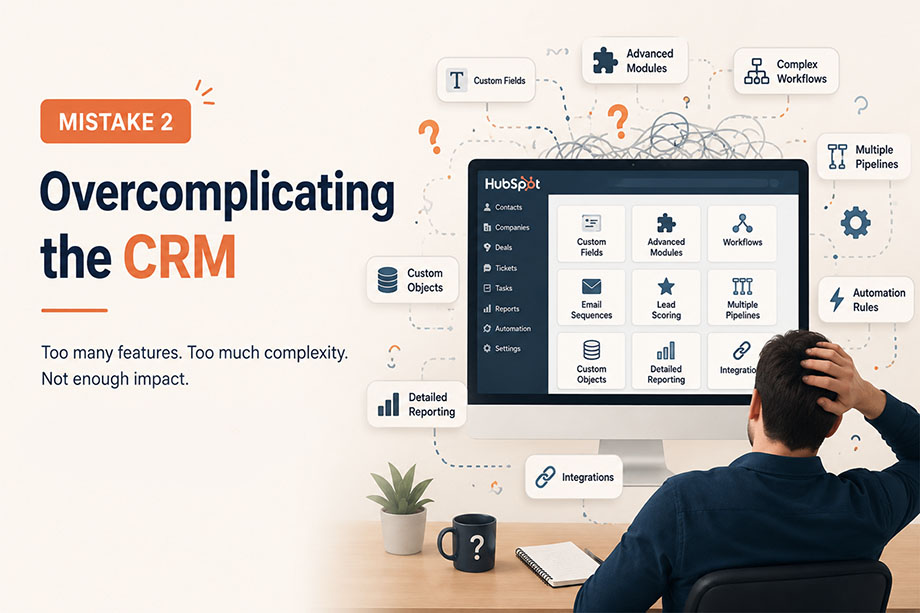
Organisations may be tempted to enable every feature offered by a CRM, like custom fields, advanced modules, and detailed workflows, particularly with robust platforms like HubSpot. However, incorporating excessive and unnecessary features can result in:
- A cluttered interface that slows down everyday tasks.
- Confusing workflows that discourage team members from using the system.
- Information overload, making it difficult to find what really matters.
How to address the issue?
Use only essential features. Begin with fundamental functionalities, prioritising the 20% of features that address 80% of organisational requirements.
- Limit your custom fields and create only those that are genuinely useful. For example, ‘Lead Source’ and ‘Industry’ may be essential, while ‘Favourite Ice Cream Flavour’ is likely unnecessary.
- Streamline dashboards by configuring the CRM homepage to display key information, like daily tasks or new leads.
- Introduce additional features incrementally. Core functionalities, like contact management, should be mastered before implementing complex automations or integrations.
Maintaining a simple CRM configuration promotes efficiency, usability, and greater team adoption.
Mistake 3: Poor Data Management
Poor data leads to Garbage in Revenue out!! According to Gartner, poor data quality costs organisations at least $12.9 million a year on average.
The effectiveness of a CRM system is determined by the quality of its data. The common challenges of poor data management include:
- Duplicate contacts, which result in confusion and redundant communications.
- Incomplete or inconsistent data, which compromises the reliability of segmentation and reporting.
- Outdated records, which introduce irrelevant information and clutter the system.
How to Maintain Clean CRM Data?
- Establish data entry standards and ensure consistent formatting for names, phone numbers, and addresses across all records.
- Regularly merge duplicate records using data deduplication tools provided by most CRM systems to prevent multiple versions of the same contact.
- Ensure completion of key fields by identifying essential information for the business, such as ‘Lead Source’ or ‘Last Contact Date’, and ensure they are always filled in.
- Schedule regular data audits and allocate time each quarter to remove outdated or incorrect records.
- Use validation tools to automate data cleaning processes, identifying invalid email addresses and duplicate entries when possible.
- A well-maintained CRM system increases operational efficiency, enhances reporting accuracy, and strengthens customer relationships.
Mistake 4: Slow Lead Response
Leads often become inactive when they are not promptly addressed in the customer relationship management system. Approximately 51% of leads are never contacted, and nearly 71% of internet leads are lost due to inadequate follow-up.
How to address the issue?
Implement CRM-based lead routing rules and automated acknowledgements within five minutes of form submission.
Mistake 5: No Pipeline Hygiene
Many organisations mistakenly view a crowded pipeline as healthy. In reality, outdated, stalled, or unqualified deals inflate forecasts and hide true revenue gaps. As a result, sales teams waste resources on unlikely opportunities.
Even, studies show that 56% of B2B deals are lost to “no decision” rather than competitors. Organisations lose about 26% of annual revenue to stalled or slipping deals. Limited pipeline visibility also reduces forecasting accuracy, with only 20% of sales organisations forecasting within 5% of actual results.
This issue often stems from poor CRM discipline, such as lack of deal velocity tracking, unclear stage-exit criteria, and inconsistent loss reporting.
How to address the issue?
Implement weekly pipeline reviews, weighted forecasting based on deal probability, and mandatory completion of “Closed Lost” reason fields in the CRM.
Mistake 6: Low User Adoption
A CRM system is effective only if sales teams use it consistently. Many representatives see CRM as an administrative burden rather than a tool for sales effectiveness. This leads to incomplete data, missed updates, and limited visibility for leadership.
How to address the issue?
Effective solutions include simplifying data entry, automating activity tracking with email and calendar integrations, and using CRM insights for coaching instead of only compliance monitoring.
Struggling With Low CRM Adoption and Lost Opportunities?
Mercurius IT helps businesses streamline CRM processes, improve user adoption, and create connected sales systems that improve conversion rates.
Mistake 7: Treating CRM as a Tool, not a System
Many organisations use CRM as a standalone system without integration with marketing, customer support, ERP, or analytics platforms. This leads to fragmented customer data, inconsistent reporting, and missed cross-department opportunities.
Studies show organisations using generative AI in CRM systems are 83% more likely to exceed sales targets. In contrast, 87% of enterprises failed to meet revenue goals despite major investments in sales technology, mainly due to disconnected systems and inconsistent pipeline data.
How to address the issue?
The solution is to audit current CRM integrations and prioritise connections between CRM, marketing automation, and customer support systems to build a connected and intelligent sales ecosystem.
Conclusion
CRM systems typically fail due to poor execution, disconnected processes, and low adoption, not because of technology. And the good news is that issues can be resolved with the right strategy and implementation. Businesses that respond to leads quickly, maintain accurate pipeline data, encourage CRM usage, and integrate systems effectively are more likely to increase conversions and protect revenue.
As a trusted CRM implementation partner, Mercurius IT helps businesses optimise their CRM systems to improve adoption, visibility, and sales performance.
Frequently Asked Questions
What is the most common CRM mistake?
The most common CRM mistake is poor user adoption and inconsistent data management. Many businesses invest in CRM platforms but lack clear workflows, automation, and user training. This leads to inconsistent record updates, inaccurate customer data, and limited pipeline visibility for leadership. A CRM system is valuable only when it is actively used, well maintained, and aligned with business processes.
Why is CRM data quality important?
CRM data quality directly affects forecasting, customer engagement, and sales decisions. Incomplete, outdated, or duplicate records create confusion and cause missed opportunities. Accurate CRM data improves reporting, personalises customer interactions, and supports better strategic decisions.
What is a common mistake in the sales process?
A common sales process mistake is delayed lead follow-up. Businesses may generate leads but fail to respond promptly, causing prospects to lose interest or choose competitors. Slow responses, unclear lead ownership, and weak follow-up workflows reduce conversion rates. Automated lead routing and CRM alerts help sales teams respond faster and improve qualification rates.
What should businesses look for in a CRM implementation partner?
Businesses should look for a CRM implementation partner with strong industry experience, process expertise, integration capabilities, and ongoing support services. A reliable partner helps align CRM systems with business goals, improve user adoption, and ensure long-term scalability rather than simply deploying software.