
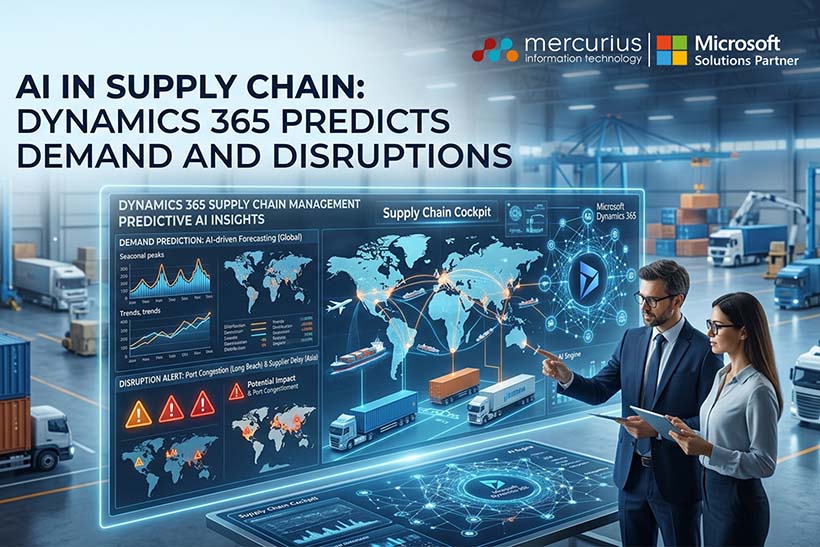
Quick Summary
AI-powered Dynamics 365 enables supply chains to predict demand, prevent disruptions, optimise inventory, and facilitate faster, data-driven decision-making. These capabilities enhance operational efficiency and support business resilience during periods of market uncertainty.Key Takeaways
- AI-powered forecasting improves demand prediction accuracy. This helps companies avoid running out of stock and keeps extra inventory to a minimum.
- Organisations can identify supplier delays, logistics issues, and market changes before they affect operations.
- AI helps manage inventory, schedule production, and handle logistics more efficiently, allowing organisations to cut costs.
- With Dynamics 365 in supply chain management, decision-makers get predictive insights by combining demand sensing, scenario planning, and real-time data.
- Adopting AI early helps build supply chains that are efficient, resilient, and better able to handle ongoing changes in the market.
Today, supply chains face constant disruption instead of occasional surprises. Demand changes quickly, suppliers encounter unexpected problems, and global events make logistics unpredictable. Still, many companies use old planning models based on past data and scheduled forecasts.
The gap between how supply chains work and how they are planned often causes problems like excess inventory, product shortages, and last-minute decisions. In fact, Research shows that using AI for forecasting can make demand predictions 20 to 50% more accurate and cut stockouts by up to 65 percent.
Now, business leaders are not asking if disruptions will happen, but how soon they can identify and handle them. AI-driven Dynamics 365 in the supply chain helps companies move from reacting to problems to predicting and preventing them. This blog explains how AI-powered Dynamics 365 supports supply chain management.
Detailed Market Analysis of AI and Microsoft Dynamics 365
The AI technology market is growing rapidly and is expected to increase by $1.8 trillion by 2030. (SOURCE). Another source shares that by 2030, the AI market for supply chains is expected to reach $41.23 billion, driven by the need for greater efficiency and better management of complex logistics. AI-powered supply chains have shown over 67% more effectiveness than traditional systems in reducing risks and cutting costs.
The Growing Role of AI in Supply Chain Decision-Making
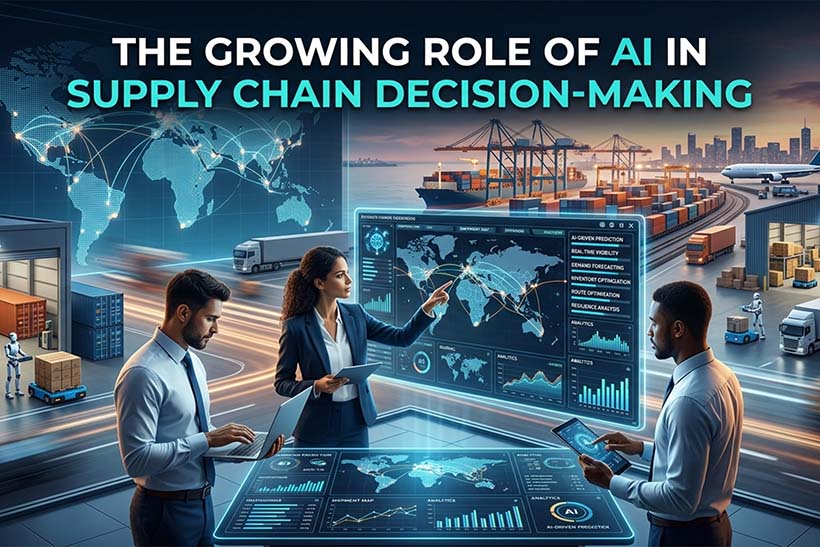
Traditionally, supply chains relied on historical data. Teams reviewed past sales, created forecasts, and planned inventory. However, today’s market often behaves unpredictably compared to the past.
Demand shifts rapidly. Suppliers encounter unexpected disruptions. Even transportation delays and global events can alter supply with little notice. Therefore, relying solely on historical averages makes timely responses more difficult. AI is transforming the entire supply chain decision-making.
Rather than relying solely on past data, AI analyses multiple signals simultaneously, including sales patterns, supplier performance, market trends, transportation constraints, and external factors such as weather or geopolitical events. An AI-driven supply chain approach provides a clearer and more timely view of likely future developments.
The impact is substantial. Many companies adopting AI also report faster and more reliable delivery performance. For leaders, this shift is both simple and powerful: supply chains transition from reacting to problems to anticipating them before they occur.
Still Reacting to Supply Chain Disruptions After They Happen?
Use AI-powered Dynamics 365 to predict demand shifts, improve planning accuracy, and reduce operational risk.
How AI Predicts Demand More Accurately
Many companies still use historical data and spreadsheets to forecast demand. The problem is that the market no longer acts the way it used to.
Prices change, promotions drive sudden spikes, and even customer preferences shift faster than planning cycles can keep up. And by the time forecasts are updated, the opportunity, or the risk, has already passed.
AI changes this situation. It looks at real-time sales, current promotions, customer buying habits, and outside factors like weather or market trends. As new data arrives, AI keeps updating demand forecasts.
In the background, machine learning models use pattern recognition and predictive analytics to identify trends early, often before teams notice them. For business leaders, this leads to fewer surprises, faster planning, and better control over inventory risk, all without depending on old & static forecasts.
How Microsoft Dynamics 365 Uses AI to Predict Demand?
AI in Dynamics 365 makes forecasting an ongoing process instead of something done only at set times.
The process begins with demand forecasting. Machine learning models look at past trends, and as new data arrives, forecasts update automatically. So, there is no need for manual updates or waiting for the next planning cycle.
Next is demand sensing. The system uses real-time signals from sales channels, POS systems, and online activity, not just past data. Forecasts can change immediately as demand shifts, instead of taking weeks.
AI also helps with inventory decisions. It suggests the best stock levels for each warehouse, so businesses can avoid having too much in one place and not enough in another. AI-driven inventory optimisation can even cut excess stock by up to 50% and improve service levels.
When things are uncertain, scenario planning helps teams get ready. Leaders can test situations like sudden demand increases, supplier delays, or capacity limits, and see the effects before they happen.
So, instead of just reviewing old reports, leaders can see what’s coming. They can predict demand, react more quickly, and make decisions with greater confidence.
Real Supply Chain Decisions AI Can Improve
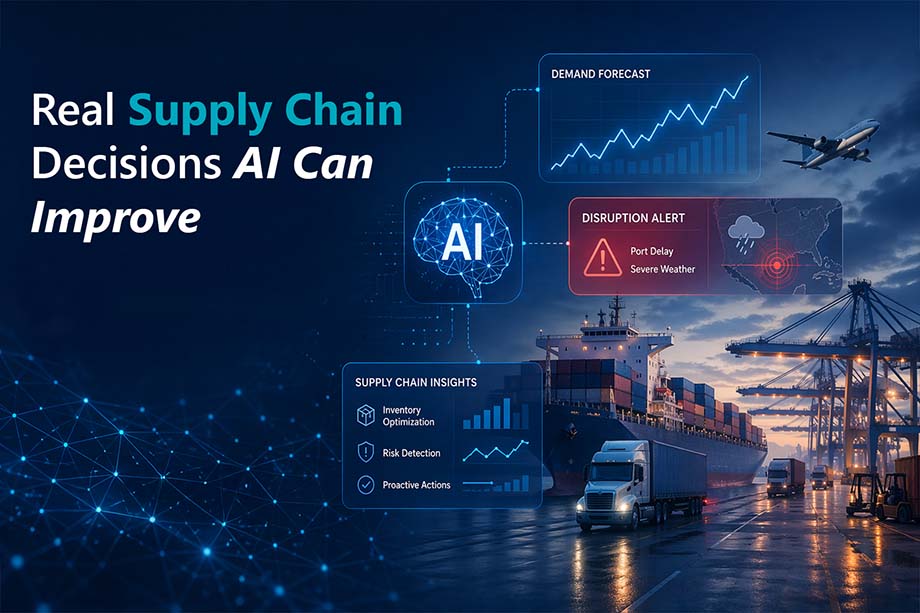
Artificial intelligence in supply chain management enables organisations to make informed decisions proactively, mitigating potential issues before they occur.
Traditionally, organisations respond to challenges such as low inventory, delayed shipments, or supplier failures only after they arise. The integration of artificial intelligence allows teams to anticipate and address these issues proactively, thereby minimising the risk of significant disruptions.
Here are the dynamics 365 supply chain management features where it creates the most value:
Inventory Planning
AI leverages real-time demand data to recommend optimal stock levels for each location. Organisations implementing AI have reduced inventory costs by 15-30% and increased product availability.
Procurement Decisions
AI analyses supplier performance and risk trends to identify potential delays in advance. This capability enables organisations to secure alternative suppliers and reduce the likelihood of disruptions. Even research indicates that AI can increase supplier reliability and decrease procurement costs by up to 15%.
Logistics Optimisation
Artificial intelligence continuously refines routing, delivery scheduling, and carrier selection. Organisations have reported logistics cost reductions of 10 to 25 per cent and accelerated delivery times because of AI-driven planning.
Production Scheduling
AI aligns production schedules with real-time demand forecasts, enabling manufacturers to avoid overproduction and last-minute adjustments. This approach increases operational efficiency and reduces waste.
Promotion Planning
Artificial intelligence integrates demand forecasts with marketing campaigns to ensure inventory levels align with anticipated demand surges. This strategy helps prevent stockouts during peak periods and stabilises revenue.
Real Business Outcomes Companies Are Seeing

AI is making a real difference in supply chains. Companies using AI-driven planning are seeing clear improvements in key supply chain metrics.
Demand forecasting accuracy improves while giving teams a much more reliable basis for planning. Companies have also seen up to a 45 percent drop in stockouts, which helps protect both revenue and customer experience.
AI helps businesses reduce inventory levels by 20 to 30% while still maintaining high service levels, something hard to achieve with traditional planning. By basing decisions on real-time data, supply chain teams can act up to 35% faster.
For leaders, the benefits go beyond just efficiency. These results mean leaner operations, quicker responses, and stronger resilience. This helps organisations work with more confidence, even when things are uncertain.
Turn Supply Chain Data into Faster Decisions
Connect forecasting, inventory, and operations with Dynamics 365 to improve visibility and respond faster to disruptions.
What Business Leaders Should Consider Before Adopting AI Supply Chains
Artificial intelligence has the potential to transform supply chains, provided that foundational prerequisites are established.
- Data readiness- The effectiveness of AI depends on the availability of clean and integrated data. In the absence of such data, even advanced models cannot generate accurate insights.
- Cross-functional alignment- Supply chain decisions involve collaboration among sales, procurement, finance, and operations. AI generates value when these functions operate from a unified data perspective.
- Technology integration- AI is most effective when integrated into core enterprise systems, like Microsoft Dynamics 365, to enable seamless, real-time decision-making.
- Change Management- Successful adoption of AI requires organisational teams to trust the insights generated and adapt their workflows accordingly. Without this cultural shift, advanced technologies may remain underutilised.
The Future of AI-Driven Supply Chains
Supply chains are increasingly becoming intelligent and self-optimising. The next phase involves a transition toward agentic artificial intelligence systems capable of prediction, decision-making, and action with minimal human intervention. Early adoption of capabilities such as autonomous planning, AI agents, AI-powered control towers, real-time digital twins, and logistics networks that continuously optimise based on changing conditions is already evident.
The momentum behind this transformation is significant. The AI supply chain market has reached $19.8 billion and is expanding at over 45% annually, indicating rapid organisational investment in these technologies.
For business leaders, this development represents a strategic direction rather than speculative future potential. Organisations that invest at this stage are constructing supply chains that are not only efficient but also predictive, resilient, and prepared for ongoing disruption.
Conclusion
AI is redefining how decisions are made in supply chain management. It has shifted organisations from delayed responses to real-time and predictive action. With Microsoft Dynamics 365, businesses can forecast demand with greater accuracy, identify disruptions earlier, and optimise inventory and logistics without constant manual intervention.
Organisations implementing AI in supply chains report improved forecast accuracy and substantial reductions in both stockouts and excess inventory.
For business leaders, these advancements extend beyond operational efficiency. To fully realise the benefits of AI integrated with Dynamics 365, collaboration with an experienced Microsoft solutions partner is essential. Mercurius IT offers expertise in this domain.
Frequently Asked Questions
How does AI improve demand forecasting?
AI analyses real-time sales data, customer behaviour, promotions, and external factors such as weather and market trends. Machine learning models identify patterns and continuously update forecasts, increasing accuracy by 20–35% and reducing stockouts and excess inventory.
What is demand sensing in supply chains?
Demand sensing applies AI to analyse real-time signals from sales channels, POS systems, and online activity. It dynamically adjusts forecasts, enabling businesses to respond quickly to sudden demand changes rather than relying solely on historical data.
How does Dynamics 365 use AI for supply chain planning?
Dynamics 365 uses AI for the following supply chain functions:
- Demand forecasting: Machine learning automatically updates forecasts.
- Inventory optimisation: AI recommends optimal stock levels across warehouses.
- Scenario planning: AI simulates disruptions, demand spikes, and capacity constraints.
- Demand sensing: AI adjusts predictions in real-time.
Can AI really predict supply chain disruptions?
Yes. AI evaluates supplier performance, logistics constraints, market signals, and external risks to identify potential disruptions early. Organisations using AI report greater resilience, fewer stockouts, and more proactive decision-making.