
Quick Summary
AI chatbots help businesses deliver faster support, personalised experiences, and scalable customer engagement while reducing service costs and improving operational efficiency across customer touchpoints.
Key Takeaways
- AI chatbots deliver instant, always-on support while reducing service workloads.
- CRM-integrated chatbots enable personalised customer interactions on a scale.
- Proactive engagement helps improve customer satisfaction and retention rates.
- Enterprise integrations unlock greater automation and operational efficiency.
- Future-ready chatbots combine AI automation with human expertise for better outcomes.
According to Gartner, 91% of customer service leaders report pressure from executive leadership to implement AI by 2026. This urgency signals a fundamental transformation in organisational approaches to customer service, engagement, and sustainable growth.
Customer expectations have reached unprecedented levels. Consumers increasingly demand immediate responses, personalised interactions, and seamless support across all channels at any time. Concurrently, businesses encounter mounting pressure to manage higher service volumes, enhance operational efficiency, and control costs.
At such stage, traditional customer service models frequently struggle to address these demands, which complicates efforts to deliver exceptional customer experiences at scale. That is why AI-powered chatbots are rapidly emerging as a strategic investment for businesses. Unlike the scripted FAQ bots of previous years, AI chatbots for customer service leverage technologies like natural language processing (NLP), machine learning, and generative AI to interpret customer intent, deliver contextual responses, automate routine enquiries, and provide continuous support.
This blog examines how AI chatbots are changing customer interactions, enhancing service efficiency, and enabling organisations to deliver the responsive, intelligent, and customer-centric experiences required by today’s market.
Why Conversational Customer Engagement is Becoming the Preferred Channel
Remember when sales reps could smooth-talk their way into a deal over the phone? Well, those days are gone!
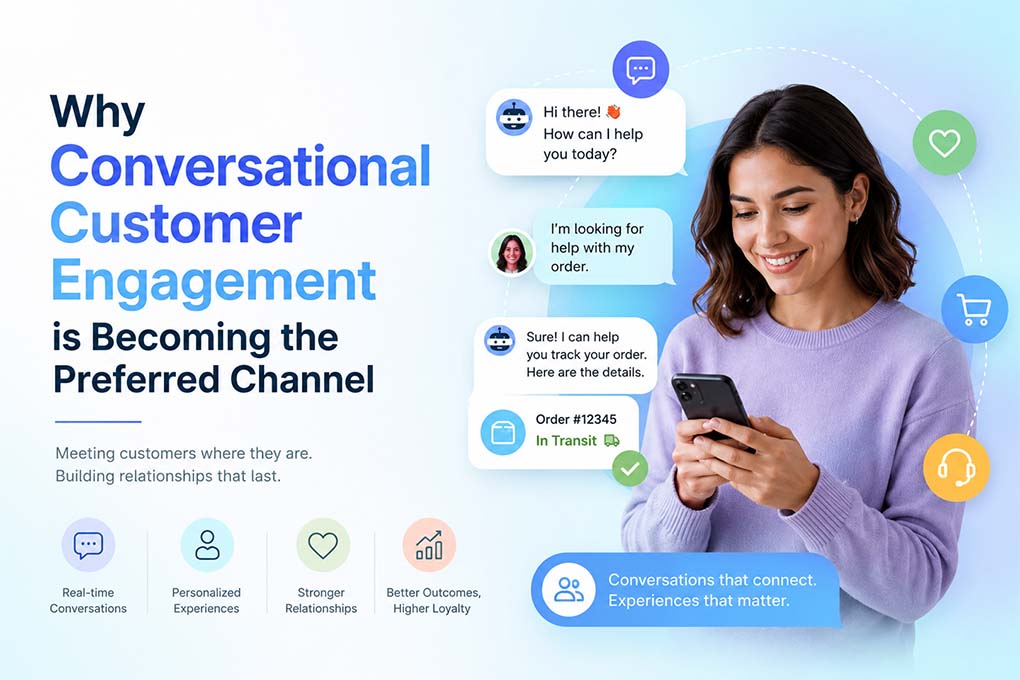
Today’s consumers are dodging emails, ignoring calls, and treating sales pitches like spam filters treat junk mail. And the numbers don’t lie: 78% of consumers want the option to text any business, and 74% say they would buy from a company that lets them message instead of call.
This is not a temporary change but a significant trend. The Economist refers to this as the ‘hermit consumer age,’ a shift accelerated by COVID-19. Many now prefer upgrading their home office to dining out, using self-checkout instead of interacting with cashiers, and texting AI chatbots rather than speaking with a representative.
Why such a shift? Let’s be honest, we are getting less patient now. And texting is a faster, easier, and less intrusive way while doing multi-tasking. You can share links, documents, and photos when needed. Something that staying on a call can’t do.
So, how can businesses adapt to retain customers in a messaging-first environment?
Well, there are ample ways to stay updated with it.
Real-World Impact: What AI Chatbots Are Actually Delivering for Businesses
Although AI chatbots are frequently discussed as technology solutions, business leaders now assess them by measurable outcomes. Organisations using chatbots share reduced service costs and improved customer satisfaction as a positive impact on customer service.
Faster Responses and Higher Resolution Rates
AI chatbots allow organisations to respond instantly to customer enquiries and resolve many routine requests without agent involvement.
Lower Cost per Interaction
Traditional support channels require significant staffing to manage increasing volumes of enquiries. AI chatbots can manage thousands of conversations at once, reducing support costs while maintaining service quality.
Improved Customer Satisfaction
AI chatbots provide immediate, 24/7 assistance, reducing customer effort and increasing satisfaction. Organisations that combine AI automation with human support often see higher CSAT and improved service experience.
Top Industries Benefitting from AI Chatbots
- Retail: Chatbots support product discovery, order tracking, and returns, helping retailers increase conversion rates and reduce support workloads.
- Banking and Financial Services: Financial institutions use AI chatbots for account enquiries, payment support, and fraud assistance, ensuring 24/7 service availability.
- Healthcare: Providers use AI chatbots for appointment scheduling, patient FAQs, and follow-up communications, reducing administrative workload and improving patient access to information.
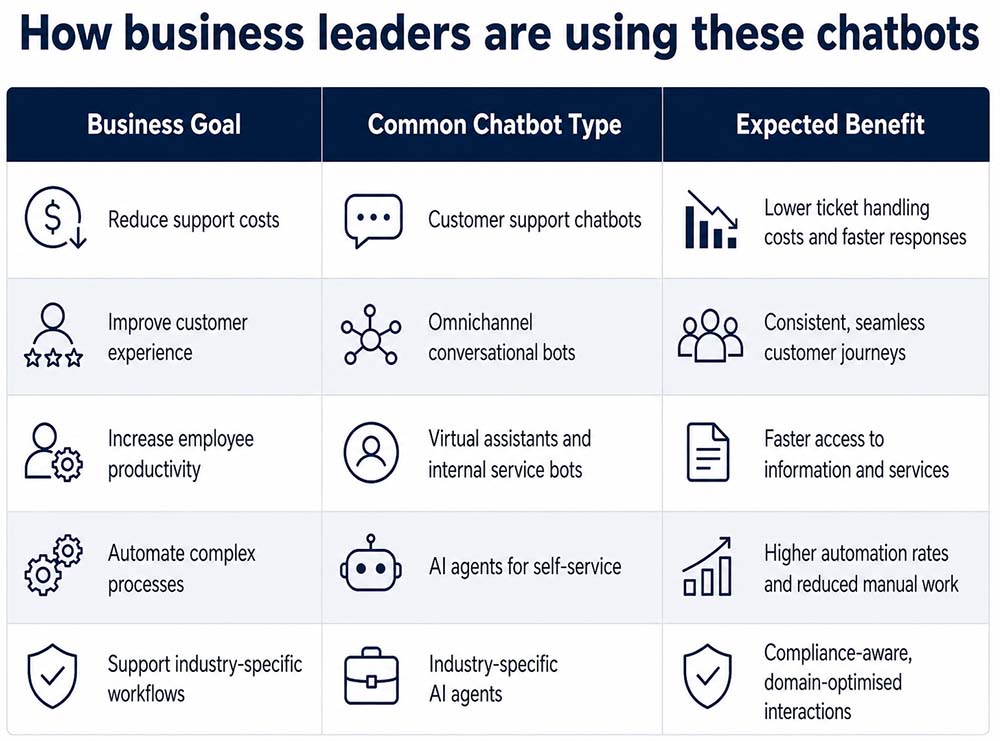
For many organisations, the business case has shifted from whether AI chatbots can automate interactions to how effectively they improve service efficiency, enhance customer experience, and deliver measurable ROI at scale. Here are some of the ways where in businesses are using AI chatbots to transform their customer service and deliver exceptional user experiences.
Types of AI Chatbots Businesses Are Using
1. Customer Support Chatbots
These are the most common AI chatbots used in customer service. They handle routine enquiries such as order tracking, account updates, billing questions, appointment scheduling, and FAQ responses. Modern versions use natural language processing and generative AI to understand customer intent and provide more contextual answers.
Typical use cases
- E-commerce order tracking
- Banking balance and transaction queries
- Telecom service requests
- Travel booking support
2. AI Virtual Assistants
Virtual assistants are broader than customer support bots. They help users’ complete tasks, retrieve information, and navigate systems through conversational interactions.
Typical use cases
- HR policy questions
- IT helpdesk support
- Sales assistant recommendations
- Executive knowledge retrieval
3. AI Agents for Self-Service
Unlike basic chatbots that answer questions, AI agents can take actions on behalf of users. They can initiate workflows, update records, process requests, and coordinate with enterprise systems.
Typical use cases
- Processing returns and refunds
- Resetting passwords and provisioning access
- Scheduling service appointments
- Updating customer records automatically
4. Omnichannel Conversational Bots
These bots maintain consistent conversations across multiple channels, like websites, mobile apps, WhatsApp, SMS, social media, email, and voice interfaces. In this, customers can start a conversation in one channel and continue it in another without losing context.
Typical use cases
- Retail customer journeys across web and messaging apps
- Banking support across chat, voice, and mobile
- Healthcare appointment and follow-up communications
The biggest gains come from integrating AI with business systems. The organisations seeing the greatest value are integrating conversational AI with CRM, ERP, contact centre, and knowledge management systems so the chatbot can access real customer context and take meaningful actions.
How AI Chatbots Are Transforming Customer Service & Customer Experience
Today, leading organisations are using conversational AI to create more personalised, proactive, and seamless customer experiences across the entire customer journey. Here are the ways AI chatbots are changing customer experience:
Proactive Customer Engagement
Traditional customer service responds only after a customer raises a question or issue. AI chatbots enable a proactive approach by anticipating needs and initiating relevant interactions. By sending order updates, payment reminders, appointment notifications, or product recommendations, chatbots engage customers before issues arise, increasing satisfaction and loyalty.
Personalisation at Scale Through Customer Data
Modern AI chatbots integrate with CRM and customer data platforms to deliver more relevant interactions. By using customer history, preferences, and past interactions, businesses can offer tailored recommendations, personalised support, and contextual conversations.
Improving Customer Experiences During Complex Interactions
Advanced AI chatbots analyse customer sentiment and conversation context to identify frustration, urgency, or dissatisfaction. When necessary, they escalate interactions to human agents, ensuring customers receive appropriate support.
Meeting the Always-On Customer Expectation
AI chatbots enable organisations to provide consistent assistance across channels and time zones, allowing customers to access information and resolve issues whenever needed.
Integrating AI Chatbots with your Existing Business Systems
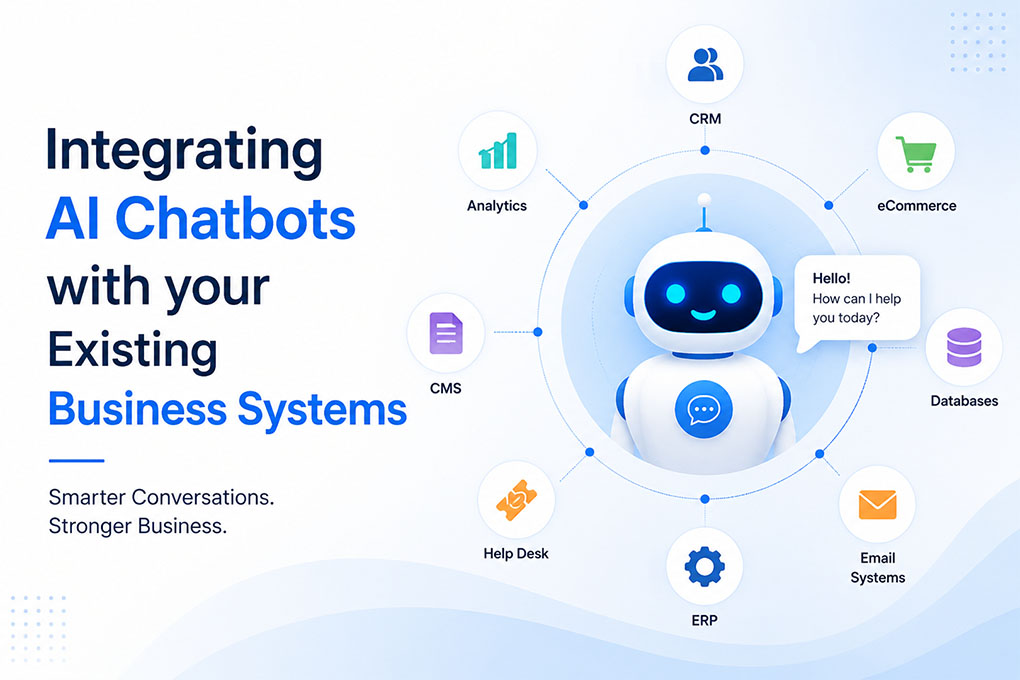
AI chatbots provide the most value when integrated with systems that support customer service and business operations. Below are the business systems that AI chatbots can seamlessly integrate with:
1. CRM Integration for Delivering Personalised Interactions
Connecting AI chatbots to CRM platforms like Dynamics 365 CRM, Salesforce or HubSpot enables access to customer profiles, purchase history, and service records. This supports more relevant recommendations, faster resolutions, and a personalised customer experience.
2. Contact Centre Integration for Combining AI and Human Expertise
Integrating Dynamics 365 contact centre platforms allows seamless escalation to human agents with full conversation history and context, improving resolution times and ensuring a consistent customer experience.
3. Knowledge Base Integration for Improving Accuracy and Consistency
Integrating chatbots with knowledge bases ensures they provide accurate, current information in every customer interaction. This reduces inconsistent responses and delivers reliable answers across all channels and times.
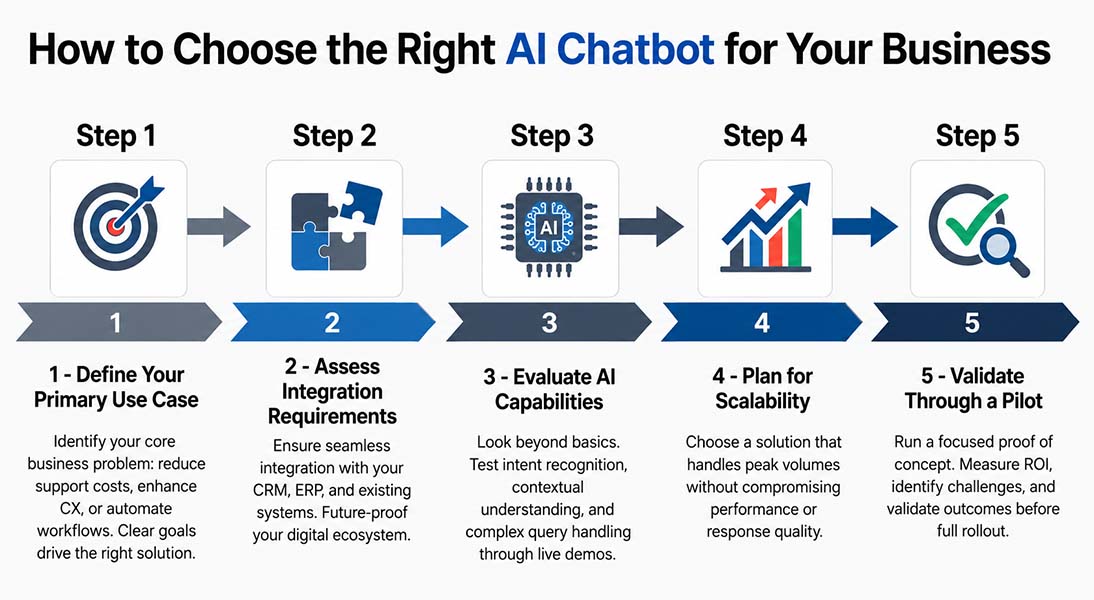
How to Choose the Right AI Chatbot for Your Business
Selecting the right AI chatbot means finding a solution that aligns with your business objectives, customer expectations, and operational needs, rather than simply choosing the most advanced technology.
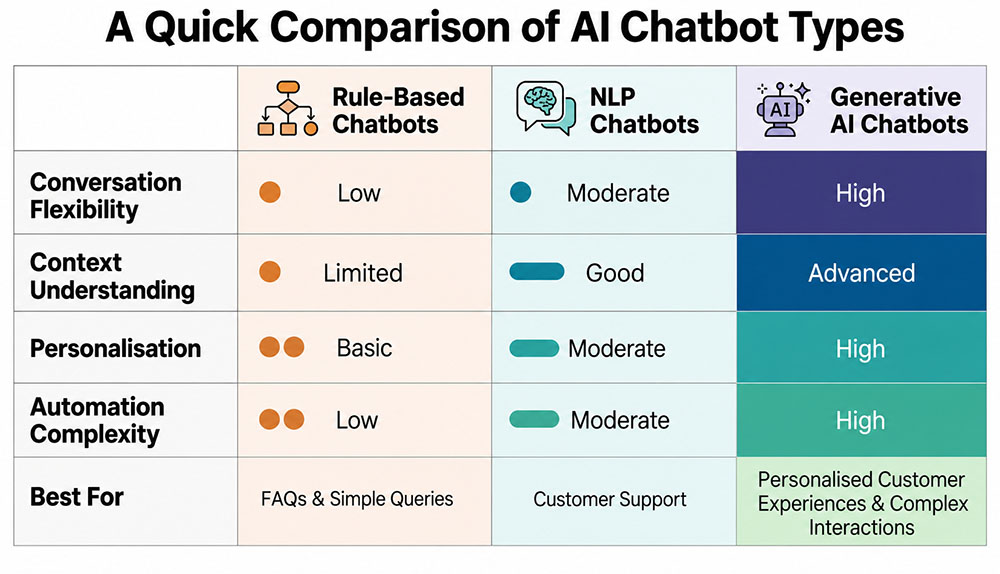
A Quick Comparison of AI Chatbot Types
Choosing the right AI chatbot involves balancing business goals, customer experience, integration capabilities, and scalability. Organisations that use a structured evaluation approach are more likely to achieve measurable returns and long-term success from their AI investments.
Looking to evaluate AI chatbot solutions for your organisation?
Speak with our experts to explore the right approach for your customer service, customer experience, and automation goals.
The Future of AI Chatbots in Customer Service
AI chatbots are evolving from simple conversation tools to intelligent assistants that understand context, take action, and support complex customer interactions. In the coming years, organisations will prioritise seamless, AI-enabled customer experiences over automation alone.
Agentic AI: From Answers to Actions
The next generation of AI chatbots will not only respond to customer enquiries but also complete tasks on a customer’s behalf. From processing service requests and updating account information to initiating workflows across business systems, agentic AI has the potential to significantly reduce customer effort while increasing service efficiency.
Voice and Text Convergence
Businesses are adopting conversational AI platforms that support both voice and text interactions through a unified intelligence layer. This enables customers to move seamlessly between channels and receive a consistent experience. In fact, a Gartner survey reveals that 85% of Customer Service Leaders will explore or pilot customer-facing conversational generative AI.
Hyper-Personalised Customer Experiences
As AI integrates with CRM and customer data platforms, chatbots will deliver more personalised interactions based on customer behaviour, preferences, and real-time context. This will help businesses improve engagement and loyalty.
Emotional Intelligence and Smarter Escalation
Advances in sentiment analysis enable AI chatbots to better recognise customer frustration, urgency, and intent. Organisations can then escalate sensitive or complex interactions to human agents more effectively, improving overall customer experience.
Ready to Explore AI Chatbots for Your Business?
Whether your goal is to improve customer service, automate routine tasks, or deliver more personalised experiences, an effective AI chatbot strategy can help you achieve measurable results.
Bottom Line – The Future Is Human-AI Collaboration
AI will increasingly support, rather than replace, customer service teams. Chatbots will manage routine enquiries and administrative tasks, allowing human agents to focus on complex problem-solving, relationship building, and high-value interactions.
For business leaders, the future of customer service will depend on how effectively organisations combine AI capabilities with human expertise to deliver faster, more personalised, and scalable customer experiences.
The greatest value comes from integrating chatbots with the existing systems, data, and processes that support the customer journey. Businesses that align chatbot initiatives with clear customer experience and operational goals will be better positioned to deliver faster, more personalised, and scalable service.
Frequently Asked Questions
How are AI-driven chatbots transforming customer service in online stores?
AI-driven chatbots provide online stores with instant, 24/7 support and personalised shopping experiences. They manage FAQs, recommend products, assist with checkout, and follow up with customers to increase engagement and retention. Using Contact Centre Artificial Intelligence (CCAI), chatbots analyse customer sentiment, resolve issues quickly, and escalate complex queries to human agents when needed.
What are the benefits of AI chatbots in customer service?
AI chatbots enable faster response times, 24/7 support, and consistent service across channels. They automate routine enquiries, reduce agent workloads, lower costs, and enhance customer satisfaction by providing quick, accurate assistance at scale.
Can AI chatbots replace customer service agents?
No, AI chatbots are intended to support, not replace, customer service agents. Chatbots handle repetitive, high-volume enquiries efficiently, while human agents are essential for complex issues, relationship management, and situations requiring empathy, judgment, or problem-solving.
How do AI chatbots improve customer experience?
AI chatbots enhance customer experience by offering instant support, personalised interactions, proactive communication, and 24/7 availability. They reduce wait times and deliver relevant information quickly, creating more convenient and seamless customer journeys across digital channels.
What industries benefit most from AI chatbots?
AI chatbots add value across industries like retail, banking and financial services (BFSI), healthcare, telecommunications, travel, insurance, and e-commerce. Organisations with high volumes of customer interactions can use AI chatbots to improve service efficiency, engagement, and scalability.
How much does an AI chatbot cost to implement?
The cost of implementing an AI chatbot depends on functionality, integration needs, AI capabilities, and deployment scale. Basic solutions may cost a few thousand pounds per year, while enterprise-grade chatbots integrated with CRM, ERP, and customer service platforms require a larger investment.