
Quick Summary
Choosing a 3PL software vendor is rarely a technology decision. It’s an operational decision with technology consequences. The right platform helps you scale customers, automate billing, improve warehouse productivity and gain real-time visibility across your operation. The wrong platform creates manual work, reporting headaches and expensive replacement projects a few years later.
Key Takeaways
- Evaluate 3PL software against your actual operating model.
- Prioritise automated billing and customer-specific pricing.
- Check warehouse, finance and ERP integration capabilities.
- Assess customer visibility and real-time reporting.
- Use a weighted scorecard to evaluate vendors objectively.
- Watch for customisation, billing and logistics expertise red flags.
- Choose a platform that can support your growth plan
Use the checklist in this guide to evaluate vendors objectively, compare solutions consistently and make a decision that supports long-term growth.
How Much Can Choosing the Wrong 3PL Software Vendor Cost?
More than most logistics businesses expect.
Software projects rarely fail during implementation. They fail when growth exposes weaknesses that were hidden during the buying process.
Customer-specific pricing becomes difficult to manage. Billing teams spend hours checking invoices manually. Warehouse supervisors create spreadsheets to compensate for missing functionality. Reporting takes longer every month, and operational visibility gets worse rather than better.
Let’s put some numbers around that.
Imagine a mid-sized 3PL investing:
- £80,000 in implementation
- £20,000 in training
- £25,000 in integrations
- £15,000 in internal project time
That’s a £140,000 investment before considering licence costs.
Now imagine discovering two years later that the software cannot support your customer billing model, warehouse workflows or growth plans.
A replacement project often means repeating most of that investment while disrupting everyday operations.
That’s why experienced logistics leaders don’t start by looking at software features.
They start by asking a different question:
Can this platform support our business three years from now, not just three months from now?
The answer usually determines whether the project becomes a growth enabler or a costly lesson.
What Should a Modern 3PL Software Platform Actually Do?
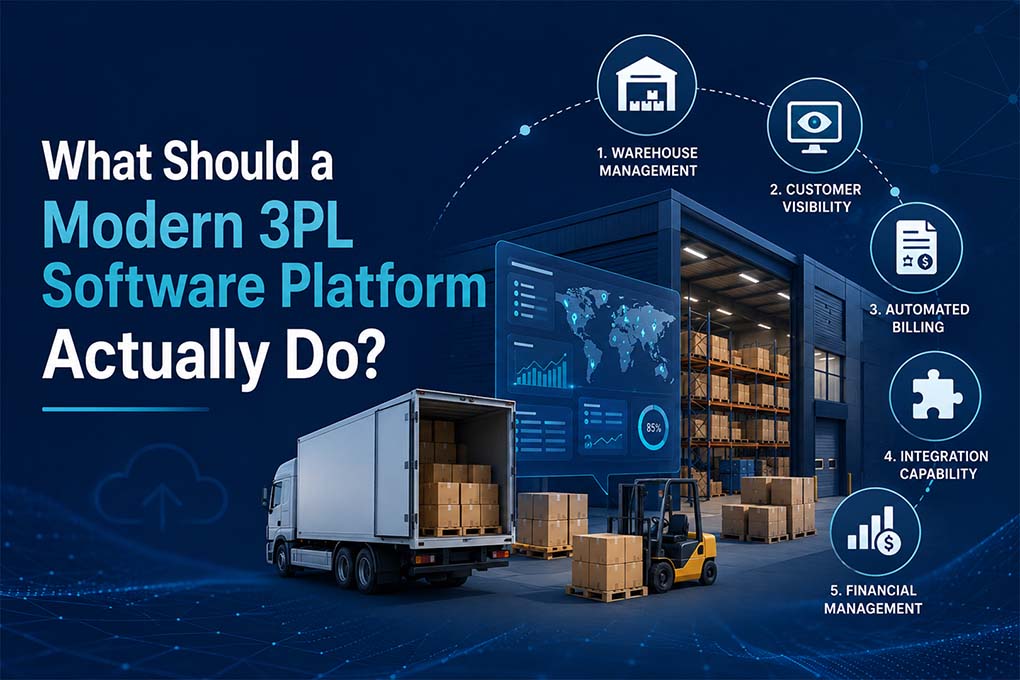
A modern 3PL platform should connect warehouse operations, customer management, billing and finance within a single ecosystem.
The logistics industry has changed significantly over the last decade. Warehouses are no longer storage facilities alone. Many now handle value-added services, e-commerce fulfilment, returns processing, contract logistics activities and customer-specific workflows. UK warehousing space has grown substantially since 2015, reflecting the increasing importance and complexity of warehouse operations.
As operational complexity increases, software requirements become more demanding.
Every vendor you evaluate should demonstrate capability across five key areas.
1. Warehouse Management
A Warehouse Management System (WMS) manages receiving, putaway, inventory control, picking, packing and dispatch activities.
Look for functionality such as:
- RF scanning
- Barcode management
- Cycle counting
- Cross-docking
- Quality control
- Location management
- Inventory traceability
Boltrics’ WMS includes capabilities such as RF scanning, cycle counting, cross-docking, quality control and value-added logistics functionality designed specifically for logistics service providers.
2. Customer Visibility
Customer expectations have changed.
Most clients now expect access to inventory levels, shipment status, order information and operational performance without having to email or call your team.
The best platforms provide self-service visibility through customer portals and real-time reporting capabilities.
3. Automated Billing
Billing often becomes the biggest operational bottleneck in growing 3PL businesses.
Storage fees, handling charges, transport costs and value-added services all need to be captured accurately and invoiced consistently.
The more manual intervention required, the greater the risk of margin leakage.
4. Integration Capability
Warehouse software does not operate in isolation.
It needs to exchange information with ERP systems, carriers, customer platforms and reporting tools.
Every integration gap eventually becomes a manual process.
5. Financial Management
This is where many evaluations fall apart.
Warehouse operations generate data. Finance teams need insight.
Without a connected ERP platform, businesses often end up maintaining separate operational and financial systems, resulting in duplicated effort and inconsistent reporting.
Microsoft Dynamics 365 Business Central combines finance, inventory, purchasing, supply chain and reporting within a single cloud ERP platform used by more than 50,000 companies worldwide.
Build a Stronger 3PL Technology Foundation
Connect warehouse operations, customer management, billing and finance through a platform built around your logistics requirements.
Which Type of Logistics Business Are You?
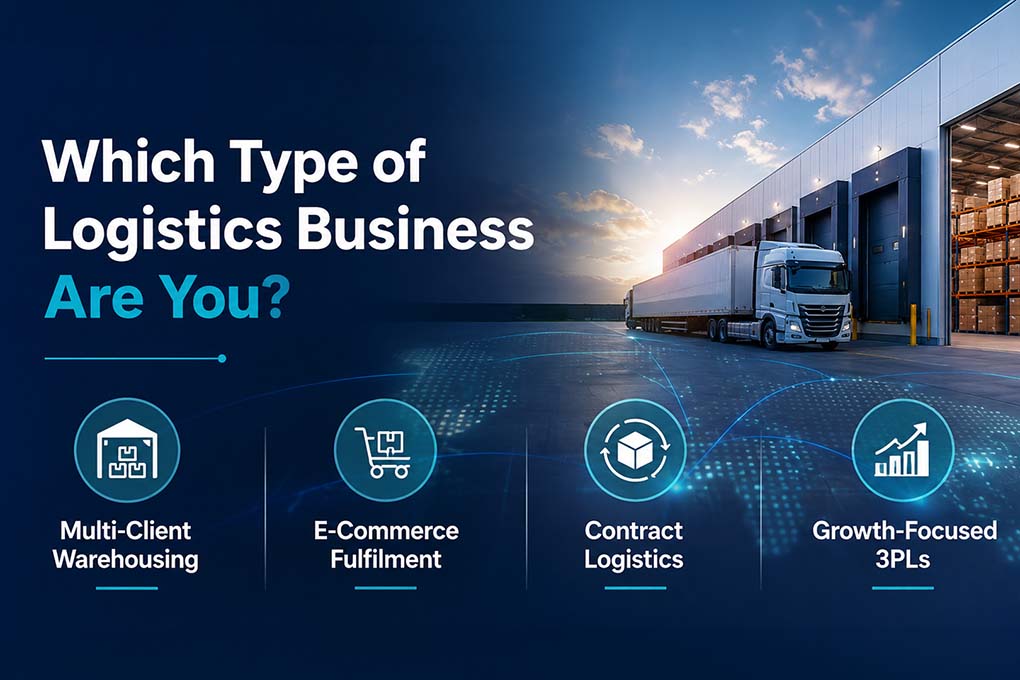
Different logistics models require different software priorities.
One of the biggest mistakes buyers make is assuming every 3PL operates in the same way.
They don’t.
A multi-client warehousing operation faces very different challenges from an e-commerce fulfilment provider or a contract logistics operator.
Multi-Client Warehousing
Multi-client warehouses require:
- Customer-specific tariffs
- Stock segregation
- Flexible billing models
- Customer visibility
- Contract management
The ability to manage complexity becomes more important than basic warehouse functionality.
E-Commerce Fulfilment
E-commerce businesses prioritise:
- High order volumes
- Fast picking and packing
- Marketplace integration
- Real-time inventory visibility
- Returns management
Speed and automation matter more than almost anything else.
Contract Logistics
Contract logistics providers often require:
- SLA management
- Labour tracking
- Customer profitability reporting
- Multi-site visibility
- Operational analytics
Reporting capability becomes a strategic requirement rather than an operational convenience.
Growth-Focused 3PLs
Businesses planning significant expansion need:
- Cloud deployment
- Scalable architecture
- Standardised processes
- Strong integration capability
- Continuous product innovation
Boltrics states that its logistics platform has been developed using best practices from more than 300 logistics service providers operating globally.
That’s worth paying attention to because logistics-specific expertise is often more valuable than generic software capability.
What Questions Should You Ask Every Vendor?
Most software demonstrations are sales presentations. Great buying decisions come from asking better questions.
Use the same evaluation criteria for every vendor.
That creates consistency and removes emotion from the process.
Operational Questions
- How many logistics companies currently use your software?
- Which warehouse processes are managed natively?
- How are customer-specific workflows configured?
- How do you handle value-added services?
- How do you support multi-client warehouse operations?
Billing Questions
- How is storage billing managed?
- How are handling charges calculated?
- How are customer tariffs maintained?
- Which billing activities are automated?
- How much manual intervention is typically required?
Integration Questions
- Which ERP systems integrate with the platform?
- Which carrier integrations exist today?
- How are new integrations developed?
- Is API access included?
Customer Experience Questions
- Is a customer portal included?
- Which information can customers access in real time?
- Can customers generate their own reports?
Vendor Questions
- How often is the software updated?
- What happens after implementation?
- What support model is provided?
- Can we speak with existing logistics customers?
Simple, right?
The goal isn’t to find impressive answers.
The goal is to identify whether the vendor truly understands logistics operations.
How Do You Compare Vendors Objectively?
Use a weighted scorecard.
Most procurement teams overcomplicate the process.
A simple 100-point model works remarkably well.
| Category | Weight |
|---|---|
| Warehouse functionality | 25% |
| Billing automation | 20% |
| Integration capability | 15% |
| Customer visibility | 15% |
| Reporting & analytics | 10% |
| Implementation approach | 10% |
| Logistics expertise | 5% |
Score every vendor from 1 to 10 against each category.
Multiply by the weighting.
Then rank the results.
The highest scoring vendor may not be the cheapest.
That’s perfectly fine.
The objective is not to minimise software spend. The objective is to maximise operational value while reducing long-term risk.
Make Your 3PL Software Decision with Confidence
Assess your current requirements, operational priorities and future growth before committing to a software platform.
What Are the Biggest Red Flags During Vendor Selection?
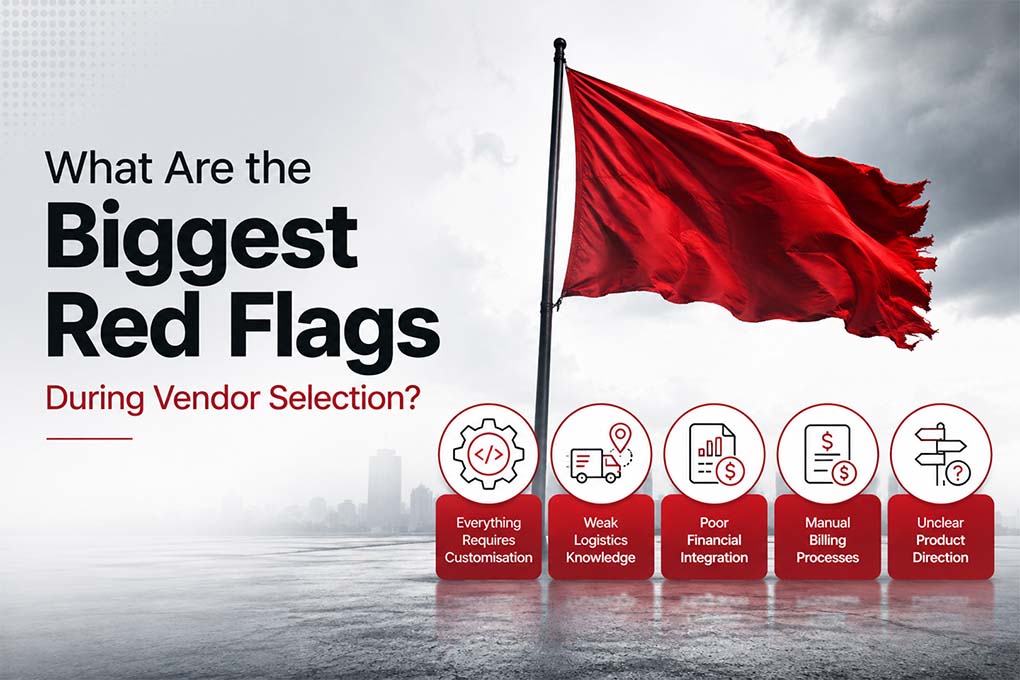
The warning signs usually appear long before contracts are signed.
The challenge is recognising them.
“Everything Requires Customisation”
Excessive customisation often signals weak standard functionality. It increases implementation costs, complicates upgrades and creates long-term dependency.
Weak Logistics Knowledge
Any vendor can demonstrate software. Not every vendor understands warehouse operations, 3PL billing models or customer-specific logistics requirements. Industry expertise matters.
Poor Financial Integration
Warehouse data without financial insight creates blind spots. Operational performance and business performance need to be connected.
Manual Billing Processes
Every spreadsheet introduces risk. Every manual adjustment consumes time. Every billing error affects customer trust.
Unclear Product Direction
Technology investments typically remain in place for many years. Vendors should demonstrate ongoing development, investment and innovation. Ask what functionality has been released recently. Strong vendors answer immediately.
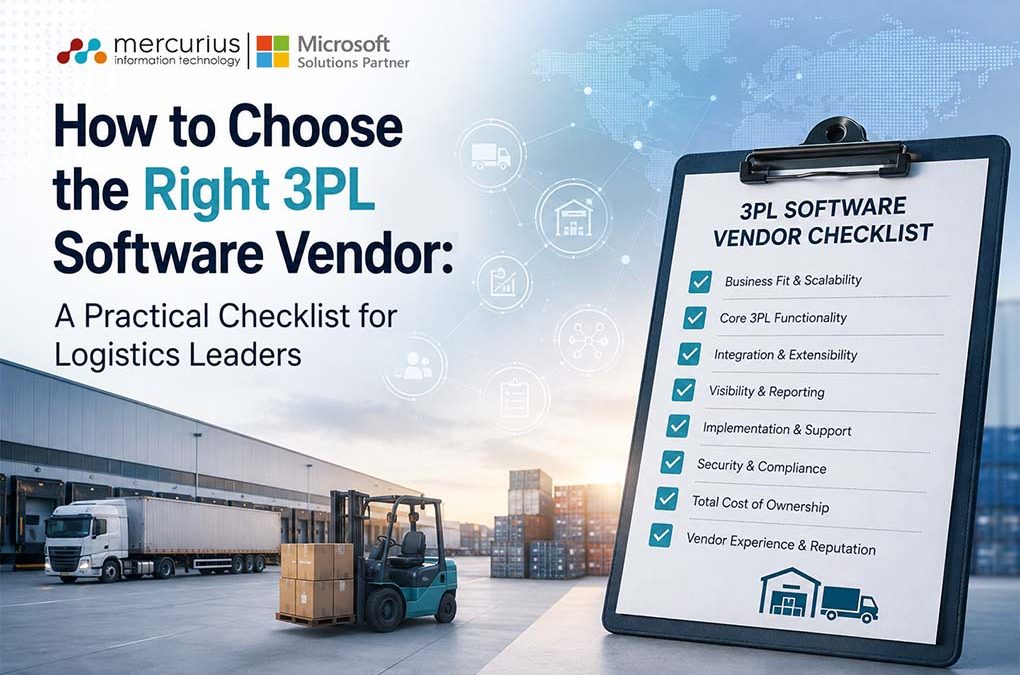
The Practical 3PL Vendor Selection Checklist
Before signing any contract, confirm all ten statements are true.
- The platform supports your logistics model.
- Billing processes can be automated.
- Customer-specific pricing can be configured.
- Reporting is available in real time.
- Customers have self-service visibility.
- ERP integration exists today.
- Warehouse operations and finance are connected.
- The vendor has proven logistics experience.
- The implementation approach is clearly defined.
- The platform supports future growth plans.
Miss several of these areas and you’ll likely revisit the software decision sooner than expected.
Get them right and the platform becomes an asset that supports profitability, customer satisfaction and long-term growth.
Ready to Assess Your 3PL Software Options?
Get practical guidance on warehouse management, billing, ERP integration and scalability for your logistics operation.
How Do Microsoft Dynamics 365 Business Central and Boltrics Fit Into the Picture?
They solve a problem that many logistics businesses face: connecting operations with finance.
Many warehouse platforms manage operational activity effectively but struggle when financial processes enter the picture.
That’s where Microsoft Dynamics 365 Business Central provides value.
Business Central manages finance, purchasing, inventory, reporting, supply chain operations and business performance within a single ERP platform. Microsoft describes it as an AI-powered ERP solution for small and mid-sized organisations.
Boltrics extends that foundation with logistics-specific functionality including warehouse management, transport management, freight forwarding capabilities, RF scanning and customer-specific logistics processes.
Instead of managing multiple disconnected applications, logistics businesses gain a platform where warehouse transactions, customer billing and financial reporting operate within the same ecosystem.
For many growing 3PLs, that distinction becomes increasingly important as complexity increases.
Frequently Asked Questions
What is a 3PL software vendor?
A 3PL software vendor provides technology designed to support logistics providers through warehouse management, transport operations, billing, customer visibility, reporting and operational management.
What is a warehouse management system?
A Warehouse Management System (WMS) is software that manages receiving, inventory control, storage, picking, packing and shipping activities within a warehouse.
Why is ERP integration important?
ERP integration connects operational processes with finance, purchasing and reporting, reducing manual work and improving visibility across the business.
Is Microsoft Dynamics 365 Business Central suitable for logistics businesses?
Yes. Business Central provides ERP functionality covering finance, inventory, purchasing, reporting and supply chain management. Logistics providers frequently extend it with industry-specific solutions such as Boltrics.
What is the biggest mistake when selecting 3PL software?
The biggest mistake is evaluating software based solely on demonstrations rather than operational requirements, scalability, billing capability and long-term business fit.