
Key Takeaways
-
Dynamics AX cannot respond effectively to volatile demand, supply disruption and labour shortages.
-
Dynamics 365 FSCM introduces AI-driven forecasting, resilient supply chain monitoring and automated workflows.
-
Manufacturers gain better inventory control, improved quality and faster financial decision-making.
-
A phased migration approach allows continuous improvement without operational disruption.
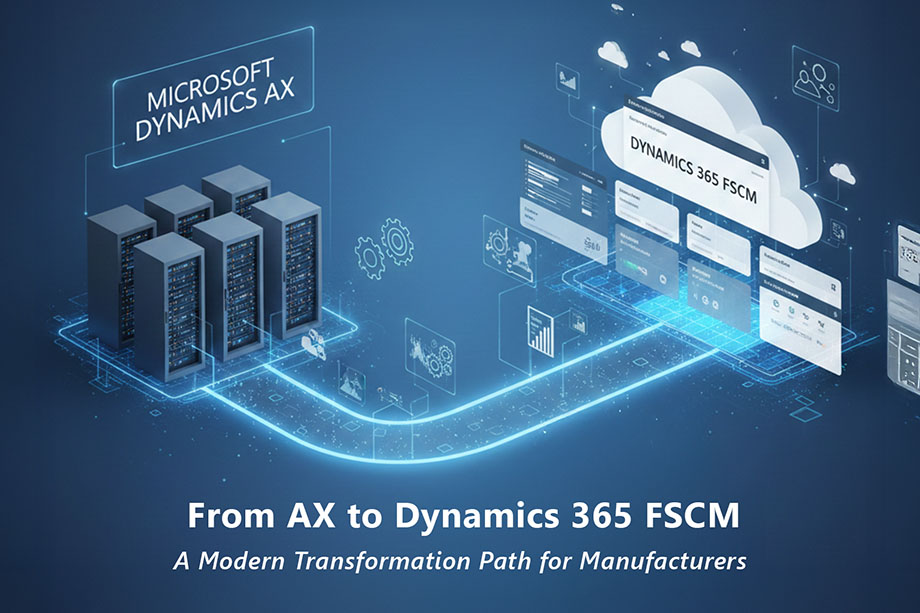
For many years, Microsoft Dynamics AX supported the daily operations of manufacturers. It handled production, finance, procurement and warehousing effectively in its time. However, the manufacturing landscape has changed significantly. Supply chains are more complex, customer expectations shift more quickly, and demand is influenced by external factors that AX was never designed to interpret. To stay competitive, manufacturers need realtime visibility, AI driven insights and connected processes. Dynamics 365 Finance and Supply Chain Management (FSCM) provides these capabilities and is the natural successor to AX.
Manufacturers are no longer just focused on output and cost control. They now prioritise agility, resilience and intelligent decision making. Dynamics 365 FSCM uses AI, predictive analytics and cloud scalability to help manufacturers plan better, execute faster and respond instantly to market changes. These are advantages that AX cannot offer in its legacy architecture.
Why AX Is No Longer Enough?
- Limited agility during disruption: Global events, supply shortages and transport issues now occur more frequently. AX does not provide the realtime visibility needed to navigate these disruptions effectively.
- Rising operational costs: Raw materials, energy and logistics costs are much more volatile than they were a decade ago. Without integrated forecasting and advanced analytics, cost management becomes increasingly difficult.
- Labour shortages and manual workflows: The manufacturing sector is experiencing a shortage of skilled workers. Manual processes in AX increase the burden on existing staff and limit productivity.
- Demand unpredictability: Consumer behaviour is influenced by social trends, seasonal changes and global events. Historical forecasting alone can lead to poor inventory planning and lost sales. AX struggles to respond to these external signals.
How Dynamics 365 FSCM Supports Modern Manufacturing?
- AI-Powered forecasting: Dynamics 365 FSCM uses AI to analyse patterns and external factors that influence demand. This helps manufacturers reduce overstocking and prevent shortages.
- Stronger and more resilient supply chains: The system provides realtime insight across suppliers, logistics and production. AI agents can also communicate with suppliers and identify delays before they escalate. This allows manufacturers to respond earlier and more effectively.
- Optimisation of production and quality: AI monitors production performance and identifies quality issues sooner. This leads to higher efficiency, better throughput and reduced waste.
- Integrated financial and operational insights: Dynamics 365 FSCM supports intelligent budgeting, realtime financial reporting and a more efficient financial close. These improvements help finance and operations teams make informed decisions quickly.
- Automation that helps mitigate labour shortages: Tasks that previously required manual effort can now be automated with Copilot. This allows staff to focus on problem solving and continuous improvement.
Struggling to manage demand volatility and supply disruption on AX?
See how manufacturers use Dynamics 365 FSCM to plan, execute and respond with confidence.
Comparison: Dynamics AX vs Dynamics 365 FSCM for Manufacturers
| Category | Dynamics AX | Dynamics 365 FSCM |
|---|---|---|
| Demand Forecasting | Uses historical data only. Limited flexibility during volatile market changes. | AI driven forecasting and Copilot support for more accurate planning and fewer stock issues. |
| Supply Chain Resilience | Limited realtime insight and slow disruption response. | AI agents monitor suppliers and alert teams to risks early. Supplier communication can be automated. |
| Inventory and Production Optimisation | Manual adjustments and fragmented data create higher risk of overstocking, understocking and reduced quality. | Predictive analytics improve stock levels, detect quality issues earlier and increase throughput. |
| Labour and Process Efficiency | Dependent on manual processes and complex interfaces. | Copilot automation reduces repetitive tasks and increases productivity. |
| Financial Insight and Reporting | Batch based reports and slower financial close. | Realtime visibility, faster consolidation and intelligent budgeting. |
| Technology Model | On premises system with costly upgrades and limited scalability. | Cloud based system that updates continuously and scales easily. |
| Decision Making | Slow and reactive due to siloed data. | Predictive analytics allow proactive planning across demand, inventory, suppliers and cash flow. |
| User Experience | Legacy interface that requires more training and manual entry. | Modern interface with built in AI guidance for better usability. |
What Manufacturers Typically Improve During Migration
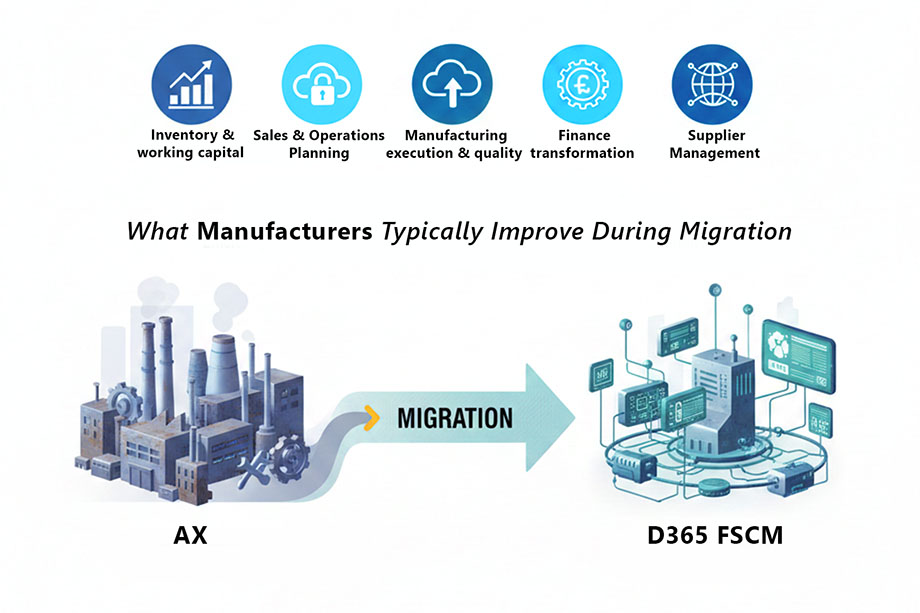
- Sales and Operations Planning: Manufacturers benefit from faster planning runs and improved scenario modelling when they move to AI supported planning. This reduces the time teams spend reacting to problems.
- Supplier management : AI agents can manage purchase order communication and identify supply risks early. This prevents downstream delays and production stoppages.
- Inventory and working capital: Predictive insights help maintain the right stock levels while reducing obsolete inventory and improving service performance.
- Manufacturing execution and quality: Realtime signals help identify quality deviations earlier and stabilise production performance.
- Finance transformation: Financial processes such as budgeting, forecasting and period close become faster and more accurate with Copilot assistance.
Build a Resilient Manufacturing Operation with FSCM
Move beyond reactive planning and gain AI-driven visibility across production, supply chain and finance.
A Practical Path from AX to FSCM
A successful migration from AX to FSCM begins with identifying highvalue improvement areas such as forecast accuracy, inventory optimisation or ontime delivery. Migration should be phased, starting with planning and visibility enhancements and then moving into supplier automation and advanced shopfloor optimisation. Ongoing training helps ensure teams adopt Copilot assisted workflows. Release waves provide continuous enhancements without disruption.
Benefits Manufacturers Can Expect
- Lower premium freight and expediting costs. Early visibility into supplier issues helps avoid lastminute corrective actions.
- Higher service levels through better demand forecasting and improved inventory accuracy.
- Greater production efficiency supported by realtime quality monitoring.
- Faster and more confident decision making because finance and operations share the same realtime information.
Conclusion
Dynamics AX was a strong ERP system for its time, but the modern manufacturing environment requires tools that provide accurate forecasting, realtime visibility and intelligent automation. Dynamics 365 FSCM brings AI, cloud scalability and predictive insights into day to day operations. This makes it the strongest platform for manufacturers who want to build a resilient, efficient and future ready business.
Frequently Asked Questions
Why is Dynamics AX no longer suitable for modern manufacturers?
Dynamics AX lacks real-time visibility, AI-driven forecasting and automation. It struggles to respond to volatile demand, supply disruptions and labour shortages.
How does Dynamics 365 FSCM improve demand forecasting?
Dynamics 365 FSCM uses AI to analyse historical patterns and external factors, helping manufacturers reduce overstocking, shortages and lost sales.
How does FSCM strengthen supply chain resilience?
The platform provides real-time insight across suppliers, logistics and production. AI agents can identify risks early and support proactive response.
Can Dynamics 365 FSCM help address labour shortages?
Yes. Copilot automation reduces manual effort, allowing employees to focus on problem-solving and continuous improvement instead of repetitive tasks.
What improvements do manufacturers typically see after migrating from AX?
Manufacturers improve planning accuracy, inventory control, production quality, supplier collaboration and financial visibility.
See How Dynamics 365 FSCM Transforms Manufacturing Operations