

Quick Summary
AI capabilities in Dynamics 365 Finance help leaders improve forecasting, detect anomalies, automate financial processes, and deliver faster insights while transforming finance teams from operational support to strategic decision partners.
Key Takeaways
- AI in Microsoft Dynamics 365 Finance helps automate forecasting, reconciliation, variance analysis, and risk detection.
- Finance teams can identify financial anomalies and risks earlier using AI-powered monitoring.
- AI assistants like Copilot enable finance professionals to ask questions and generate financial insights instantly.
- Intelligent automation reduces manual effort in processes such as invoice processing, expense management, and approvals.
- Organisations adopting AI in finance gain faster decision-making, better financial visibility, and improved operational efficiency.
Finance leaders are constantly expected to answer important questions quickly:
- Why did margins drop this quarter?
- What’s driving the increase in operational costs?
- Are there any financial risks we should be aware of right now?
In many organisations, finding these answers still takes hours of manual work across spreadsheets, reports, and separate systems. By the time insights are available, the chance to act may have already passed. AI features in Microsoft Dynamics 365 Finance are helping finance teams work in new ways.
With AI, finance teams no longer must dig through data manually. They can identify anomalies, automate reconciliations, improve forecasting, and find useful insights faster.
This change is not something new; it is already happening. According to Gartner, 59% of finance teams are already using AI. McKinsey & Company also found that 85% of CFOs expect AI to greatly reduce manual financial analysis.
For finance leaders, the conversation is no longer about whether AI will impact finance. It is about which AI features will have the biggest impact on financial operations, reporting, and decision-making?
In this article, we’ll explore the key AI capabilities in Dynamics 365 that finance leaders should understand and how they can help finance teams to gain proactive financial insight.
Top AI Capabilities in Dynamics 365 Finance Leaders Should Know
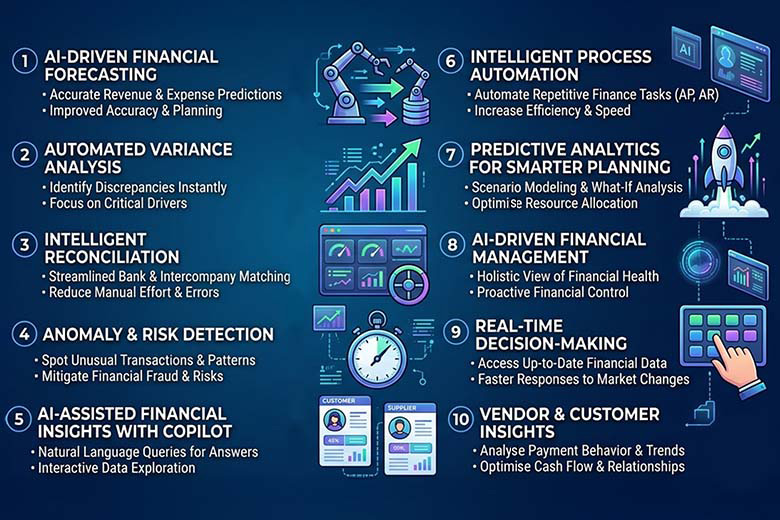
AI-Driven Financial Forecasting
Accurate forecasting is critical for finance leaders, yet traditional forecasting methods often rely heavily on spreadsheets, assumptions, and historical comparisons.
AI-driven forecasting in Microsoft Dynamics 365 Finance tackles this problem by automatically analysing large amounts of financial and operational data. It finds patterns in past performance, seasonal trends, and business activity, so it can create more reliable forecasts and spot changes sooner.
For finance leaders, this feature can improve important planning areas like:
- Anticipating revenue fluctuations more accurately
- Strengthening cash flow planning and liquidity management
- Reducing forecast bias caused by manual assumptions
Automated Variance Analysis
Automated variance analysis in the Microsoft Dynamics 365 Finance solution uses AI to quickly find and explain changes in financial performance. So, rather than manually comparing numbers, the AI highlights patterns and unusual results that require attention.
Intelligent Reconciliation
Financial reconciliation often takes up a lot of time for finance teams. AI-enabled reconciliation in Microsoft Dynamics 365 Finance can automate much of this process. The AI quickly reviews transaction data and can:
- Automatically match transactions across records.
- Identify discrepancies or unmatched entries.
- Suggest corrections based on patterns and historical data.
So, finance teams no longer need to check every transaction by hand. They can focus on the exceptions that need attention, saving time and making the process more consistent.
Anomaly & Risk Detection
Financial risks are usually found after reports are reviewed or audits are finished. AI-powered anomaly detection in Microsoft Dynamics 365 Finance helps finance teams take a more proactive approach. By continuously analysing financial data, AI can automatically flag unusual patterns that may indicate potential risks or irregularities.
With these tools, teams can identify issues like:
- Duplicate invoices
- Suspicious transactions
- Unexpected spikes in spending
- Revenue irregularities across periods
So, rather than depending only on manual reviews, finance teams now get early alerts when something unusual happens. This helps them investigate issues more quickly.
AI-Assisted Financial Insights with Copilot
One of the most transformative AI capabilities for finance teams is interacting with financial data using AI assistants. Instead of manually building reports or analysing multiple dashboards, finance professionals can ask questions and receive contextual insights.
With Microsoft Copilot integrated with Microsoft Dynamics 365 Finance, finance teams can use natural language to explore financial data and generate insights quickly.
For example, teams can:
- Ask natural language questions about financial performance
- Automatically generate explanations for variances
- Draft financial summaries and reports for leadership review
Intelligent Process Automation
Traditional finance automation uses fixed rules and workflows. These systems are useful, but they still need people to step in when transactions do not fit the usual patterns. AI improves on this by allowing automation to learn from financial data and adjust to new situations.
With AI features in Microsoft Dynamics 365 Finance, finance teams can automate many routine tasks that usually take a lot of time and effort.
Examples of such intelligent process automation includes:
- Invoice processing and validation
- Expense management and policy checks
- Payment approvals based on transaction patterns
- Collections prioritisation using risk and payment behaviour signals
Automating these tasks helps finance teams cut down on manual work and keep processes running smoothly.
Predictive Analytics for Smarter Planning
Dynamics 365 predictive analytics helps finance leaders forecast revenue, cash flow, and expenses more accurately. By analysing both past and current data, AI offers insights that help CFOs make confident decisions.
AI-Driven Financial Management
AI in Dynamics 365 automates repetitive financial tasks such as invoice processing, collections, and reconciliations. This reduces manual errors, ensures compliance, and frees up finance teams to focus on strategy.
Real-Time Decision-Making
With Dynamics 365 AI, executives can make decisions in real time and respond quickly to changes in the market. Features like dynamic pricing and demand forecasting help businesses adapt fast and stay ahead of competitors.
Vendor & Customer Insights
AI reviews how customers pay and how vendors perform, then suggests ways to manage working capital better and communicate more effectively with vendors.
Moving from Finance Operations to Finance Intelligence
Many finance teams still spend much of their time on operational tasks such as reconciling data, preparing reports, checking numbers, and answering business questions. These jobs are important, but they often leave little time for deeper analysis.
Business leaders, however, increasingly rely on finance to answer questions like:
- What risks are building in our cash flow?
- Where are we overspending?
- What will our financial position look like next quarter?
Answering these questions requires operational efficiency and financial intelligence.
With AI tools in Microsoft Dynamics 365 Finance, finance teams can spend less time managing processes and more time understanding financial trends. Here’s what this change can look like:
| Traditional Finance Operations | Dynamics 365 Finance Intelligence |
|---|---|
| Preparing financial reports | Interpreting financial trends |
| Investigating numbers manually | AI surfacing key insights |
| Processing transactions | Supporting strategic decisions |
Turn Financial Data into Faster Decisions
Use AI in Dynamics 365 Finance to improve forecasting, detect risks early, and automate financial operations.
The Future of AI in Finance
AI adoption in finance is still evolving, but the pace of transformation is accelerating. As financial systems become more data-driven, AI is expected to play a larger role in planning, risk monitoring, and financial decision support.
In fact, Gartner research predicts that 90% of finance functions will deploy at least one AI-enabled technology solution by 2026, signalling a quick shift toward AI-supported finance operations.
Looking ahead, AI capabilities in Microsoft Dynamics 365 Finance are expected to evolve beyond automation into more advanced intelligence, including:
- Autonomous financial planning – Where AI continuously evaluates financial performance and recommends adjustments to budgets and forecasts
- AI agents managing financial workflows – Assisting teams with tasks such as reconciliations, variance explanations, and reporting preparation.
- Continuous forecasting – Where financial projections update dynamically as new business data becomes available
- Predictive risk management – Enabling organisations to identify potential financial risks earlier and respond proactively
And not ending here, even the adoption momentum is already building. According to Gartner, 59% of finance leaders are already using AI within their finance functions, and organisations further along in adoption report greater optimism about its long-term impact.
Final Thoughts
AI is quickly changing how finance teams work. With AI features in Microsoft Dynamics 365 Finance, finance leaders can do more than report on the past. They help their teams focus on forecasting, spotting risks sooner, and supporting key business decisions. Finance teams are not just managing numbers; they are helping move the organisation ahead.
To get the most out of these tools, it is important to have the right approach, industry know-how, and processes that fit your business.
As a trusted Microsoft Dynamics 365 solutions partner, Mercurius IT helps organisations across industries implement and optimise Dynamics 365 Finance to drive smarter financial operations. From assessing AI readiness to configuring intelligent capabilities within the platform, our team works closely with finance leaders to ensure the technology delivers real, measurable value.
Frequently Asked Questions
How does AI improve financial forecasting in Dynamics 365?
AI analyses historical financial data, seasonal patterns, and operational signals to generate more accurate forecasts. This helps finance leaders anticipate revenue changes and improve cash flow planning.
Can AI in Dynamics 365 detect financial risks?
Yes. AI-powered anomaly detection continuously monitors financial data to identify unusual patterns such as duplicate invoices, suspicious transactions, unexpected spending spikes, or revenue irregularities.
How does Microsoft Copilot help finance teams?
Copilot allows finance professionals to ask natural language questions about financial data, generate variance explanations, and draft financial summaries automatically using information from Dynamics 365 Finance.
How does AI improve financial visibility for CFOs?
AI continuously monitors financial data and highlights trends, risks, and irregularities in real time. This provides CFOs with clearer financial visibility and enables quicker responses to changes in business performance.
Is AI in finance only useful for large enterprises?
No. AI capabilities in Dynamics 365 Finance can benefit organisations of different sizes. Mid-sized companies can use AI to automate routine finance tasks, improve forecasting accuracy, and gain better financial insights.