

Quick Summary
Improve CRM adoption by reducing manual work, aligning workflows with sales processes, and using role-based strategies that increase engagement, pipeline visibility, and CRM-driven sales performance.
Key Takeaways
- Low CRM adoption often results in poor forecasting, incomplete pipelines, and disconnected reporting.
- Workflow alignment is one of the most important factors in improving CRM engagement.
- Leadership accountability helps establish CRM as the single source of truth for sales operations.
- Peer influence and internal champions can accelerate adoption more effectively than mandates.
- Long-term CRM success depends on ongoing optimisation, feedback, and user enablement.
Most CRM failures occur when sales teams stop using the system. Incomplete pipelines, inaccurate forecasts, and poor visibility often stem from low CRM adoption rather than platform limitations.
Although organisations invest substantially in CRM systems, fewer than 40% achieve full implementation, and 25% identify user adoption and training as their primary challenges. Conversely, organisations with high CRM adoption report conversion rates up to 300% higher and an average return on investment (ROI) of $8.71 for every dollar spent.
The problem is rarely resistance to technology itself. Sales teams often avoid CRM systems because they create extra admin work, slow down workflows, or fail to provide visible value in day-to-day selling activities.
This article examines seven practical strategies to enhance CRM implementation and adoption by addressing the underlying reasons for sales team resistance. These approaches are designed to support sales leaders, revenue operations managers, and CRM administrators in fostering greater engagement, improving data quality, and increasing sales performance.
Why Sales Teams Resist CRM
Most sales teams don’t avoid CRM because they dislike technology. In fact, they push back against systems that slow down their work.
If a CRM adds extra admin work, doesn’t fit real sales workflows, or comes without training for each role, people are less likely to use it. In many companies, sales reps update the CRM only because management tells them to, not because it helps them close deals faster.
That’s why many CRM adoption efforts don’t work out. Usually, the issue isn’t the platform itself but how people experience using it.
Identifying the sources of friction is the first step to improving adoption. The following strategies aim to remove these barriers rather than mandate usage.
Low CRM Usage is Costing More Than You Think
Incomplete pipelines, inaccurate forecasts, and missed follow-ups often start with poor CRM adoption. Fix the root cause before it impacts revenue growth.
The 7 Strategies That Improve CRM Adoption
1. Involve Sales Reps Before the CRM Goes Live
A common CRM mistake is allowing only leadership, IT, or consultants to select and configure the platform. Excluding sales teams often leads to resistance before implementation starts.
Involving reps early helps organisations identify workflow gaps, usability concerns, and adoption risks before rollout. Running small pilot groups, collecting feedback on day-to-day sales activities, and allowing teams to influence workflows creates stronger buy-in across the organisation. People are more likely to adopt systems they help shape.
2. MakeLeadership Accountability Non-Negotiable
CRM adoption suffers when leadership treats the system as optional.
When pipeline reviews, forecasting, and performance discussions occur outside the CRM, sales teams see updates as unimportant. High-performing organisations make CRM data the single source of truth for all sales conversations.
Leadership behaviour shapes adoption culture. When managers actively use the CRM, teams are more likely to benefit and follow consistently.
3. Fix the Data Entry Problem First
Manual data entry is a leading reason sales teams avoid CRM systems.
If updating opportunities, logging calls, or entering notes is time-consuming, reps will prioritise selling over administration. The goal is to reduce effort through automation and workflow simplification.
Features like email sync, automated activity logging, mobile updates, and voice-to-text capture in Dynamics 365 CRM can reduce friction. If CRM updates take too long, adoption will decline regardless of platform capabilities.
4. Train Teams by Role
Most CRM training fails because it focuses on system functionality rather than real sales workflows.
An SDR, Account Executive, and Sales Manager all use CRM differently. Training should reflect those differences by showing how the platform supports their specific responsibilities, targets, and daily activities.
Organisations that provide role-based onboarding, short workflow tutorials, and ongoing support see stronger long-term adoption than businesses that rely on one-time, generic training sessions.
5. Identify and Activate Internal Champions
Peer influence often drives adoption more effectively than executive mandates.
Every sales team has individuals who naturally embrace new systems and processes earlier than others. These employees can become internal CRM champions who guide peers, answer questions, and identify usability issues before they become larger adoption problems.
The most effective champions are usually respected sales performers who understand both customer-facing workflows and operational processes. Giving them visibility and involvement in CRM decisions strengthens trust across the wider team.
6. Show Reps How CRM Helps Them Win More Deals
Sales teams adopt tools that help them generate revenue faster.
CRM adoption improves significantly when organisations position the platform as a personal sales tool rather than a management reporting requirement. Reps need to see direct value in their daily work, whether that means faster follow-ups, stronger pipeline visibility, automated reminders, or recovering stalled opportunities.
Sharing real examples of closed deals, revived opportunities, or time saved through CRM use shifts the narrative from compliance to performance improvement.
7. Track Adoption Metrics and Act on Feedback
CRM adoption should be measured continuously, not assumed after rollout.
Metrics like active usage rates, login frequency, opportunity updates, and feature engagement help organisations identify where and why adoption is declining. A drop in usage often signals workflow friction, poor training, or usability issues.
The most successful organisations also create regular feedback loops through quick surveys and team discussions. When employees see their feedback leading to visible improvements, long-term engagement increases significantly.
Get Your Sales Teams Using CRM Faster
Mercurius IT helps businesses deploy Microsoft Dynamics 365 quickly with preconfigured sales workflows, training, dashboards, and post-go-live support.
How to Measure CRM Adoption Progress?
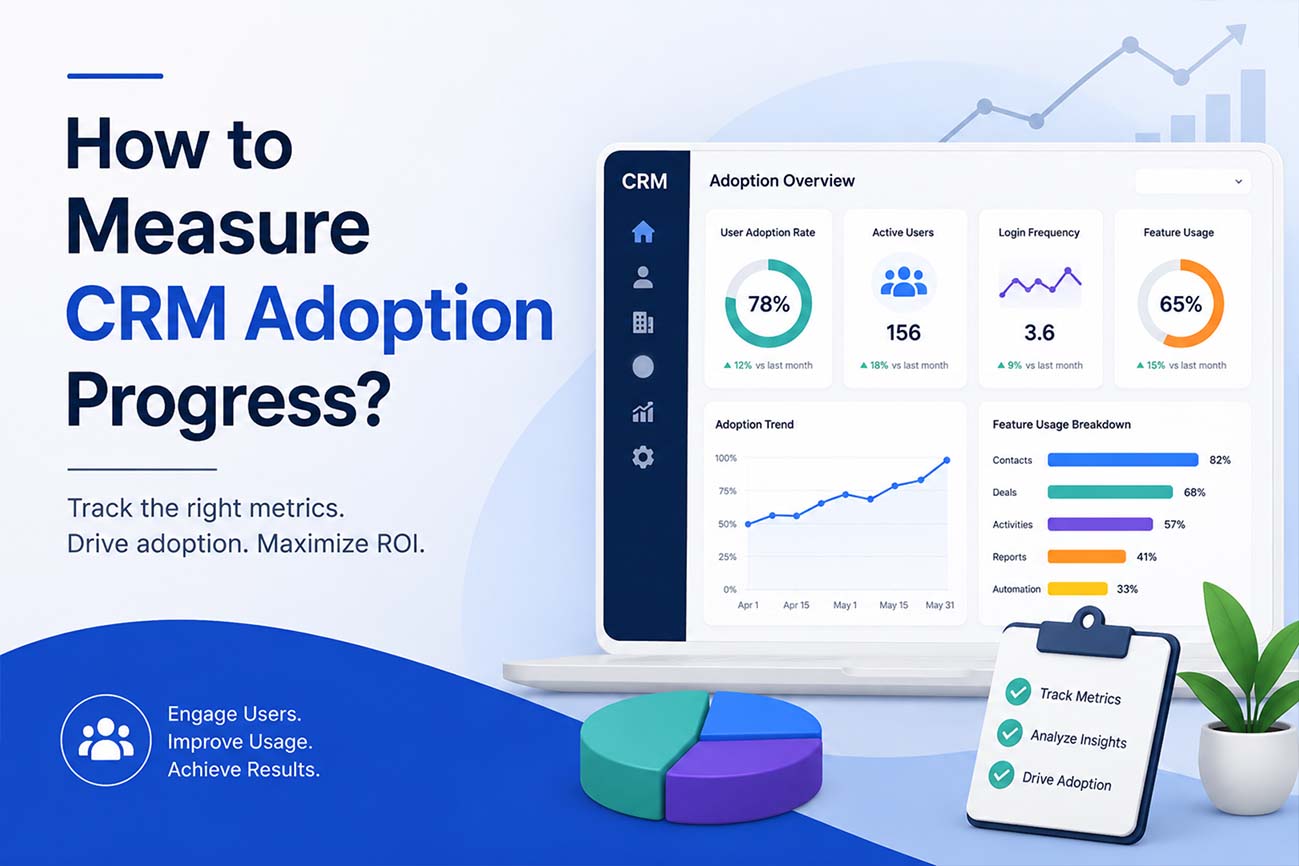
Tracking CRM adoption requires more than checking login numbers. The real goal is understanding whether sales teams are consistently using the system as part of their daily workflow.
| Metric | What It Signals | Healthy Benchmark |
|---|---|---|
| Daily Active Users | Measures ongoing engagement and regular CRM usage | 70%+ of licensed users active daily |
| Records Updated Per Week | Indicates whether reps are maintaining accurate pipeline and customer data | Consistent weekly activity across teams |
| Pipeline Logged in CRM vs. Actual Deals | Identifies use of spreadsheets or “shadow CRM” tracking outside the system | Close to 100% pipeline visibility |
| Feature Utilisation Rate |
Highlights whether teams are using key workflows and automation features |
Strong adoption across core sales activities |
The most important thing to monitor is consistency over time. Sudden drops in usage often indicate workflow friction, poor training, or processes that sales teams no longer find valuable.
Conclusion
Successful CRM adoption does not happen through enforcement alone. It happens when sales teams genuinely believe the system helps them work faster, manage opportunities better, and close deals more efficiently.
That is why the most effective CRM adoption strategies focus less on pushing usage and more on improving the overall sales experience. Small changes like reducing manual work, simplifying workflows, improving training, and creating accountability often deliver far greater results than large-scale system changes.
For business leaders, the priority should not be “How do we make reps use CRM?” but rather “What is preventing teams from seeing value in it today?”
Begin by identifying and addressing the primary friction point in your current CRM process. Incremental improvements in adoption can lead to significant gains in pipeline visibility, forecasting accuracy, and sales performance over time.
As an experienced Microsoft Dynamics 365 partner, Mercurius IT helps organisations build CRM environments that sales teams want to use, not just systems that are technically implemented.
Still Chasing Sales Updates Outside Your CRM?
Mercurius IT helps organisations create CRM systems that improve pipeline visibility, forecasting accuracy, and sales accountability.
Frequently Asked Questions
How long does it typically take to improve CRM adoption?
Most organisations begin seeing measurable improvements within 3–6 months when adoption strategies focus on workflow simplification, leadership accountability, role-based training, and automation. Long-term adoption improvement, however, requires continuous optimisation and user feedback.
How can Microsoft Dynamics 365 improve CRM adoption?
Microsoft Dynamics 365 improves CRM adoption by combining sales automation, AI-driven insights, workflow integrations, mobile accessibility, and collaboration tools within a single platform. When configured correctly, it helps reduce admin effort and align CRM usage with real sales processes.
What is a good CRM adoption rate for sales teams?
Most organisations consider 70–80% active user engagement a healthy benchmark. However, adoption quality matters more than login volume. Consistent opportunity updates and workflow usage are stronger indicators of success.