
Quick Summary
Accurate CRM reporting enables better forecasting, stronger operational visibility, and more confident decision-making. Dynamics 365 CRM helps organisations turn fragmented data into actionable business insights.
Key Takeaways
- CRM reporting challenges typically result from poor data quality, disconnected systems, and inconsistent business processes, not from the reporting tool itself.
- Inaccurate CRM reports affect forecasting, decision-making, customer experience, and overall business performance.
- Dynamics 365 CRM addresses reporting challenges with real-time dashboards, AI-driven insights, automated reporting, and system integration.
- Strong data governance, system integration, automation, and user training are essential for maintaining reporting accuracy.
- Reliable CRM reporting enables organisations to make informed decisions, improve operational visibility, and support long-term business growth.
According to Gartner, poor data quality costs organisations an average of $12.9 million annually, impacting everything from operational efficiency to strategic decision-making. Yet despite significant investments in CRM technology, many businesses continue to struggle to transform CRM data into accurate, actionable insights.
CRM systems are designed to provide visibility into customer relationships, sales performance, marketing effectiveness, and service operations. When reporting works as intended, leaders can forecast revenue more accurately, identify growth opportunities more quickly, and make more confident business decisions. However, for many organisations, CRM reports often raise more questions than answers.
Inaccurate forecasts, conflicting dashboards, incomplete customer records, and inconsistent performance metrics can make it difficult to trust the data being presented. The issue is rarely the reporting functionality itself. More often, it stems from underlying challenges such as poor data quality, disconnected systems, inconsistent processes, and low user adoption.
As businesses become more data-driven, the cost of unreliable reporting increases. Decisions based on incomplete or inaccurate CRM data can negatively impact sales performance, customer experience, resource allocation, and overall growth.
Understanding the root causes behind CRM reporting challenges is the first step toward building reports that deliver meaningful insights and support better decision-making. In this blog, we explore the most common CRM reporting challenges businesses face and how Microsoft Dynamics 365 CRM helps to overcome them.
The Importance of CRM Reporting for Business Success
CRM reporting provides leaders with the visibility required to make informed business decisions. Accurate CRM reports help organisations monitor sales, marketing, and customer service performance, identify growth opportunities, improve forecasting accuracy, and address potential risks.
In fact, Salesforce research found that 73% of business leaders believe data helps reduce uncertainty and supports better decision-making. However, these benefits can only be realised when reporting is built on reliable data and consistent business processes. Without that foundation, even the most advanced CRM reports can lead to inaccurate insights and poor decisions.
Struggling to trust your CRM reports?
Discover how Dynamics 365 CRM can help improve reporting accuracy, data visibility, and business decision-making.
7 Common CRM Reporting Challenges Businesses Face and How to Solve Them
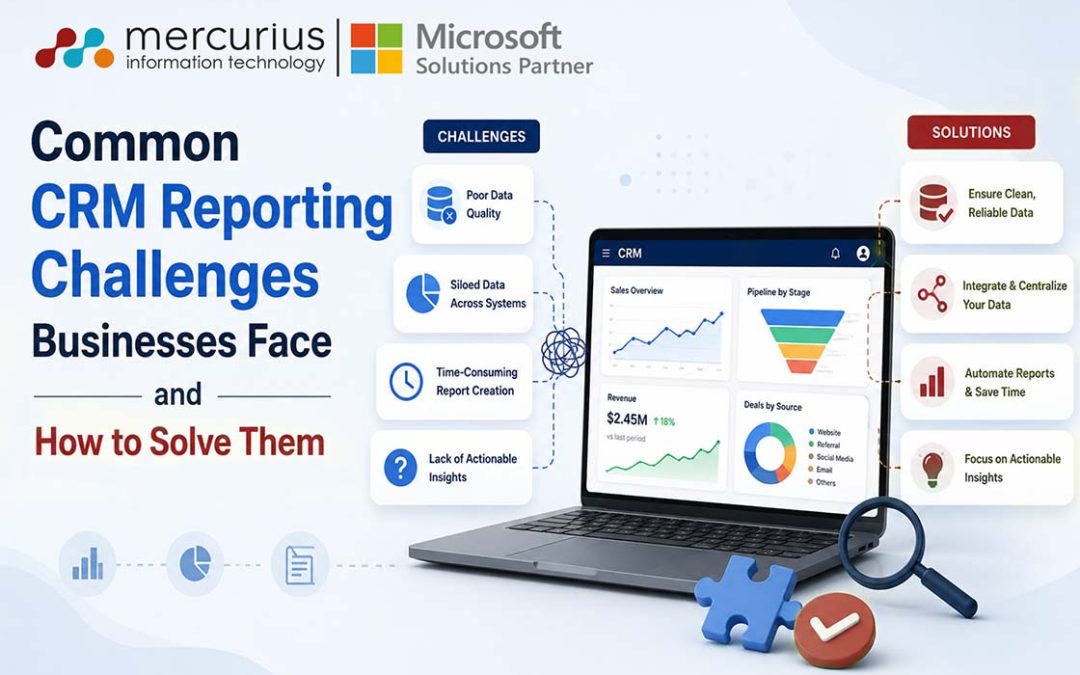
Businesses rely on CRM reports to guide sales strategies, improve customer engagement, and support critical decision-making. However, reporting challenges such as poor data quality, disconnected systems, and inconsistent processes can limit the value of these insights. Below are some of the most common CRM reporting challenges organizations face and how Dynamics 365 CRM helps address them.
1. Poor Data Quality and Incomplete Records
CRM reports are only as reliable as their underlying data. Missing, duplicate, or outdated records can result in inaccurate forecasts, misleading pipeline reports, and poor decisions.
How Dynamics 365 CRM Helps?
Dynamics 365 CRM enhances data accuracy with automated validation, duplicate detection, business rules, and guided data entry. These features help organisations maintain clean records and produce reliable reports.
2. Data Silos Across Multiple Systems
Many businesses store customer data across CRM, ERP, marketing, customer service, and finance systems. This often leads to reports that provide an incomplete view of customer interactions and business performance.
How Dynamics 365 CRM Helps?
Dynamics 365 CRM integrates with Microsoft applications and third-party systems to create a unified view of customer and operational data. This supports comprehensive reporting and consistent performance measurement across departments.
3. Inconsistent Data Entry Practices
Inconsistent data entry processes lead to unreliable reporting. Differences in naming conventions, sales stages, and customer classifications can distort performance metrics and KPI tracking.
How Dynamics 365 CRM Helps?
Dynamics 365 CRM supports standardised data entry through configurable forms, mandatory fields, workflows, and business process flows. This helps ensure data consistency and improves reporting accuracy across teams.
4. Low CRM User Adoption
Even the most advanced reporting tools cannot deliver accurate insights if employees fail to consistently update CRM records. Incomplete activity tracking and missing sales information often result in unreliable reports.
How Dynamics 365 CRM Helps?
With an intuitive user interface, Microsoft 365 integration, mobile accessibility, and workflow automation, Dynamics 365 CRM simplifies daily CRM usage. Improved adoption leads to more complete data and more trustworthy reports.
5. Too Many Reports with Not Enough Actionable Insights
Organisations often generate large volumes of reports but struggle to identify the metrics that truly influence business outcomes. Excessive reporting can create confusion rather than clarity.
How Dynamics 365 CRM Helps?
Dynamics 365 CRM offers customisable dashboards, role-based reporting, and AI-driven insights to help decision-makers focus on key KPIs. This supports faster and more informed decision-making.
6. Lack of Real-Time Reporting Visibility
Delayed reporting makes it difficult for leaders to respond quickly to changing customer demands, sales performance issues, or emerging business risks.
How Dynamics 365 CRM Helps?
Real-time dashboards and automated reporting capabilities within Dynamics 365 CRM provide up-to-date visibility into sales, service, and customer engagement metrics, enabling faster responses and more proactive decision-making.
7. Poor Report Customisation and KPI Alignment
Generic reports often do not meet the needs of different departments or leadership teams. As business objectives change, reporting must adapt accordingly.
How Dynamics 365 CRM Helps?
Dynamics 365 CRM allows organisations to build customised reports, dashboards, and KPIs tailored to specific business goals, departments, and user roles. This ensures reporting remains relevant, actionable, and aligned with strategic priorities.
Eliminate reporting bottlenecks before they impact business performance.
See how Mercurius IT helps organisations overcome CRM reporting challenges with Dynamics 365 CRM.
How Dynamics 365 Help Overcome Other Reporting Challenges
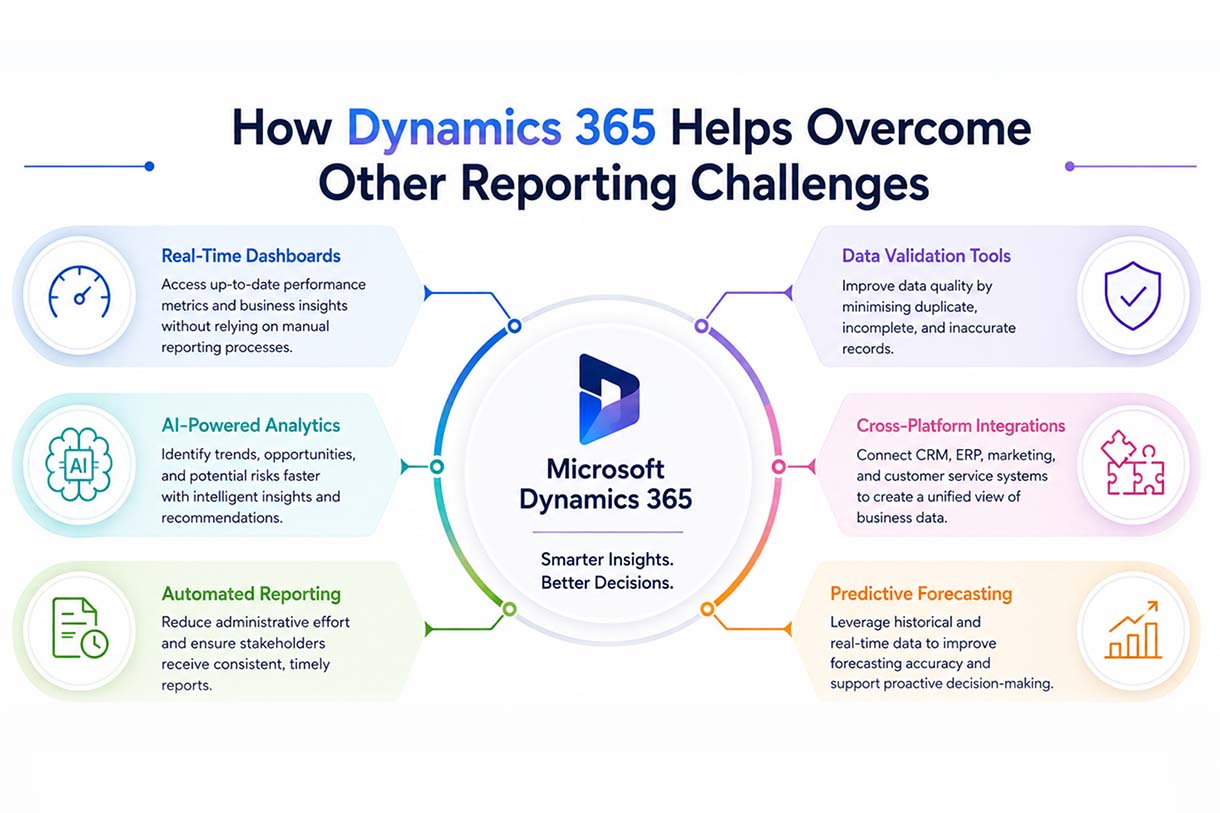
Modern CRM platforms improve reporting accuracy, enhance business visibility, and enable faster, data-driven decisions. Platforms like Microsoft Dynamics 365 Customer Engagement centralise these capabilities, eliminating data silos, standardising reporting, and providing actionable insights across sales, marketing, and customer service. Key features of Dynamics 365 include:
- Real-Time Dashboards: Access up-to-date performance metrics and business insights without relying on manual reporting processes.
- AI-Powered Analytics: Identify trends, opportunities, and potential risks faster with intelligent insights and recommendations.
- Automated Reporting: Reduce administrative effort and ensure stakeholders receive consistent, timely reports.
- Data Validation Tools: Improve data quality by minimising duplicate, incomplete, and inaccurate records.
- Cross-Platform Integrations: Connect CRM, ERP, marketing, and customer service systems to create a unified view of business data.
- Predictive Forecasting: Leverage historical and real-time data to improve forecasting accuracy and support proactive decision-making.
Best Practices for Improving CRM Reporting Accuracy
Accurate CRM reporting depends on more than technology. Organisations should implement consistent processes, maintain high-quality data, and promote user accountability to ensure reliable, actionable reports.
Establish Data Governance Standards
Establish clear guidelines for data ownership, entry, maintenance, and quality management. Clear accountability ensures CRM data remains accurate, consistent, and trustworthy throughout the organisation.
Automate Data Collection Wherever Possible
Reducing manual data entry minimises errors and improves consistency. Automating data capture and routine processes maintains accuracy and enables teams to focus on higher-value tasks.
Integrate CRM with Business-Critical Systems
Integrating CRM with ERP, marketing, and customer service platforms creates a unified view of business data. This improves reporting accuracy and eliminates inconsistencies from disconnected systems.
Conduct Regular Data Audits
Regularly reviewing CRM data identifies duplicate, outdated, or incomplete records before they affect reporting quality. Continuous and ongoing audits provide more reliable insights and support better decision-making.
Train Users Continuously
Consistent user training helps teams understand the importance of accurate data entry and CRM adoption. Well-trained users contribute to higher-quality data and more reliable reporting outcomes.
Bottom Line
CRM reporting challenges often arise from poor data quality, disconnected systems, inconsistent processes, and low user adoption. Addressing these issues is essential to transform CRM data into accurate, actionable insights that drive better decisions, improve forecasting, and enhance customer experiences. Dynamics 365 CRM offers a dependable solution to these challenges.
However, achieving reliable reporting requires more than technology alone. It requires the right strategy, implementation approach, and ongoing optimisation. As a trusted Microsoft Solutions Partner, Mercurius IT helps organisations maximise the value of Dynamics 365 CRM through tailored implementations, system integrations, data management, and reporting solutions designed to support long-term business growth.
Frequently Asked Questions
How does Dynamics 365 ensure GMP compliance in pharma manufacturing?
Dynamics 365 supports regulatory compliance with batch traceability, digital records, automated quality checks, audit trails, and CAPA workflows. These system-driven controls replace manual processes, reduce audit risk, and enhance data integrity.
How can Dynamics 365 CRM improve reporting accuracy?
Dynamics 365 CRM enhances reporting accuracy with data validation tools, automated workflows, real-time dashboards, AI analytics, and integration with other business systems. These features help organisations maintain consistent, reliable data.
How do CRM reporting challenges impact sales forecasting?
CRM reporting challenges can significantly reduce forecasting accuracy. Issues such as poor data quality, incomplete records, inconsistent processes, and low CRM adoption lead to inaccurate pipeline visibility. This may cause business leaders to misjudge future revenue, complicating resource allocation, target setting, and growth planning. Addressing these challenges improves forecast reliability and supports better decision-making.
What metrics should business leaders track in CRM reports?
Business leaders should track metrics that influence revenue growth, customer retention, and operational performance. Key CRM metrics include pipeline value, sales conversion rates, forecast accuracy, customer acquisition cost (CAC), customer lifetime value (CLV), lead-to-opportunity conversion rates, sales cycle length, customer satisfaction scores, and service resolution times. Monitoring these metrics offers clearer insight into business performance and supports effective decision-making.