
TL;DR
Cold storage warehouses require more than traditional warehouse management software. Temperature-controlled operations demand real-time traceability, expiry management, compliance reporting, lot tracking and product recall readiness. A specialist solution such as Boltrics WMS helps cold chain operators improve inventory accuracy, maintain regulatory compliance, reduce waste and gain complete operational visibility.
Why Warehouse Software Requirements Are Changing?
Warehousing has evolved from a storage function into a critical component of modern supply chains. Growing customer expectations, increasing regulatory scrutiny, rising operational costs and the need for end-to-end visibility are forcing organisations to rethink how warehouses are managed.
That shift is particularly evident in cold chain logistics. Whether storing frozen food, chilled products, pharmaceuticals or temperature-sensitive ingredients, cold storage operators face a significantly more complex operating environment than traditional warehouses.
The wider warehousing sector continues to expand. According to the UK Warehousing Association (UKWA) and Savills, the UK warehousing market has grown by 61% since 2015 and now exceeds 690 million square feet of warehouse space. Development of facilities larger than one million square feet has increased by 345% over the same period. These trends are creating greater demand for technology-driven operational control and visibility.
At the same time, food producers, pharmaceutical distributors and third-party logistics providers (3PLs) are expected to maintain product integrity, support rapid fulfilment and provide complete traceability throughout the supply chain.
For these organisations, cold storage warehouse management software has become a strategic necessity rather than an operational convenience.
What Is the Difference Between Cold Storage and Traditional Warehousing?
A traditional warehouse focuses on receiving, storing, moving and shipping inventory. While operational efficiency remains important, environmental conditions are usually stable and product sensitivity is relatively low.
Cold storage environments introduce additional requirements, including temperature control, shelf-life management, product integrity protection and compliance obligations.
Cold Storage vs Traditional Warehousing Comparison
| When | What happens | Cold Storage Warehousing |
|---|---|---|
| Storage Environment | Ambient temperature | Chilled, frozen or temperature-controlled |
| Product Sensitivity | Generally low | High, often temperature-sensitive |
| Inventory Rotation | FIFO commonly used | FIFO and FEFO critical |
| Traceability Requirements | Often basic | Complete lot and batch traceability |
| Compliance Demands | Moderate | High, including food and pharmaceutical regulations |
| Product Recall Risks | Lower | Significantly higher |
| Inventory Visibility | Important | Mission-critical |
| Stock Expiry Management | Useful | Essential |
| Operational Costs | Lower energy consumption | Higher operating costs |
| Data Requirements | Transaction-based | Real-time operational monitoring |
Cold chain businesses cannot afford gaps in inventory visibility, manual tracking processes or incomplete audit trails. A stock discrepancy in a traditional warehouse may create inefficiencies. The same issue in a pharmaceutical or food storage facility may lead to compliance failures, product spoilage or costly recalls.
Is Your Cold Storage Warehouse Ready for the Future?
Why Traditional WMS Functionality Is Often Not Enough
Many warehouse management systems were originally designed to manage stock movements rather than supporting the unique demands of temperature-controlled warehousing.
As cold chain operations become more digitally connected, organisations increasingly require specialised functionality that goes beyond basic inventory management.
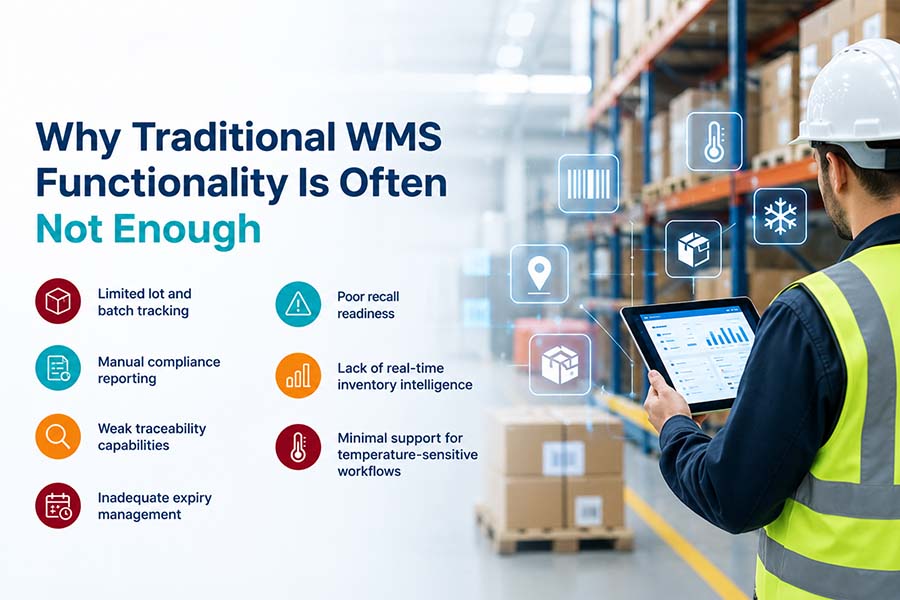
Challenges frequently encountered with generic warehouse systems include:
- Limited lot and batch tracking
- Manual compliance reporting
- Weak traceability capabilities
- Inadequate expiry management
- Poor recall readiness
- Lack of real-time inventory intelligence
- Minimal support for temperature-sensitive workflows
In highly regulated sectors such as pharmaceuticals, compliance requirements are particularly stringent. The MHRA’s Good Distribution Practice (GDP) guidelines require medicinal products to be consistently stored, transported and handled under suitable conditions, with organisations demonstrating appropriate documentation and traceability controls.
Meeting these requirements demands specialised warehouse compliance software capable of providing accurate, real-time operational data.
Why Is Warehouse Management Software Important for Cold Chain Logistics?
Cold chain logistics technology provides the digital foundation required to manage inventory integrity and operational performance simultaneously.
Without robust software, organisations risk:
- Product spoilage
- Compliance breaches
- Inventory inaccuracies
- Customer dissatisfaction
- Revenue leakage
- Increased administrative workload
Modern cold chain warehouse software enables warehouses to operate proactively rather than reactively by providing visibility into products, locations, movements, expiry dates and operational performance.
Key Software Features Every Cold Storage Warehouse Needs
Lot and Batch Traceability
Traceability is arguably the most important capability within any cold storage WMS.
Every product movement should be linked to:
- Batch numbers
- Lot numbers
- Receipt information
- Storage locations
- Customer ownership
- Dispatch records
This creates a complete product history from inbound receipt through to final delivery.
Business Benefits
- Faster investigations
- Improved customer confidence
- Stronger compliance posture
- Reduced recall exposure
Expiry Date Management
Cold storage operators often manage products with limited shelf lives.
Software should support:
- Expiry date registration
- Production date capture
- FEFO allocation
- Shelf-life monitoring
- Automated alerts
Business Benefits
- Reduced waste
- Improved stock rotation
- Better inventory utilisation
- Stronger customer service
Temperature-Sensitive Inventory Control
Temperature-controlled warehousing requires specialised handling processes and data management.
Cold storage operations benefit from systems capable of supporting:
- Temperature-linked inventory records
- Product-specific handling workflows
- Quality control procedures
- Cold chain master data management
Business Benefits
- Reduced spoilage
- Improved product integrity
- Lower financial losses
- Higher service reliability
Warehouse Zoning
Cold storage warehouses often need to manage multiple storage environments within the same operation, including chilled, frozen, ambient and quarantine areas.
Warehouse zoning helps operators control where products are stored, apply the right handling rules and prevent goods from being placed in unsuitable areas.
Business Benefits
- Better control over temperature-specific storage
- Reduced risk of stock misplacement
- Improved use of warehouse space
- Stronger support for quarantine and exception handling
Real-Time Inventory Visibility
Real-time stock visibility enables warehouse teams to make faster and more informed decisions.
Warehouses should be able to instantly identify:
- Stock quantities
- Product locations
- Ownership
- Inventory status
- Available storage capacity
Business Benefits
- Faster response times
- Improved warehouse utilisation
- Better customer communication
- Reduced stock discrepancies
Compliance and Audit Reporting
Food and pharmaceutical supply chains increasingly require evidence-based compliance.
Warehouse compliance software should provide:
- Digital audit trails
- Inventory transaction histories
- Quality inspection records
- Compliance documentation
- Automated reporting
Business Benefits
- Reduced audit preparation time
- Improved regulatory readiness
- Lower compliance risk
Quality and Quarantine Management
Cold storage operators need clear controls for products that are damaged, non-compliant, temperature-exposed or awaiting inspection.
Quality and quarantine management enables affected stock to be placed on hold until checks, approvals or corrective actions are completed.
Business Benefits
- Improved quality control
- Reduced risk of releasing non-compliant stock
- Clearer exception management
- Stronger auditability for held or rejected inventory
Product Recall Readiness
Product recalls are operationally challenging and financially damaging.
A robust cold storage WMS enables organisations to quickly identify:
- Impacted products
- Affected customers
- Storage locations
- Shipment history
Business Benefits
- Faster recall execution
- Reduced business disruption
- Lower risk exposure
Mobile Warehouse Operations
Paper-based processes are increasingly incompatible with modern warehouse environments.
Mobile warehouse functionality enables:
- Barcode scanning
- Real-time product validation
- Digital receiving
- Mobile picking
- Mobile replenishment
Business Benefits
- Reduced errors
- Faster execution
- Improved productivity
Automated Task Management
Warehouse activities should be directed through intelligent workflows rather than manual instructions.
Examples include:
- Put-away tasks
- Replenishment activities
- Picking priorities
- Quality inspections
- Cross-docking activities
Business Benefits
- Consistent execution
- Reduced travel time
- Increased throughput
Customer and Supplier Visibility
Supply chain transparency is becoming a competitive differentiator.
Modern solutions increasingly support customer access to:
- Inventory balances
- Order status
- Shipment tracking
- Warehouse activity information
Business Benefits
- Higher customer satisfaction
- Fewer support requests
- Improved service quality
TMS Integration
Cold chain visibility does not end when goods leave the warehouse. Transport planning, dispatch, delivery tracking and customer communication are all part of the same operational flow.
TMS integration connects warehouse activities with transport planning, helping operators manage storage, picking, dispatch and delivery through a more joined-up process.
Business Benefits
- End-to-end visibility from storage to delivery
- Improved coordination between warehouse and transport teams
- Faster dispatch planning
- Better customer service through clearer delivery visibility
3PL Billing and Charge Management
For third-party logistics providers, cold storage operations often involve customer-specific rates, complex charging models and value-added services.
3PL billing and charge management helps operators capture and manage charges for storage, handling, pallet movements, transport-related activities and additional services.
Business Benefits
- Reduced revenue leakage
- More accurate customer billing
- Better visibility of service profitability
- Stronger support for multi-client warehouse operations
Warehouse Performance Analytics
Cold storage operators must continuously balance service levels, efficiency and profitability.
Key reporting capabilities include:
- Inventory accuracy
- Pick rates
- Order throughput
- Space utilisation
- Labour productivity
- Customer profitability
Business Benefits
- Better decision-making
- Continuous improvement
- Stronger operational performance
Which WMS Features Improve Cold Storage Operations?
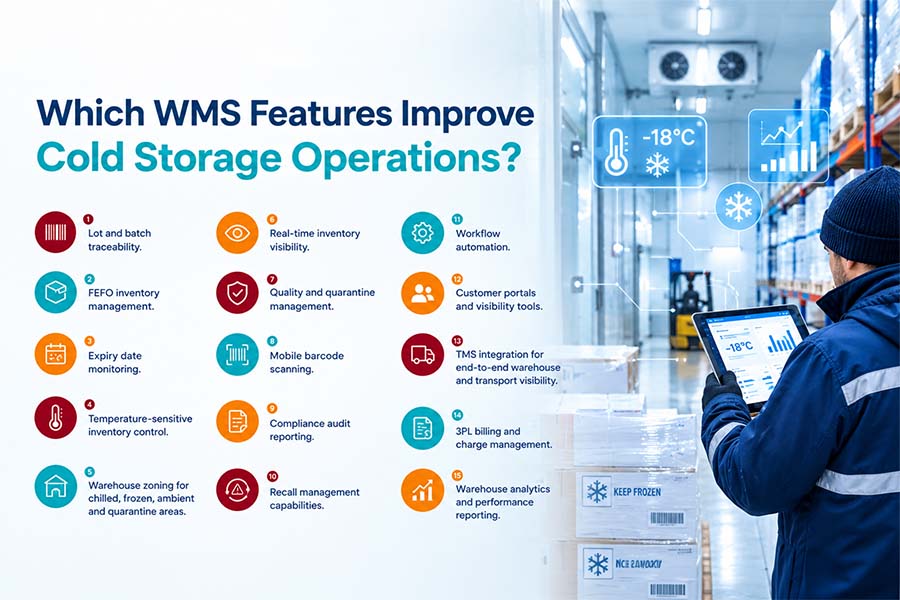
For temperature-controlled warehouses, the most valuable capabilities typically include:
- Lot and batch traceability.
- FEFO inventory management.
- Expiry date monitoring.
- Temperature-sensitive inventory control.
- Warehouse zoning for chilled, frozen, ambient and quarantine areas.
- Real-time inventory visibility.
- Quality and quarantine management.
- Mobile barcode scanning.
- Compliance audit reporting.
- Recall management capabilities.
- Workflow automation.
- Customer portals and visibility tools.
- TMS integration for end-to-end warehouse and transport visibility.
- 3PL billing and charge management.
- Warehouse analytics and performance reporting.
Together, these features create the operational discipline required to manage complex cold chain environments efficiently and profitably.
How Boltrics WMS Supports Cold Storage Operations
Boltrics WMS has been developed specifically for logistics service providers and cold storage operators rather than adapted from a general-purpose ERP system. According to Boltrics, its cold storage solution was developed with industry input and supports requirements such as batch registration, production dates, expiry dates, temperature-related processes and end-to-end track-and-trace capabilities.
Key capabilities include:
Inventory Traceability
Boltrics supports comprehensive lot and batch tracking, helping operators maintain complete product histories and improve recall readiness.
FEFO and Shelf-Life Management
The platform supports production dates, expiry dates and inventory rotation methodologies such as FIFO and FEFO.
Mobile Scanning Operations
Warehouse processes can be controlled through scanning devices, improving transaction accuracy and reducing manual data entry.
Real-Time Warehouse Workflows
Inventory movement, quality processes and warehouse workflows are managed in real time, improving operational visibility and responsiveness.
Multi-Client Warehousing
Boltrics provides functionality designed for third-party logistics providers managing multiple customers within a shared warehouse operation.
Reporting and Analytics
Warehouse managers gain insight into operational performance, inventory activity and customer-specific metrics.
Microsoft Dynamics 365 Business Central Integration
Built on Dynamics 365 Business Central, Boltrics combines warehouse-specific functionality with a secure and scalable Microsoft platform.
Business Benefits Beyond Compliance
Although compliance is a critical driver, the right warehouse management software delivers significantly broader strategic value.
Organisations typically achieve:
- Higher inventory accuracy
- Reduced spoilage and waste
- Faster order fulfilment
- Improved customer satisfaction
- Better warehouse utilisation
- Reduced administrative costs
- Increased workforce productivity
- Improved scalability
The greatest value often comes from enhanced visibility and decision-making rather than compliance alone.
Why Technology Projects Need the Right Partner
Warehouse transformation projects frequently fail because organisations focus on software selection rather than operational change.
Successful implementations require:
- Process analysis
- Warehouse design optimisation
- Change management
- User adoption planning
- Training programmes
- Continuous improvement frameworks
Technology must support operational objectives rather than simply digitising inefficient processes.
Future Trends in Cold Chain Warehousing

Several trends are likely to shape the next generation of cold chain operations:
AI-Driven Inventory Optimisation
Artificial intelligence will increasingly support demand forecasting, replenishment planning and warehouse slotting decisions.
Predictive Risk Management
Historical data and machine learning models will help identify inventory, compliance and operational risks before they occur.
Greater Automation
Warehouse automation technologies will continue expanding across receiving, storage, picking and fulfilment activities.
Real-Time Monitoring
Continuous visibility across warehouse and transport environments will become standard practice.
End-to-End Supply Chain Visibility
Customers, suppliers and logistics providers will increasingly operate from shared data environments, improving collaboration and decision-making.
Conclusion
Cold storage operations require fundamentally different software capabilities than traditional warehousing. Regulatory compliance, lot traceability, shelf-life management, product integrity and recall readiness place significantly higher demands on warehouse technology.
The most successful cold chain operators are moving beyond compliance-focused systems and investing in platforms that provide real-time visibility, operational intelligence and scalable process control.
Boltrics WMS addresses these requirements with industry-specific functionality designed for logistics and cold storage operations, while Dynamics 365 Business Central provides a robust business platform behind the solution.
Combined with Mercurius IT’s warehouse consulting, implementation and optimisation expertise, organisations gain a strong foundation for building efficient, compliant and future-ready warehouse operations.
Ready to Modernise Your Cold Storage Operations?
Whether you operate a temperature-controlled distribution centre, pharmaceutical warehouse, food logistics network or multi-client 3PL facility, Mercurius IT can help you evaluate, implement and optimise the right Boltrics WMS solution for your business.
Contact Mercurius IT to discuss your warehouse transformation objectives and discover how an industry-specific warehouse management platform can improve visibility, traceability, compliance and operational performance.
Ready to Optimise Your Cold Chain Operations?
Frequently Asked Questions
What software does a cold storage warehouse need?
A cold storage warehouse typically requires specialised cold storage warehouse management software that supports lot traceability, expiry management, temperature-sensitive workflows, compliance reporting and real-time inventory visibility.
What is the difference between cold storage and traditional warehousing?
Cold storage facilities manage temperature-sensitive products and therefore require stricter controls around traceability, compliance, inventory rotation and product integrity.
Why is warehouse management software important for cold chain logistics?
Warehouse management software provides the visibility, auditability and operational control needed to prevent spoilage, maintain compliance and improve warehouse efficiency.
What is FEFO inventory management?
FEFO means First Expired, First Out. Products with the earliest expiry dates are allocated first to minimise waste and maintain product quality.
How does WMS improve cold storage compliance?
A WMS creates digital audit trails, automates reporting and provides traceability records needed for regulatory inspections and audits.
What is lot and batch traceability?
Lot and batch traceability enables organisations to track products throughout the warehouse lifecycle, from receipt through storage and distribution.
Can a WMS help manage product recalls?
Yes. Modern WMS platforms can rapidly identify affected inventory, customer shipments and product locations to accelerate recall activities.
Why is real-time inventory visibility important in cold storage?
Real-time visibility improves decision-making, inventory accuracy and customer service while reducing operational risk.
How does Boltrics WMS support cold storage operations?
Boltrics WMS supports batch tracking, expiry management, FEFO processing, mobile scanning, real-time workflows, reporting and customer visibility.
Why choose Mercurius IT for a Boltrics implementation?
Mercurius IT combines warehouse consulting expertise, logistics industry knowledge and Microsoft platform experience to deliver successful warehouse transformation projects.